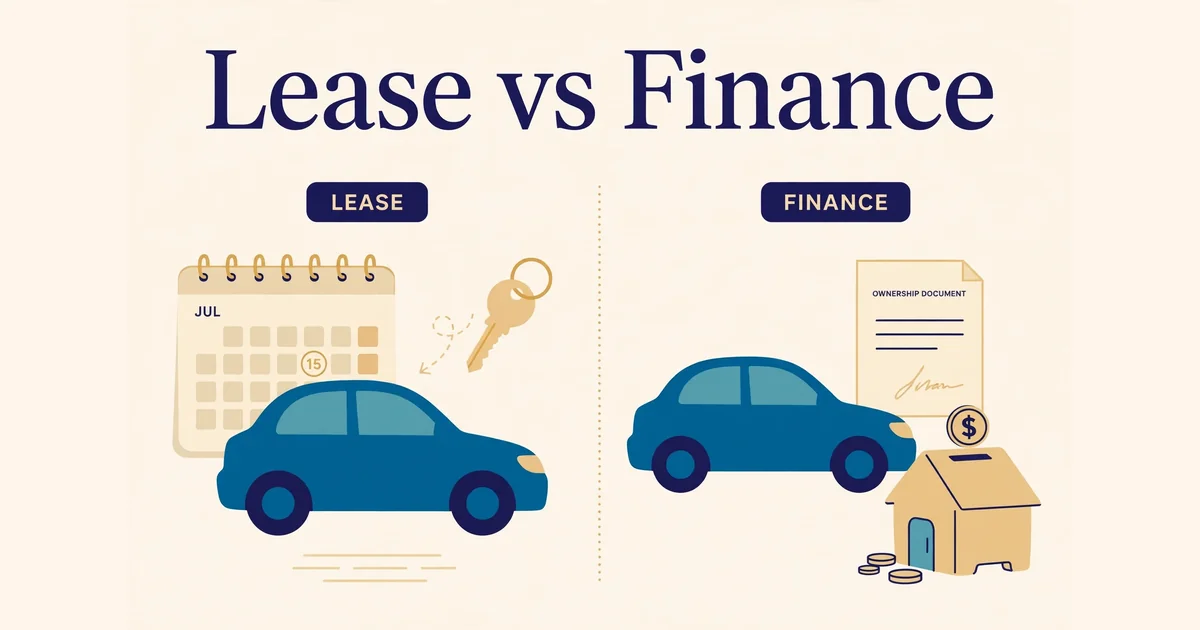
The difference between lease and finance is what your monthly payment buys you. Lease a car, and you pay to use it for a set time — usually two to four years — then give it back. Finance a car, and you borrow money to buy it: you pay the loan back in parts, and the car is yours when the last payment is made.
| Attribute | Lease | Finance |
|---|---|---|
| What you pay for | Use of the car for a set term | The full price of the car, in parts |
| Ownership | The leasing company owns it | You own it once the loan is paid |
| Monthly payment | Usually lower | Usually higher |
| Mileage | Set limit, often 10,000–15,000 miles a year | No limit |
| Wear and damage | Fees for excess wear when you return it | No fees; wear lowers resale value |
| Length of the deal | Usually 2 to 4 years | Loan usually 3 to 7 years |
| At the end | Return the car, or buy it if the lease allows | Keep, sell, or trade in the car |
Introduction
At a car dealer, the same car can leave the lot under two very different deals. The price on the window is the same, and both ask for money every month. But the contract decides who owns the car, how far you may drive it, and what happens at the end.
Both deals put you behind the wheel today — which is why buyers confuse them. The real difference hides at the end of the contract.
Still choosing the car itself? Our guide on the difference between a crossover and an SUV can help.
What Is a Lease?
Merriam-Webster defines a lease as a contract by which one side gives over real estate, equipment, or facilities “for a specified term and for a specified rent” (Merriam-Webster, “Lease”). For cars, the Consumer Financial Protection Bureau puts it plainly: a lease is “an agreement to use a vehicle, new or used, for a certain number of months and miles” (CFPB, “Leasing versus buying a car”).
The two sides have names: the company that owns the car is the lessor, and you, the driver, are the lessee — our guide on the difference between a lessor and a lessee explains both sides.
As the Federal Trade Commission explains, your lease payment covers the car’s expected loss of value (depreciation) during the lease, “plus a rent charge, taxes, and fees” (FTC, “Financing or Leasing a Car”) — not the whole car.
Main Characteristics of a Lease
- The contract runs for a set term, usually two to four years
- A mileage limit applies, most often 10,000 to 15,000 miles a year
- The monthly payment is usually lower than a loan payment
- You must service the car on schedule and keep it in good shape
- At the end, you return the car or buy it, if allowed
What Is Financing?
Financing is buying a car with borrowed money. The FTC describes a loan this way: you agree to pay “the amount financed, plus a finance charge, over a certain period of time” (FTC, “Financing or Leasing a Car”). You can borrow directly from a bank or credit union, or let the dealer arrange the loan.
Each payment pays back part of the loan and grows your share — your equity — in the car. Until the loan is paid in full, the lender keeps a claim, called a lien, on the car’s title. When the last payment clears, the lien ends and the title is fully yours.
Homeowners borrow the same way against a house, as our guide on the difference between a HELOC and a refinance shows.
Main Characteristics of Financing
- You borrow the price of the car and pay it back with interest
- Loan terms usually run three to seven years
- The monthly payment is usually higher than a lease payment
- Once the loan is paid, the car is yours to keep, sell, or trade in
- You pay for repairs yourself after the warranty ends
Core Difference Between Lease and Finance
Five clear points separate a lease from financing.
Difference 1: Ownership and Equity
In a lease, the car never becomes yours. The leasing company owns it from day one to the last day, and your payments build nothing you can sell. In financing, every payment buys a larger share of the car. When the loan ends, you own something of value — a car you can keep driving with no payment at all, or sell for cash. Our guide on the difference between a condo and a co-op shows the same split in home deals.
Difference 2: What the Monthly Payment Covers
A lease payment covers only part of the car’s value: its depreciation during your term, plus a rent charge. A finance payment covers the whole price of the car, plus interest. That is why the lease payment is lower for the same car — you are not getting a discount; you are paying for less.
Difference 3: Mileage Limits
The CFPB notes that most leases restrict mileage to 10,000–15,000 miles per year, and extra miles bring fees when you return the car. A financed car has no limit at all: high mileage only lowers its resale value.
Difference 4: Wear, Tear, and Changes to the Car
A leased car must go back in good shape. If the leasing company finds excess wear or damage, you pay for it — and the company decides what counts as “excess.” Big changes are out, too: the car is not yours. With financing, wear only lowers the resale value; there are no return fees, and you may paint, upgrade, or adapt the car freely.
Difference 5: The End of the Deal and Total Cost
When a lease ends, you return the car, pay any end-of-lease fees, and start again with a new lease and a new monthly payment. When a loan ends, the payments simply stop, and owners often keep the car for years. Over time, leasing again and again usually costs more in total than financing once and keeping the car.
Which One Should You Choose?
The right choice follows from how you drive and how long you keep a car.
Choose a Lease If:
- You like a new car every two to four years
- You drive fewer miles than the lease limit
- A lower monthly payment matters most right now
- You want a car that stays under warranty
- You do not want the work of selling a car later
Choose Financing If:
- You plan to keep the car for many years
- You drive a lot of miles each year
- You want the monthly payments to end one day
- You want to change or customize your car
- You want to own something you can sell
Similarities Between Lease and Finance
The two deals also share some basics.
- Both put you in a car today for a monthly payment
- Both check your credit; stronger credit wins better terms
- Both may ask for money down, which lowers your total cost
- Both require you to insure the car
One warning covers both: the FTC advises you to know your total cost, not just the monthly payment. A small monthly number can hide an expensive contract.
Common Mistakes and Misconceptions
Mistake 1: Judging the Deal by the Monthly Payment Alone
A low monthly payment can be the most expensive deal in the room. The FTC warns that lower loan payments often come with longer terms and higher interest rates, which raise the overall cost a lot. Always compare the total over the whole contract — payments, fees, and money down.
Mistake 2: Thinking You Can Hand Back a Leased Car at Any Time
A lease is a promise for the full term, not a rental you can drop early. The CFPB warns that if you end a lease early, the termination charges “can be very expensive,” and you cannot simply return the vehicle and stop making payments. Before you sign, be sure the term fits your plans.
Mistake 3: Thinking a Financed Car Is Fully Yours from Day One
When you finance, the title is not fully yours until the loan is paid. The FTC notes that the creditor has a lien on the car’s title until you have paid the contract in full. If you fall behind, the lender can take the car back, and missed payments damage your credit.
Frequently Asked Questions
Is it better to lease or finance a car?
Neither is better for everyone. Leasing suits drivers who cover few miles, like a new car every few years, and want a lower monthly payment. Financing suits drivers who keep a car long, drive many miles, and want the payments to end. Compare the total cost of both deals and match the deal to your habits.
Who owns the car in a lease and in financing?
In a lease, the leasing company owns the car for the whole term: you pay to use it and return it at the end. In financing, the lender holds a lien on the title while you pay, but each payment builds your ownership. When the loan is fully paid, the lien ends and the car is completely yours.
What happens when a car lease ends?
At the end of a lease, you return the car, and the company checks the mileage and condition. If you passed the mileage limit, or the car has excess wear or damage, you pay extra fees; many leases also charge a return fee. After that, most drivers either lease a new car or switch to buying.
Can I buy the car at the end of a lease?
Often, yes. Many leases include a purchase option, letting you buy the car at a price set in the contract, based on its expected end-of-lease value — the residual value. Buying makes sense if the car is worth more than that price, or simply because you know its history: you drove it.
Which costs more in the long run, leasing or financing?
Financing usually costs less over a long period. A lease payment is lower each month, but when the lease ends, you own nothing and must pay for another car. A loan payment is higher, yet it ends. Owners who keep a paid-off car for years drive payment-free — and that is where financing wins on total cost.
Conclusion
Leasing and financing pay for the same car in two ways, with two different endings. A lease rents you the car’s best years: lower payments, a mileage limit, and nothing at the end but the next contract. Financing buys the car piece by piece: higher payments, no mileage limit, and full ownership when the loan is done. Drive little and love new cars? Lease. Drive far and keep cars long? Finance. Match the deal to your life, and the choice makes itself.

Hi! I am Arshad Ullah presently working as linguist in Punjab Education Department. I have done MA in English Literature while M.Phil in Applied Linguistics. I have taught creative writing to the post graduation classes for 15 years. Presently I am working as content writer, and offering classes for blog writing. On this site, I research each topic from authoritative sources and edit every comparison for accuracy and clear, simple language.