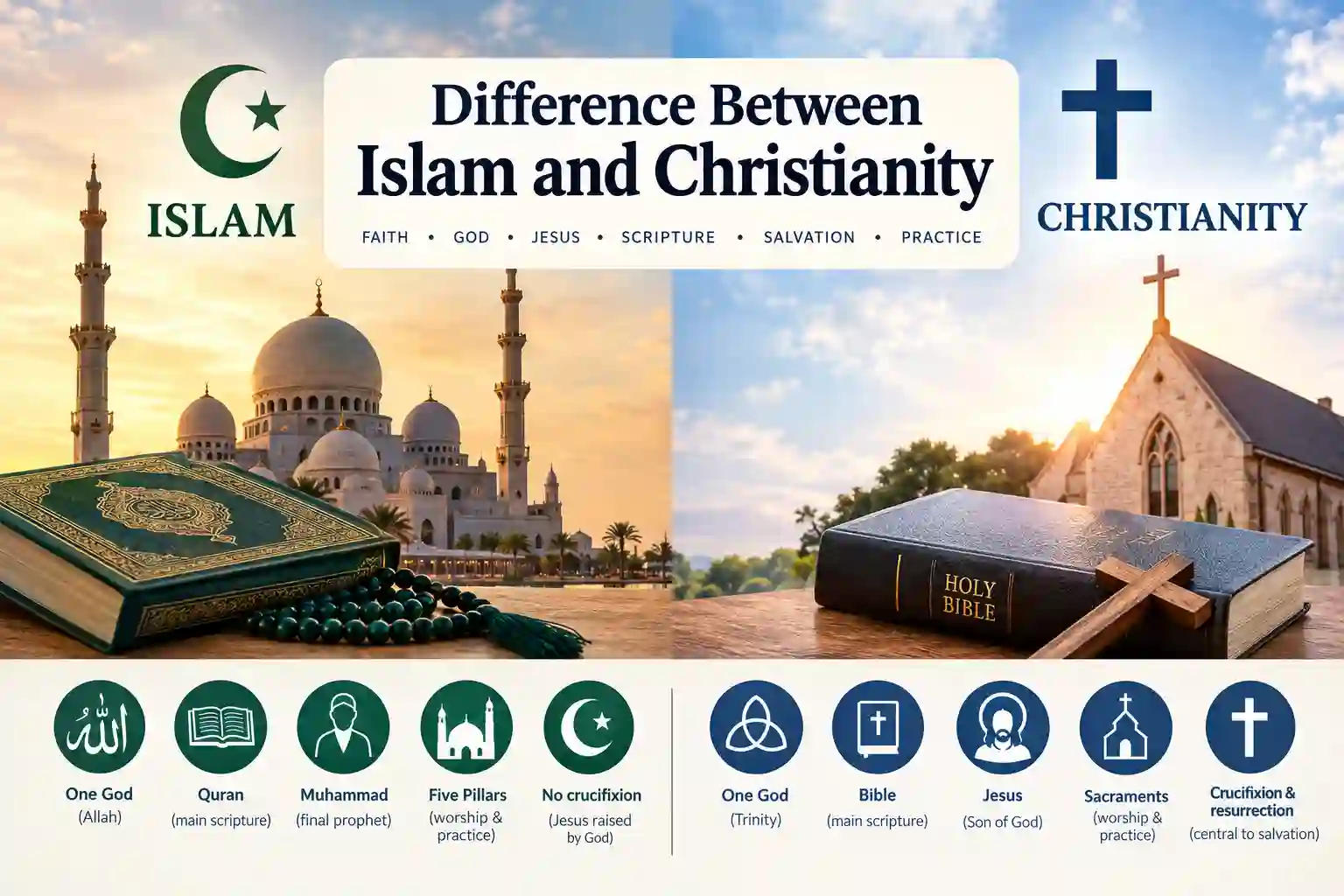
The difference between Islam and Christianity centers mainly on the nature of God, the identity of Jesus, scripture, salvation, and religious practice. Islam teaches absolute oneness of God and regards Jesus as the Messiah and a prophet. Christianity, in its mainstream Trinitarian form, teaches one God in three persons and regards Jesus as the divine Son of God, whose death and resurrection are central to salvation.
Quick Comparison Table
| Attribute | Islam | Christianity |
| View of God | One God, absolutely one | One God in the Trinity |
| Main scripture | Quran | Bible |
| Jesus | Messiah and prophet of God | Son of God and divine Christ |
| Muhammad | Final prophet in Islam | Not accepted as a prophet |
| Crucifixion | Quran teaches Jesus was not killed or crucified | Jesus was crucified and died |
| Resurrection of Jesus | Jesus was raised by God; Islamic belief does not accept the Christian crucifixion-resurrection account | Jesus rose from the dead |
| Salvation | Faith in God, righteous deeds, repentance, and God’s mercy | Centered on God’s grace and salvation through Christ |
| Main worship | Prayer, fasting, charity, pilgrimage, declaration of faith | Prayer, worship, baptism, Communion, and other practices |
| Place of worship | Mosque | Church |
| Major religious leaders | Muhammad and other prophets | Jesus and the apostles; churches have different leadership structures |
Introduction
Islam and Christianity are two major monotheistic religions. They share important beliefs and figures, but they also have major theological differences.
Both teach belief in one Creator, moral responsibility, prayer, charity, and life after death. Both also honor figures such as Abraham, Moses, Mary, and Jesus.
The biggest difference is the way the two religions understand God and Jesus.
For Christians, Jesus is central to God’s plan of salvation and is understood as the divine Son of God. The Catholic Catechism, for example, describes the Trinity as one God in three persons: Father, Son, and Holy Spirit.
For Muslims, God is one and has no partners. Jesus is honored as the Messiah and a messenger of God, but he is not considered God or God’s son in the Christian theological sense. The Quran describes Jesus as the Messiah, son of Mary, and one who is honored by God.
What Is Islam?
Islam is a monotheistic religion based on submission to the one God, called Allah in Arabic.
Muslims believe that God sent prophets to guide humanity. These include Adam, Noah, Abraham, Moses, David, Jesus, and Muhammad.
Main beliefs in Islam
Muslims generally believe in:
- One God.
- Angels.
- God’s revealed books.
- God’s prophets and messengers.
- The Day of Judgment.
- Divine decree.
The Quran is the central scripture of Islam.
Muslims also follow the Five Pillars of Islam:
- Shahadah — declaration of faith.
- Salah — five daily prayers.
- Zakat — required charitable giving.
- Sowm — fasting during Ramadan.
- Hajj — pilgrimage to Mecca for those who are able.
These practices shape the daily religious life of Muslims.
What Is Christianity?
Christianity is a monotheistic religion centered on Jesus Christ.
Christians believe that Jesus is the Messiah and that his life, death, and resurrection are central to Christian faith. The Christian creeds describe Jesus as the Son of God who became human, was crucified, died, and rose again.
The Bible is the central Christian scripture. It contains the Old Testament and New Testament.
Christianity has many denominations, including Catholic, Orthodox, and Protestant traditions. Their practices and some theological teachings differ, but mainstream Trinitarian Christianity shares core beliefs about God, Jesus, and the resurrection.
Core Differences Between Islam and Christianity
1. Difference in the Concept of God
This is one of the most important differences.
Islam teaches that God is absolutely one. Muslims reject the idea that God has partners or that Jesus is God.
The Quran explicitly presents Jesus as a messenger and calls people to worship God.
Christianity, in its mainstream Trinitarian form, teaches that there is one God in three persons:
- Father
- Son
- Holy Spirit
Christian teaching does not describe these as three separate gods. The Catholic Catechism, for example, explains the Trinity as one God in three persons.
So, while both religions are monotheistic, they understand God’s oneness in different ways.
2. Difference in the Role of Jesus
Jesus is important in both religions, but his identity is understood very differently.
In Islam
Jesus is known as Isa ibn Maryam, or Jesus, son of Mary.
Muslims believe that he was:
- The Messiah.
- A prophet and messenger of God.
- Born miraculously to Mary.
- A worker of miracles by God’s permission.
- Honored by God.
- Not God himself.
The Quran describes Jesus as the Messiah and says that he was honored in this world and the Hereafter.
In Christianity
Christians believe that Jesus is:
- The Messiah.
- The Son of God.
- The Word made flesh.
- Divine.
- The Savior.
- Crucified and resurrected.
Christian teaching therefore gives Jesus a divine status that Islam does not accept.
3. Difference Over the Crucifixion
The crucifixion of Jesus is another major dividing point.
Christianity teaches that Jesus was crucified, died, and rose from the dead. The resurrection is a central part of Christian faith.
The Quran presents a different account. Quran 4:157 says that Jesus was not killed or crucified, and the following verse says that Allah raised him to Himself.
Therefore:
Christianity: Jesus was crucified, died, and rose again.
Islam: Jesus was not killed or crucified; God raised him.
This difference also affects how the two religions understand salvation.
4. Difference in Scripture
Islam and Christianity both have traditions connected with earlier prophets, but they do not have the same scripture.
Islam:
- The Quran is the central and final revelation.
- Muslims believe it was revealed by God to Muhammad.
Christianity:
- The Bible is the central scripture.
- It contains the Old Testament and New Testament.
- The New Testament focuses strongly on Jesus and the early Christian community.
The Quran also speaks about earlier revelations, including the Torah and Gospel, while presenting itself as a confirming revelation.
5. Difference in Muhammad’s Role
Muhammad has a central role in Islam.
Muslims believe Muhammad is the final prophet and messenger of God. His teachings and example are important sources for Islamic religious life.
Christianity does not accept Muhammad as a prophet in the Islamic sense.
This creates another major difference between the two religions.
6. Difference in Salvation
Islam and Christianity both teach that human beings are accountable to God, but they explain salvation differently.
Islam
Islam emphasizes:
- Faith in the one God.
- Following God’s guidance.
- Repentance.
- Righteous actions.
- God’s mercy.
- Accountability on the Day of Judgment.
Muslims do not believe that Jesus died as a sacrifice to remove the sins of humanity.
Christianity
Christianity places the death and resurrection of Jesus at the center of salvation.
The Christian Catechism describes Christ’s death as redemptive and his resurrection as central to Christian faith.
In simple terms, the two traditions have different answers to the question:
How does a person become reconciled with God?
Islam emphasizes submission to God, faith, repentance, righteous living, and God’s mercy. Christianity places special emphasis on God’s grace and salvation through Christ.
7. Difference in Religious Practice
Both religions include prayer, fasting, charity, and worship, but their practices are different.
Islamic practices include:
- Five daily prayers.
- Fasting during Ramadan.
- Zakat.
- Hajj.
- Friday congregational prayer.
- Reading and reciting the Quran.
Christian practices can include:
- Prayer.
- Sunday worship.
- Baptism.
- Communion or Eucharist.
- Reading the Bible.
- Fasting in some traditions.
- Charity and service.
Christian practices vary more widely among denominations.
8. Difference in Religious Festivals
Muslims and Christians have different major religious celebrations.
Major Islamic celebrations include:
- Eid al-Fitr — marks the end of Ramadan.
- Eid al-Adha — associated with the Hajj and the story of Abraham’s willingness to obey God.
Major Christian celebrations include:
- Christmas — celebrates the birth of Jesus.
- Easter — commemorates Jesus’ death and resurrection.
- Good Friday — commemorates the crucifixion of Jesus.
The meaning and practices of these celebrations can vary among different communities.
Similarities Between Islam and Christianity
Despite major differences, Islam and Christianity share many important ideas.
What They Have in Common
- Both believe in one Creator God.
- Both teach prayer and worship.
- Both believe in angels.
- Both recognize many biblical figures.
- Both honor Mary.
- Both recognize Jesus as an important religious figure.
- Both teach moral behavior.
- Both believe in life after death.
- Both teach accountability before God.
- Both encourage charity and care for others.
The similarities should not hide the major theological differences, but they help explain why the two religions are often studied together.
Islam and Christianity on Jesus: A Simple Comparison
| Question | Islam | Christianity |
| Was Jesus born to Mary? | Yes | Yes |
| Was Jesus the Messiah? | Yes | Yes |
| Was Jesus a messenger of God? | Yes | Christianity understands him as more than a prophet |
| Is Jesus God? | No | Yes, in mainstream Trinitarian Christianity |
| Is Jesus the Son of God? | No, not in the Christian divine sense | Yes |
| Was Jesus crucified? | No, according to the Quran | Yes |
| Did Jesus rise from the dead after crucifixion? | No | Yes |
| Is Jesus central to salvation? | Important prophet and Messiah, but not the basis of salvation through crucifixion | Yes |
The Quran explicitly calls Jesus the Messiah and describes him as honored by God, while Christian teaching identifies him as the divine Son of God.
Common Misconceptions
Is Allah a different God from the God of Christianity?
The word Allah is the Arabic word for God. Arabic-speaking Christians also use the word Allah when referring to God.
However, Islam and Christianity have different theological understandings of God. Islam rejects the Trinity, while mainstream Christianity teaches the Trinity.
So the important difference is not simply the name “Allah.” It is the way each religion understands God’s nature.
Do Muslims believe in Jesus?
Yes.
Jesus is an important figure in Islam. Muslims believe he was the Messiah, was born miraculously to Mary, performed miracles by God’s permission, and was a messenger of God.
The major difference is that Muslims do not believe Jesus is God.
Do Christians believe in one God or three gods?
Mainstream Trinitarian Christianity teaches one God, not three separate gods.
The Trinity refers to the Father, Son, and Holy Spirit as three persons within one divine being.
Islam rejects this understanding and emphasizes the absolute oneness of God.
Do Muslims and Christians believe in the same prophets?
There is considerable overlap.
Islam recognizes many figures also found in the Bible, including:
- Adam
- Noah
- Abraham
- Moses
- David
- Solomon
- Jesus
But Islam also recognizes Muhammad as God’s final prophet, while Christianity does not accept him as a prophet.
Is Mary important in Islam?
Yes.
Mary, known as Maryam in Arabic, has a highly honored position in Islam. The Quran describes the miraculous announcement of Jesus’ birth to Mary.
Mary is also highly important in Christianity, where she is the mother of Jesus.
Which Is Better: Islam or Christianity?
There is no neutral factual test that can declare one religion “better” for everyone. This is a matter of religious belief, faith, and theology.
A useful comparison is to ask what each religion teaches about its central questions:
- Who is God?
- Who is Jesus?
- What is the nature of revelation?
- What happened at the crucifixion?
- How are human beings saved?
- What happens after death?
Islam and Christianity give different answers to several of these questions. Understanding those differences is more useful than simply asking which religion is better.
FAQs
What is the main difference between Islam and Christianity?
The main difference is their understanding of God and Jesus. Islam teaches absolute monotheism and regards Jesus as the Messiah and a prophet. Mainstream Trinitarian Christianity teaches one God in three persons and regards Jesus as the divine Son of God. The two religions also differ sharply over the crucifixion and the meaning of salvation.
Do Muslims believe Jesus is the Son of God?
No. Muslims honor Jesus as the Messiah and a messenger of God, but they do not believe he is God’s divine Son. The Quran presents Jesus as the son of Mary and calls people to worship Allah rather than Jesus.
Do Christians believe Muhammad was a prophet?
Christianity does not accept Muhammad as a prophet in the Islamic sense. Muhammad’s prophetic role is a central belief in Islam, while Christianity bases its faith on Jesus Christ and the Christian scriptures.
Do Muslims and Christians believe in the same God?
Both religions describe themselves as worshiping one Creator God, but their theological teachings about God are different. Islam rejects the Trinity, while mainstream Christianity teaches one God in three persons. Therefore, the similarity in monotheism should not be confused with identical theology.
Why do Muslims not believe Jesus was crucified?
The Quran states that Jesus was not killed or crucified and that God raised him to Himself. This is a major difference from Christianity, which teaches that Jesus was crucified, died, and rose from the dead.
Do Islam and Christianity have anything in common?
Yes. Both are monotheistic traditions and share many religious figures and moral teachings. Both recognize Abraham, Moses, and Jesus, and both teach prayer, charity, moral responsibility, and accountability before God. Their similarities are significant, but their teachings about God, Jesus, scripture, and salvation are also substantially different.
Conclusion
The difference between Islam and Christianity is most clear in their teachings about God and Jesus. Islam teaches that God is absolutely one and that Jesus is the Messiah and a prophet, not God. Christianity, in its mainstream Trinitarian form, teaches one God in three persons and regards Jesus as the divine Son of God. The two religions also disagree about the crucifixion: Christianity teaches that Jesus was crucified and resurrected, while the Quran says that he was not killed or crucified.
At the same time, Islam and Christianity share important beliefs about God, prophets, morality, prayer, charity, and the life after death. Understanding both the similarities and the differences gives a clearer and more respectful picture of these two major religions.

Hi! I am Arshad Ullah presently working as linguist in Punjab Education Department. I have done MA in English Literature while M.Phil in Applied Linguistics. I have taught creative writing to the post graduation classes for 15 years. Presently I am working as content writer, and offering classes for blog writing. On this site, I research each topic from authoritative sources and edit every comparison for accuracy and clear, simple language.