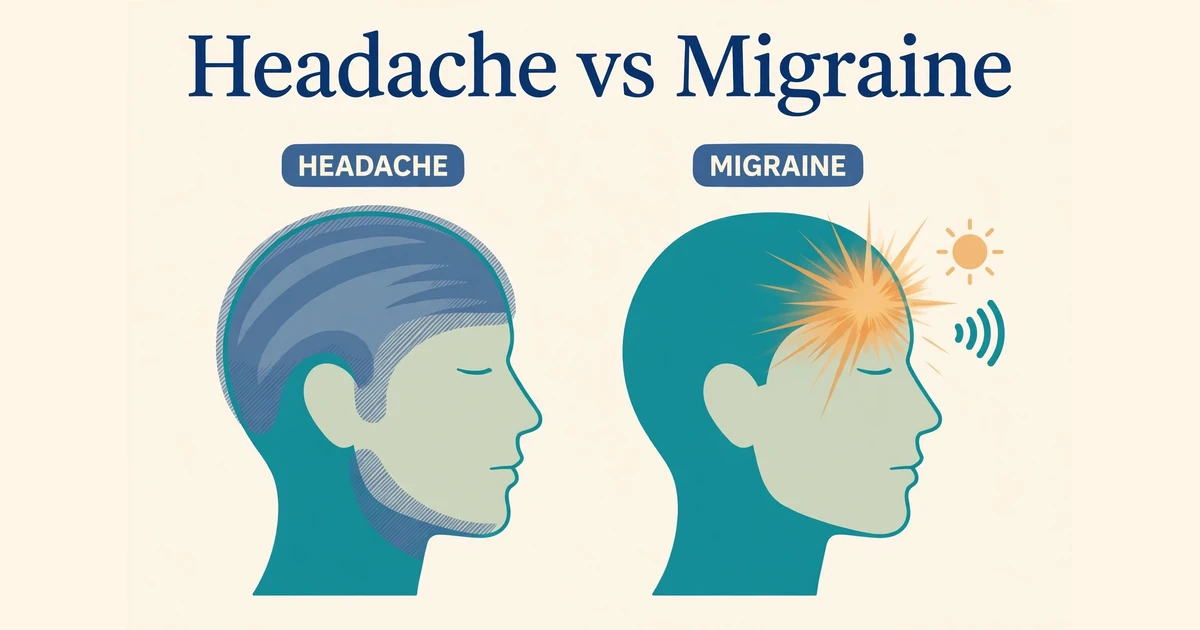
The difference between a headache and a migraine starts with what each word names. A headache is a symptom: pain in the head or face, with many possible causes. A migraine is a specific condition of the brain and nerves, causing repeated attacks of strong, throbbing pain, often with nausea and a strong dislike of light and sound. Most headaches are not migraines, and a migraine is always more than a headache.
| Attribute | Headache | Migraine |
|---|---|---|
| What it is | A symptom: pain in the head | A brain and nerve condition with attacks |
| Pain feel | Dull, tight, pressing, like a band | Throbbing or pulsing |
| Pain place | Often both sides or the whole head | Often one side |
| Pain strength | Mild to moderate | Moderate to severe |
| How long | 30 minutes to a few days | 4 to 72 hours if not treated |
| Other signs | Usually none | Nausea, vomiting, dislike of light and sound |
| Warning stage | None | Aura in some people: flashing lights, zigzag lines |
| Effect of activity | Normal activity is usually fine | Movement often makes the pain worse |
Introduction
Almost everyone has had a headache. MedlinePlus calls headache the most common form of pain, and a top reason people miss work or school (MedlinePlus, “Headache”).
Migraine is not just a worse headache. It is a long-term condition that switches on in attacks, and the head pain is only one part. This guide explains both, point by point, so you can tell them apart.
This article gives general information only. It is not medical advice. If your head pain is new, very strong, or keeps coming back, please see a doctor.
What Is a Headache?
A headache is pain in the head or face. It is a symptom, not a disease on its own, with many possible causes. The most common type is the tension headache. MedlinePlus explains that tension headaches come from tight muscles in the shoulders, neck, scalp, and jaw, and are often linked to stress, missed meals, too little sleep, or alcohol (MedlinePlus, “Headache”). Stress is a common trigger — and stress is not the same as anxiety: our guide on the difference between PTSD and anxiety explains how stress-related conditions differ.
Other common types include cluster headaches, with severe pain around one eye, and sinus headaches, linked to colds and allergies.
Main Characteristics of a Headache
- Dull, aching pain or tightness across the forehead, sides, or back of the head
- Pain is usually mild to moderate
- Can last from 30 minutes to a week
- Rarely brings nausea, vomiting, or vision changes
- Walking and normal activity do not usually make it worse
What Is a Migraine?
A migraine is a condition of the brain and nerves, with repeated attacks. MedlinePlus describes migraines as a recurring type of headache with moderate to severe throbbing or pulsing pain (MedlinePlus, “Migraine”). Migraine often runs in families, and it appears more often in people who live with anxiety, depression, or bipolar disorder. Brain-based conditions are easy to mix up; our guide on the difference between bipolar and ADHD compares two of them.
Mayo Clinic explains that an attack can move through four stages: prodrome, aura, attack, and postdrome (Mayo Clinic, “Migraine”). The prodrome comes a day or two before the pain, with signs like mood changes, food cravings, or a stiff neck. After the attack, the postdrome can leave a person drained and confused for up to a day.
The best-known stage is the aura, which affects some people. An aura is usually visual: shapes, bright spots, flashes of light, or zigzag lines. It can also bring pins and needles, numbness, or trouble speaking. Aura signs build up over a few minutes and can last up to 60 minutes.

Main Characteristics of a Migraine
- Throbbing or pulsing pain, often on one side of the head
- Moderate to severe pain, hard to work through
- Nausea, and sometimes vomiting
- Strong sensitivity to light, sound, and sometimes smells
- Pain grows worse when you move, cough, or sneeze
- An untreated attack lasts 4 to 72 hours
Core Difference Between Headache and Migraine
Five clear points separate an ordinary headache from a migraine.
Difference 1: A Symptom vs a Condition
A headache is a symptom: a signal that something — stress, tired muscles, illness, lack of sleep — is causing pain. A migraine is the condition itself, with its own pattern, stages, and triggers. Many things can cause a headache; a migraine is one specific cause with a much wider set of signs.
Difference 2: The Feel and Place of the Pain
A tension headache feels dull and tight, like a band around the head, and usually covers both sides. Mayo Clinic describes dull, aching pain and tightness or pressure across the forehead, or on the sides and back of the head (Mayo Clinic, “Tension Headache”). Migraine pain throbs or pulses, and usually settles on one side.
Difference 3: What Comes With the Pain
An ordinary headache usually brings nothing but the pain. A migraine brings company: nausea, sometimes vomiting, a strong dislike of light, sound, and even smells, and, for some people, the warning stage called aura. If head pain arrives with sickness and a need to lie in the dark, migraine is the likely name for it.
Difference 4: How Long It Lasts
A tension headache can last from 30 minutes to a week, but the pain stays mild. A migraine attack lasts 4 to 72 hours if not treated, and its warning and recovery stages can stretch the episode over days. So length alone is not the test: what matters is the strength of the pain and the signs that come with it.
Difference 5: Triggers
Both can be set off by stress and poor sleep, but migraine has more triggers. MedlinePlus lists stress, hormone changes in women, bright or flashing lights, loud noises, strong smells, too much or too little sleep, skipped meals, caffeine, and certain foods like aged cheese and cured meats (MedlinePlus, “Migraine”). A trigger starts an attack; it does not create the condition.
Similarities Between Headache and Migraine
The two share some ground.
- Both involve pain in the head
- Both can be set off by stress, poor sleep, and skipped meals
- Both often ease with rest
- Both are very common, and one person can have both
How Each One Is Treated
Most ordinary headaches settle with rest, water, and a quiet room. Simple pain relievers help many people, and regular sleep, meals, and less stress can cut down tension headaches.
A migraine attack needs more. Rest in a quiet, dark room with your eyes closed often helps, and so does a cool cloth on your forehead (MedlinePlus, “Migraine”). There is no cure, but doctors can prescribe medicines that ease an attack and, for frequent or severe attacks, medicines that help prevent them. A simple diary of attacks and triggers helps many people spot patterns.
See a doctor if your head pain is new, keeps coming back, or changes pattern. For repeated attacks, a doctor may refer you to a neurologist, a brain and nerve specialist. Choosing the right specialist matters: our guide on the difference between a nephrologist and a urologist shows how two similar-sounding specialists treat different problems. Get medical help right away for a sudden, severe headache, a headache after a blow to the head, or one with a stiff neck, fever, confusion, or fainting (MedlinePlus, “Headache”).
Common Misconceptions
Misconception 1: A Migraine Is Just a Very Bad Headache
Strength is not the line between them. A migraine is a whole-body attack: throbbing pain plus nausea, sensitivity to light and sound, and stages before and after. A tension headache can hurt a lot and still not be a migraine — and a migraine attack can even happen with no head pain at all.
Misconception 2: Migraine Pain Is Always on One Side
One-sided pain is common, but not a rule. Mayo Clinic notes that migraine pain is usually on one side, although it can occur on both (Mayo Clinic, “Migraine”). Pain on both sides does not rule it out.
Misconception 3: No Aura Means It Is Not a Migraine
Aura affects only some people with migraine. Many attacks have no aura at all, and they are still migraines: the aura is one possible stage, not a requirement.
Frequently Asked Questions
Is a migraine a type of headache?
Doctors list migraine among the headache disorders, because head pain is its main sign. But it is more exact to call migraine a condition of the brain and nerves that causes headache, along with signs like nausea and light sensitivity. Migraine belongs to the headache family, yet it is a specific condition — not just a stronger ordinary headache.
Can you have a migraine without a headache?
Yes. MedlinePlus notes that sometimes a person can have a migraine without a headache (MedlinePlus, “Migraine”). In these attacks, the aura signs appear — flashing lights, zigzag lines, pins and needles, or trouble speaking — yet little or no pain follows. Because these signs can look like other problems, a doctor should check them.
Which doctor should I see for a migraine?
Start with your regular doctor, who can treat most headaches and many migraine attacks, and can refer you to a neurologist if attacks are frequent or severe. Migraine care is medical care, not pregnancy care: our guide on the difference between a midwife and a doctor explains how health roles are divided.
Can children get migraines?
Yes. Mayo Clinic notes that migraines can affect children and teenagers as well as adults (Mayo Clinic, “Migraine”). In children, attacks are often shorter, pain is more often on both sides, and stomach pain or sickness may stand out more than head pain. A child with repeated attacks should see a doctor.
Do migraines run in families?
Often, yes. Most people with migraine have family members with migraines, and researchers believe the condition has a genetic cause (MedlinePlus, “Migraine”). Women are about three times more likely than men to get migraines, and hormone changes are one reason attacks often follow monthly patterns. A parent or close relative with migraine raises your own chance of having it.
Conclusion
A headache is a symptom — pain in the head, most often a tension headache. A migraine is a condition of the brain and nerves that arrives in attacks, with throbbing pain, nausea, sensitivity to light and sound, and, for some people, an aura before the pain. Learn to read the signs that come with the pain, and the two are not hard to tell apart. When head pain is new, severe, or keeps returning, let a doctor make the final call.

Hi! I am Arshad Ullah presently working as linguist in Punjab Education Department. I have done MA in English Literature while M.Phil in Applied Linguistics. I have taught creative writing to the post graduation classes for 15 years. Presently I am working as content writer, and offering classes for blog writing. On this site, I research each topic from authoritative sources and edit every comparison for accuracy and clear, simple language.