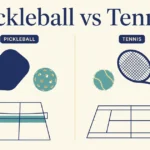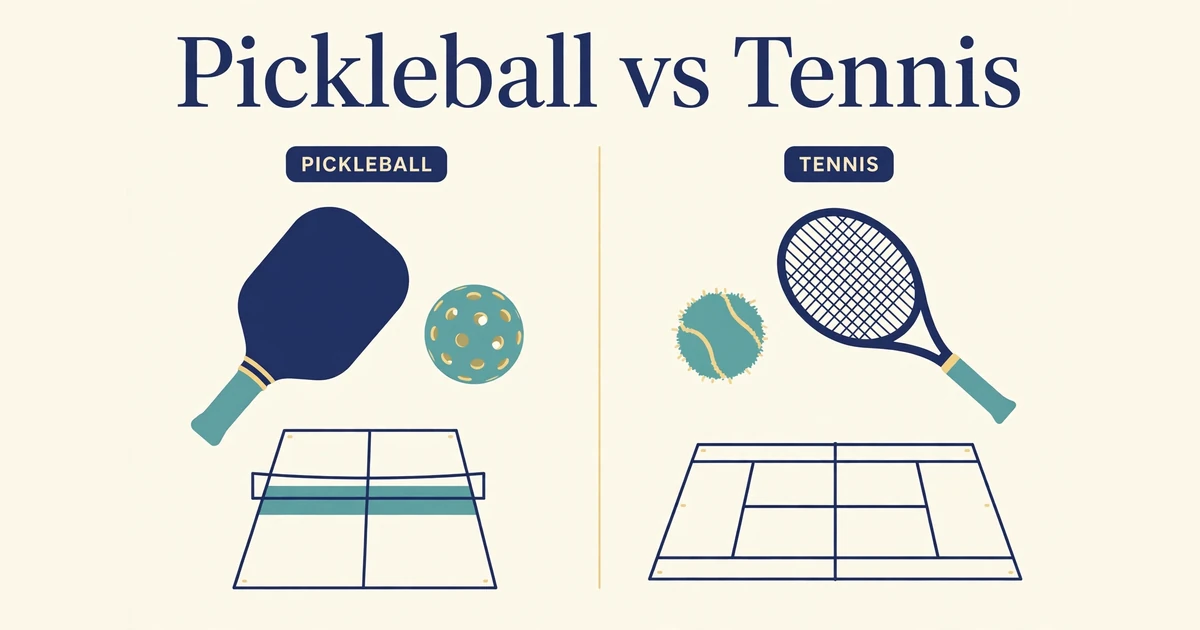
The difference between pickleball and tennis comes down to size and touch. Pickleball is played on a small court, 20 by 44 feet, with a solid paddle and a holed plastic ball. Tennis is played on a much bigger court, 78 feet long, with a strung racket and a soft felt ball. Pickleball starts each point with a gentle underhand serve; tennis starts with a fast overhead serve. They look alike, but play very differently.
| Attribute | Pickleball | Tennis |
|---|---|---|
| Court size | 20 × 44 feet (6.10 × 13.41 m) | 78 feet long (23.77 m); 27 or 36 feet wide |
| Net height | 36 inches at sides, 34 in middle | 3.5 feet at posts, 3 feet in middle |
| You hit with | Solid paddle, up to 17 inches | Strung racket, up to 29 inches |
| Ball | Plastic, with 26 to 40 holes | Felt-covered rubber, air inside |
| Serve | Underhand, below the waist, one try | Overhead, two tries |
| Special zone | The 7-foot “kitchen” — no volleys inside | None; volleys allowed anywhere |
| Scoring | Only the serving side scores; game to 11 | Every rally scores; games build into sets |
| Best for | Beginners, social play, sore joints | Power, spin, and long matches |
Introduction
Pickleball and tennis are cousins. Both are played over a net, in singles or pairs. Pickleball is often played on old tennis courts, which is why new players mix up the rules.
Still, they were born in very different worlds. Tennis took its modern shape in Britain in the 1870s. Pickleball was made up in 1965 by three dads on Bainbridge Island, Washington, looking for a game for their bored kids.
This guide compares them side by side: court, gear, serve, scoring, and cost.
What Is Pickleball?
Pickleball is a paddle sport that blends parts of tennis, badminton, and table tennis. USA Pickleball, the sport’s governing body, calls it a game of a solid paddle and a perforated plastic ball, on a badminton-sized court with a slightly lower net than tennis (USA Pickleball, “What Is Pickleball?”). It began in 1965, when Joel Pritchard, Bill Bell, and Barney McCallum built the first game from ping-pong paddles and a plastic ball.
The three dads shaped the rules so weaker players could still compete: a soft underhand serve, a ball that bounces once on each side before volleys, and no smashing from next to the net. Those choices still define the game. Doubles is the most common form, because the small court makes it a social game.
Main Characteristics of Pickleball
- Court 20 by 44 feet (6.10 by 13.41 m), same for singles and doubles
- Net 36 inches (91 cm) high at the sides, 34 inches (86 cm) in the middle
- 7-foot (2.13 m) no-volley zone by the net — the kitchen
- Solid paddle, no strings; plastic ball with 26 to 40 holes
- Underhand serves; only the serving side scores
What Is Tennis?
Tennis is a racket sport. Two players, or two pairs, use strung rackets to hit a ball over a net. A point is won when the other side cannot return the ball inside the lines. Britannica notes that organized tennis follows rules set by the International Tennis Federation (ITF), the sport’s world governing body (Encyclopaedia Britannica, “Tennis”).
The modern game was set down in Britain in 1873, and Wimbledon followed in 1877. That early event fixed the court’s length at 78 feet and kept the old 15, 30, 40 scoring, still used today.
Tennis is played on hard courts, clay, and grass. Its biggest events, the four Grand Slam tournaments, are international. Our guide on the difference between national and international explains how those two levels work.
Main Characteristics of Tennis
- Court 78 feet (23.77 m) long; 27 feet (8.23 m) wide for singles, 36 feet (10.97 m) for doubles
- Net 3 feet (0.91 m) high in the middle, 3.5 feet (1.07 m) at the posts
- Strung racket; felt-covered ball, 2.5 to 2.8 inches wide
- Overhead serve, two tries per point
- Points build into games, and games into sets
Core Difference Between Pickleball and Tennis
Six clear points separate pickleball from tennis.
Difference 1: The Size of the Court
A pickleball court covers 880 square feet. A tennis court covers more than twice that: 2,106 square feet for singles, 2,808 for doubles. Pickleball uses one size for singles and doubles; tennis adds side strips, called alleys, for doubles. Less ground means less running.
Difference 2: Paddle and Ball vs Racket and Ball
A pickleball paddle is solid, capped at 17 inches long. A tennis racket has strings that stretch and snap back, adding power and spin; it may be up to 29 inches long. The balls differ just as much: the pickleball is thin plastic with holes, so air slows it down, while the tennis ball is felt-covered rubber, built to fly fast.
Difference 3: The Serve and the Two-Bounce Rule
In pickleball, the serve is hit underhand, struck below the waist. You get one try, and the ball must land past the kitchen, in the diagonal box. A tennis serve is the opposite: tossed high and hit overhead, with two tries. Pickleball adds one more brake: the two-bounce rule. The serve and the return must each bounce once before anyone may volley, so the serving side cannot charge the net at once (USA Pickleball, Basic Rules Summary).
Difference 4: The Kitchen
The kitchen is pickleball’s most famous rule: the zone within 7 feet (2.13 m) of the net on both sides. You may stand in it, but you cannot volley while touching it — not its line, and not if your swing carries you in after the shot. It stops players camping at the net to smash every ball. Tennis has no such zone.
Difference 5: Scoring
In pickleball, only the serving side can score. If the receivers win the rally, the serve simply changes hands — no point. A game is played to 11 points, win by 2. In tennis, every rally scores. Points run 15, 30, 40, then game, with deuce settled by a two-point margin. Games build into sets: first to six games, ahead by two, takes the set, usually with a tiebreak at six all (Encyclopaedia Britannica, “Tennis” summary). A match is the best of three or five sets.
Difference 6: Your Body and Your Wallet
Pickleball is the gentler game: a small court, a slow ball, and what USA Pickleball calls a low-impact workout. Most beginners play a real game on day one. Tennis asks more — long sprints, hard stops, an overhead serve — and takes longer to learn, though it builds more speed and power. Costs differ too: a paddle and balls get you onto a public court, while tennis needs a racket, fast-wearing balls, and often court fees. Both are healthy exercise — as our guide on the difference between hiking and walking shows, gentle exercise counts.
Similarities Between Pickleball and Tennis
The two sports share a good deal.
- Both are net sports, played as singles or doubles
- Both serve diagonally, into a marked box on the other side
- Both use groundstrokes, volleys, lobs, and smashes
- In both, a point ends on a double bounce, an out ball, or a netted ball
- Both are played indoors and outdoors, by children and professionals
Both are also played in schools and clubs, where the best young players earn spots on the top team. Our guide on the difference between varsity and JV explains how those levels work.
Common Misconceptions
Misconception 1: Pickleball Is Just Mini Tennis
The small court fools people. Pickleball borrows the net and diagonal serve, but its solid paddle, holed ball, kitchen, two-bounce rule, and serving-side scoring are its own. It is a blend of tennis, badminton, and table tennis — not a shrunken copy.
Misconception 2: Pickleball Is Only for Old People
Pickleball was invented for children, not grandparents: three dads built it for their bored kids in 1965. Older players love it, but it is now played by school children, families, and full-time professionals.
Misconception 3: You Can Volley in the Kitchen if You Are Quick
Speed does not save you. Volleying while touching the kitchen or its line is a fault, and so is stepping in because your swing carried you there. You may enter it freely to hit a bounced ball — just not to volley.
Frequently Asked Questions
Which is easier to learn, pickleball or tennis?
Pickleball is easier for most beginners. The court is small, the ball is light and slow, and the serve is a simple underhand swing. USA Pickleball says beginners often learn enough in one session to play a real game. Tennis takes longer: its serve, bigger court, and faster ball demand more practice.
Can you play pickleball on a tennis court?
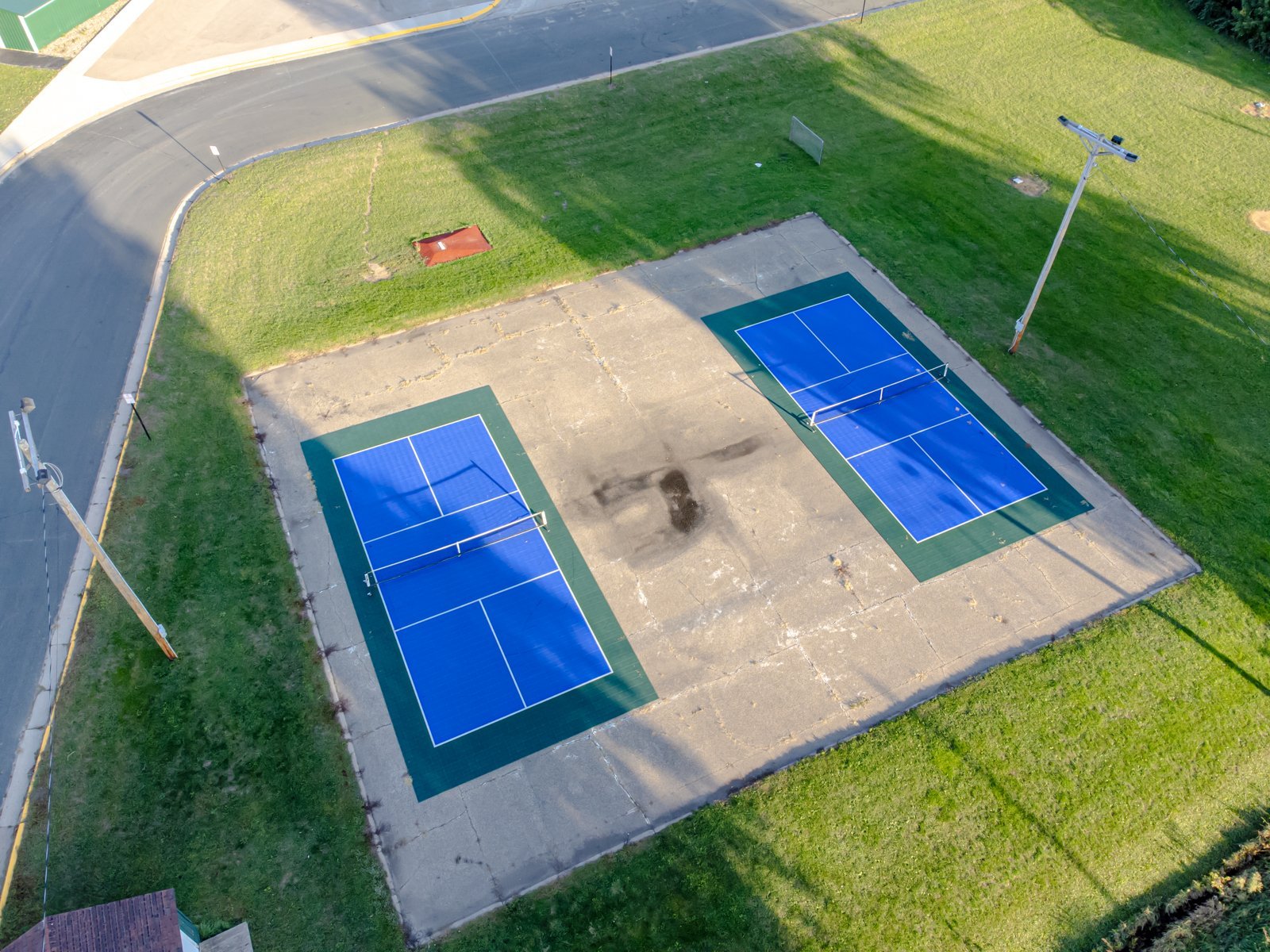
Yes, and many parks do exactly that. A pickleball court is 44 feet long, so it fits inside a tennis court’s 78 feet. Players tape or paint the smaller lines on the tennis surface and use a portable net, or lower the tennis net. Several pickleball games fit on one tennis court.
What is the kitchen in pickleball?
The kitchen is the 7-foot zone on each side of the net, also called the non-volley zone. You may stand in it, but you may not volley while touching it, and your swing may not carry you into it after a volley. The rule stops smashes from right next to the net.
Which sport is better exercise, pickleball or tennis?
Both are good exercise, but they load the body differently. Tennis burns more energy, with hard sprints across a big court. Pickleball gives steady cardio with shorter steps and less strain on knees and shoulders, with long rallies that keep beginners moving. The better workout is the one you will actually do each week.
Which costs less to start, pickleball or tennis?
Pickleball usually costs less to start. One paddle and a few plastic balls are enough for your first games, and many public courts are free. Tennis asks for a racket, felt balls that wear out quickly, and often court fees. Lessons cost extra in both, but pickleball gear stays cheaper.
Conclusion
The two sports share a net and a serve style, but were built for different players. Pickleball is the small, friendly game: a short court, a solid paddle, a slow ball, and rules that keep rallies long and fair. Tennis is the big, powerful game: a long court, a strung racket, an overhead serve, and scoring with more than a century of history. Choose pickleball for an easy start and kind joints. Choose tennis for speed, spin, and a deeper test of skill.

Hi! I am Arshad Ullah presently working as linguist in Punjab Education Department. I have done MA in English Literature while M.Phil in Applied Linguistics. I have taught creative writing to the post graduation classes for 15 years. Presently I am working as content writer, and offering classes for blog writing. On this site, I research each topic from authoritative sources and edit every comparison for accuracy and clear, simple language.