Ali started a small clothing business in his city. At first, he sold clothes only inside his country. Later, he began shipping products to other countries too. One day, he asked, “What is the difference between national and international?”
Many students and English learners ask the same question. The difference between national and international is very important in school, business, travel, sports, and daily life. Understanding the difference between national and international helps people use the right word in the right place.
These two words may look similar, but they have different meanings. “National” relates to one country, while “international” relates to many countries. In this guide, you will learn both words in a very simple and clear way.
What is “National”?
“National” means something related to one country only. It can be about people, business, sports, laws, or events inside a country.
Example: A national holiday is celebrated inside one country.
The word comes from the Latin word nationem, meaning “people” or “country.” During the 18th and 19th centuries, many countries became stronger and created national systems like national banks, national schools, and national governments. The word became common in politics, education, and culture. Today, people use “national” to talk about things connected with one nation only. For example, national news, national language, and national economy are all related to one country.
What is “International”?
“International” means something involving two or more countries. It connects people, groups, or activities across borders.
Example: An international airport connects many countries.
The word “international” became popular in the late 18th century. It was first used to describe relations between countries. As travel, trade, and communication grew, countries started working together more often. International organizations, international trade, and international sports became common. Today, the word is used in business, education, politics, and travel. It describes activities or systems that involve different nations around the world.
National vs International
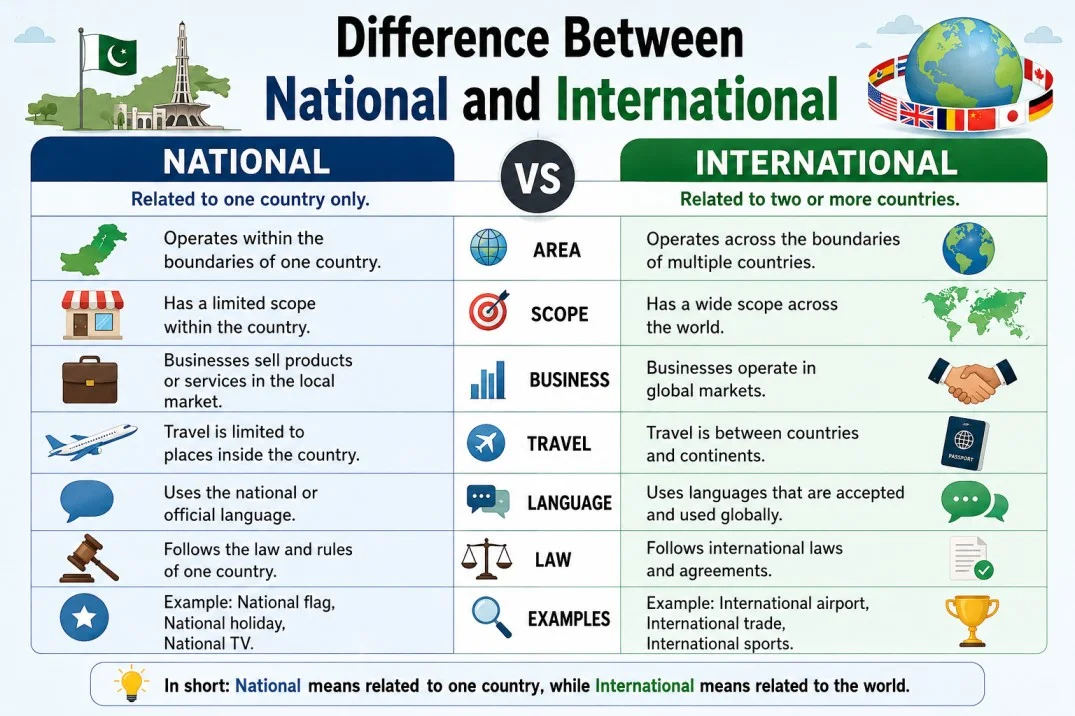
National means connected to one country. International means connected to many countries.
Both words are important in modern English. Now let us explore how each one works in real life.
How National Works
Key Features
- Connected to one country
- Follows local laws and rules
- Uses one national system
- Common in local government and culture
- Limited inside country borders
🔵 The national football team won the match.
🔵 She works for a national newspaper.
Uses
- National education systems
- National companies
- National sports teams
- National holidays
- National television channels
How International Works
Key Features
- Involves many countries
- Connects people globally
- Uses worldwide systems
- Common in trade and travel
- Crosses country borders
🟢 He studies at an international university.
🟢 The company sells products in international markets.
Uses
- International business
- International travel
- International schools
- International sports events
- International organizations
Which One Should You Use?
Use “national” when talking about one country only. Use “international” when talking about many countries together.
For example, a local train system is national, but an airline flying to many countries is international.
10 Differences Between National and International
1. Area of Connection
National: Related to one country only.
🔴 The national museum is in the capital city.
🔴 National laws protect citizens.
International: Related to many countries.
🔴 International flights arrive daily.
🔴 The meeting included leaders from many nations.
2. Business Scope
National: Business works inside one country.
🔴 The company sells products only in Pakistan.
🔴 National brands serve local markets.
International: Business works across countries.
🔴 International companies sell worldwide.
🔴 The brand opened stores in Europe and Asia.
3. Travel
National: Travel inside one country.
🔴 We took a national flight to Karachi.
🔴 National tourism helps local cities.
International: Travel between countries.
🔴 They booked an international flight to Turkey.
🔴 International travel needs a passport.
4. Language Use
National: One country’s official language.
🔴 Urdu is Pakistan’s national language.
🔴 National songs use local language.
International: Used across countries.
🔴 English is an international language.
🔴 International meetings often use English.
5. Education
National: Follows one country’s system.
🔴 National schools follow local rules.
🔴 National exams happen every year.
International: Follows global systems.
🔴 International schools teach foreign programs.
🔴 Students join international exchange programs.
6. Sports
National: Teams represent one country.
🔴 The national cricket team played well.
🔴 National games unite people.
International: Teams from many countries compete.
🔴 The Olympics are international events.
🔴 International matches attract global fans.
7. Law and Rules
National: Laws apply inside one country.
🔴 National law protects workers.
🔴 The case followed national rules.
International: Rules apply between countries.
🔴 International law supports peace.
🔴 Countries signed an international agreement.
8. Culture
National: Related to local traditions.
🔴 National dress shows culture.
🔴 National food is part of identity.
International: Shared among many cultures.
🔴 International music reaches global audiences.
🔴 International festivals welcome all nations.
9. Communication
National: Communication inside one nation.
🔴 National TV covers local news.
🔴 National radio uses local language.
International: Communication across countries.
🔴 International media shares world news.
🔴 International calls connect families abroad.
10. Economy
National: Economy inside one country.
🔴 National banks manage local money.
🔴 National taxes support services.
International: Economy between countries.
🔴 International trade boosts growth.
🔴 International markets affect prices worldwide.
Why People Get Confused About Their Use
People get confused because both words relate to countries. Also, both words are often used in news, business, and education. The main difference is simple: “national” stays inside one country, while “international” connects many countries.
Table: Difference and Similarity
| Feature | National | International | Similarity |
| Area | One country | Many countries | Both relate to nations |
| Travel | Inside country | Between countries | Both involve movement |
| Business | Local market | Global market | Both involve trade |
| Education | Local system | Global system | Both involve learning |
| Sports | One nation team | Many nation teams | Both involve competition |
| Law | Local laws | Global agreements | Both use rules |
| Language | National language | Global language | Both involve communication |
Which is Better in What Situation?
National systems are better when people want local control, local culture, and local rules. National businesses often understand local customers better. National education also follows local traditions and values.
International systems are better for global trade, travel, and worldwide communication. International companies reach more customers. International education gives students global knowledge and opportunities.
How Are “National” and “International” Used in Metaphors and Similes?
🟣 “National pride spread like fire during the match.”
🟣 “The internet created an international village.”
🟣 “Her music crossed borders like an international bridge.”
🟣 “The national flag stood like a symbol of unity.”
Connotative Meaning
National
- Usually positive and connected with pride or identity
🟣 “People celebrated their national hero.”
🟣 “The national anthem brought tears to many eyes.”
International
- Usually positive and connected with growth or unity
🟣 “International friendship builds peace.”
🟣 “The company gained international success.”
Idioms or Proverbs
🟣 “Think globally, act locally.”
Meaning: Care about the world while helping your local area.
Example: “The business thinks globally, but acts locally.”
🟣 “The world is one family.”
Meaning: All people are connected.
Example: “International events show that the world is one family.”
Works in Literature
🟣 Imagined Communities — Imagined Communities — Benedict Anderson — 1983
🟣 The Clash of Civilizations — The Clash of Civilizations — Samuel P. Huntington — 1996
Movies Related to the Keywords
🟣 The Terminal — 2004 — United States
🟣 Hotel Rwanda — 2004 — United Kingdom/South Africa
🟣 Babel — 2006 — United States/Mexico
Frequently Asked Questions
Is national the same as local?
No. National means the whole country, while local means one city or area.
What does international mean in simple words?
It means involving many countries.
Can a company be both national and international?
Yes. A company may start nationally and later become international.
Is English an international language?
Yes. People use English in many countries around the world.
Which word is bigger in scope?
International is bigger because it includes many countries.
Final Words
Learning new English words becomes easy when you understand real-life meaning and examples. “National” and “international” are common words in daily life, school, and business. Keep practicing them in sentences, and soon you will use them naturally and confidently.
Conclusion
The difference between national and international is simple but important. National relates to one country, while international connects many countries. These words are used in travel, education, business, sports, and communication. By learning their meanings, examples, and uses, students and English learners can improve their vocabulary and avoid confusion. Practice using both words in daily conversation to remember them better.

Hi! I am Arshad Ullah presently working as linguist in Punjab Education Department. I have done MA in English Literature while M.Phil in Applied Linguistics. I have taught creative writing to the post graduation classes for 15 years. Presently I am working as content writer, and offering classes for blog writing.