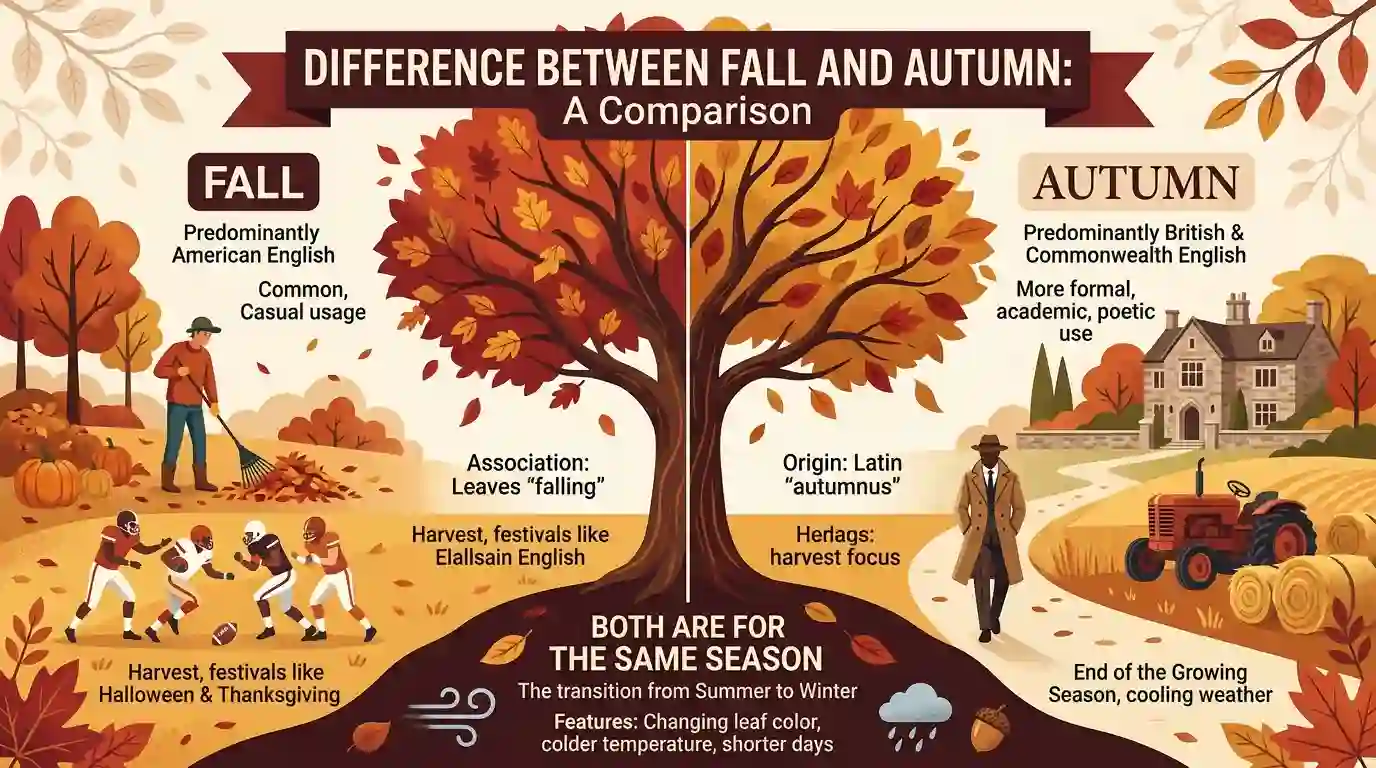
I still remember reading an American magazine that talked about fall fashion trends, and then later seeing a British article discussing autumn colors. At first, I thought they were talking about different seasons.
Many people first assume there is a difference between fall and autumn, especially when they hear one term used in the United States and another used in the United Kingdom. This confusion is common among students, writers, travelers, and English learners.
Understanding the difference matters because choosing the wrong term can sometimes sound unusual to your audience. It can also affect writing style, communication, and even search engine optimization when creating content for different regions.
The good news is that the answer is much simpler than most people expect.
This guide explains everything in simple English with practical examples so you can clearly understand the real difference.
What Is Fall?
Fall is one of the four seasons of the year. It comes after summer and before winter.
The term “fall” refers to the period when temperatures begin to cool and leaves start falling from trees.
Origin of the Word Fall
The word “fall” became popular in England during the 16th and 17th centuries.
It came from the phrase “fall of the leaf,” which described leaves dropping from trees.
Later, American English continued using the word “fall” while British English gradually preferred the term “autumn.”
Practical Meaning of Fall
In everyday use, fall means:
- Cooler weather
- Falling leaves
- Shorter days
- Harvest season
- Preparation for winter
Example Sentences
- Fall starts in September in many countries.
- The weather becomes cooler during fall.
- Many people enjoy fall festivals and pumpkin picking.
Who Uses the Word Fall?
The term “fall” is most commonly used in:
- United States
- Canada (along with autumn)
- American media
- American schools
- American businesses
What Is Autumn?
Autumn is also one of the four seasons of the year. It represents the same period between summer and winter.
The word is older and comes from Latin and French influences.
Origin of the Word Autumn
The word “autumn” comes from the Latin word autumnus.
It entered English through Old French and became widely used in literature and formal writing.
Practical Meaning of Autumn
Autumn describes:
- Colorful leaves
- Cooler temperatures
- Harvest activities
- Seasonal changes
- Transition into winter
Example Sentences
- Autumn is known for beautiful golden leaves.
- Many photographers love autumn landscapes.
- Autumn brings shorter daylight hours.
Who Uses the Word Autumn?
The term “autumn” is more common in:
- United Kingdom
- Ireland
- Australia
- New Zealand
- International English publications
Quick Comparison Table
| Feature | Fall | Autumn |
| Meaning | Season between summer and winter | Season between summer and winter |
| Definition | American English term | Traditional English term |
| Origin | Fall of the leaf | Latin and French roots |
| Usage Region | Mostly North America | UK and many Commonwealth countries |
| Formality | More casual | More formal |
| Popularity in US | Very high | Less common |
| Popularity in UK | Less common | Very high |
| Writing Style | Conversational | Literary and formal |
| Everyday Use | Common | Common outside North America |
| Academic Use | Accepted | Often preferred |
| Main Advantage | Simple and familiar | Elegant and traditional |
| Main Drawback | Regional preference | Can sound formal in some regions |
Biggest Difference Between Fall and Autumn
The biggest difference is not the season itself.
Fall and autumn mean exactly the same season.
The real difference is the word choice and regional preference.
- Americans usually say fall.
- British speakers usually say autumn.
This matters more than many beginners realize because language often depends on audience expectations.
For example:
- An American travel guide will likely say “fall foliage.”
- A British travel guide will likely say “autumn colors.”
The season remains identical.
Key Differences Explained
1. Regional Usage
Fall
Used mainly in North America.
Autumn
Used more often in Britain and Commonwealth countries.
Real-World Impact
Choosing the preferred local term makes communication sound more natural.
2. Historical Development
Fall
Developed from the phrase “fall of the leaf.”
Autumn
Derived from Latin and French language traditions.
Example
Many older literary works prefer autumn.
3. Formality Level
Fall
Sounds casual and conversational.
Autumn
Often sounds slightly more formal and elegant.
Example
A poetry collection may use autumn more often than fall.
4. Literary Appeal
Fall
Used frequently in modern writing.
Autumn
Common in classic literature and artistic writing.
Real-World Observation
Many authors choose autumn because it creates a richer emotional tone.
5. Marketing and Branding
Fall
Popular in American advertising.
Autumn
Common in British promotional content.
Example
- Fall Sale
- Autumn Collection
Both refer to seasonal promotions.
6. Educational Preferences
Fall
Frequently taught in American schools.
Autumn
Often appears in international English courses.
Why It Matters
Students preparing for international exams may encounter autumn more often.
7. Search Behavior
Fall
Receives strong search traffic in the US.
Autumn
Popular in UK-based searches.
SEO Importance
Content creators often choose terminology based on target audiences.
8. Cultural Associations
Fall
Often linked with Thanksgiving in the United States.
Autumn
Often associated with countryside scenery and seasonal traditions in Britain.
9. Emotional Tone
Fall
Feels straightforward and practical.
Autumn
Feels warmer and more poetic.
Example
“Autumn leaves” often sounds more artistic than “fall leaves.”
10. Media Usage
Fall
Common in American TV, newspapers, and websites.
Autumn
More common in British media.
11. International Recognition
Fall
Widely understood globally because of American influence.
Autumn
Recognized as the traditional English term worldwide.
Similarities Between Them
People often confuse fall and autumn because they share almost everything.
Both Refer to the Same Season
There is no calendar difference.
Both Occur Between Summer and Winter
The timing remains identical.
Both Describe Seasonal Changes
- Falling leaves
- Cooler weather
- Harvest activities
- Shorter daylight hours
Both Are Correct English
Neither term is wrong.
Both Are Widely Understood
Most English speakers understand both words regardless of location.
Pros and Cons
Pros of Fall
- Easy to understand
- Common in North America
- Short and simple
- Frequently used in media
Cons of Fall
- Less common in British English
- Can confuse some international learners
Pros of Autumn
- Traditional term
- Widely accepted internationally
- Common in literature
- Sounds elegant
Cons of Autumn
- Slightly formal in some situations
- Less common in everyday American speech
Which Is Better for Different Situations?
For Beginners
Both are equally correct.
For American Audiences
Fall is usually the better choice.
For British Audiences
Autumn sounds more natural.
For Students
Learning both terms is useful.
For Writers
Audience location should guide the choice.
For International Content
Autumn often works well because it is recognized globally.
For SEO Projects
Use the term your target audience searches most often.
Common Mistakes People Make
Thinking They Are Different Seasons
This is the most common misunderstanding.
Assuming One Is Incorrect
Both words are grammatically correct.
Ignoring Audience Location
Regional language preferences matter.
Following Trends Without Context
Some users later regret forcing one term into content aimed at the wrong audience.
Overcomplicating the Difference
The distinction is mainly about vocabulary, not meaning.
Expert Recommendation
Choose Fall If:
- Your audience is American
- You write for US businesses
- You want casual language
- You create US-focused content
Choose Autumn If:
- Your audience is British
- You write formal content
- You create educational material
- You prefer traditional wording
Avoid Fall If:
- Your audience strongly prefers British English
- You need a more literary tone
Avoid Autumn If:
- Your content targets only American readers
- You want highly conversational language
Final Verdict
The difference between fall and autumn is much smaller than most people think.
Both words describe the same season between summer and winter. The main distinction comes from regional language preferences. Americans generally use fall, while British and many international English speakers prefer autumn.
For everyday use, either term is correct. The best choice depends on your audience, writing style, and communication goals. In real-world use, most native speakers understand both words without confusion.
If you write for American readers, fall often feels more natural. If you write for British or international audiences, autumn may be the better option. Over the long term, learning both terms helps you communicate more effectively and understand English content from around the world.
FAQ Section
Is there a real difference between fall and autumn?
No. Fall and autumn refer to exactly the same season. The difference is mainly regional usage. Americans commonly say fall, while British speakers usually prefer autumn.
Which is better, fall or autumn?
Neither is better. The best choice depends on your audience. Fall is common in American English, while autumn is preferred in British English and many international settings.
Why do Americans say fall instead of autumn?
The word fall evolved from the phrase “fall of the leaf.” American English continued using it after British English gradually favored autumn.
Is autumn more formal than fall?
Yes. Autumn often sounds slightly more formal, literary, and traditional. Fall usually feels more casual and conversational.
Are fall and autumn interchangeable?
Yes. In most situations, the words can be used interchangeably because they describe the same season and seasonal changes.
Which term is more popular worldwide?
Autumn is widely used across many English-speaking countries. However, fall remains extremely popular because of the global influence of American English.
Which word should students learn?
Students should learn both. Understanding both terms helps when reading books, articles, exams, and content from different English-speaking countries.
What mistake should beginners avoid?
The biggest mistake is thinking fall and autumn are different seasons. They mean the same thing and only differ in regional preference.
Conclusion
The difference between fall and autumn is primarily a matter of language, not meaning. Both terms describe the season that comes between summer and winter, bringing cooler temperatures, colorful leaves, harvest activities, and shorter days. The key distinction lies in where the words are used. Fall is more common in the United States and parts of Canada, while autumn is preferred in the United Kingdom, Australia, New Zealand, and many international English-speaking regions.
For most people, either term is perfectly correct. The smartest approach is to consider your audience. If you are writing for American readers, fall may feel more natural. If your audience is British or global, autumn often works better. Understanding both words helps improve communication, writing, and cultural awareness. In the end, they describe the same beautiful season—just with different names.

Hi! I am Arshad Ullah presently working as linguist in Punjab Education Department. I have done MA in English Literature while M.Phil in Applied Linguistics. I have taught creative writing to the post graduation classes for 15 years. Presently I am working as content writer, and offering classes for blog writing. On this site, I research each topic from authoritative sources and edit every comparison for accuracy and clear, simple language.










1 thought on “Difference Between Fall and Autumn: A Simple Study”