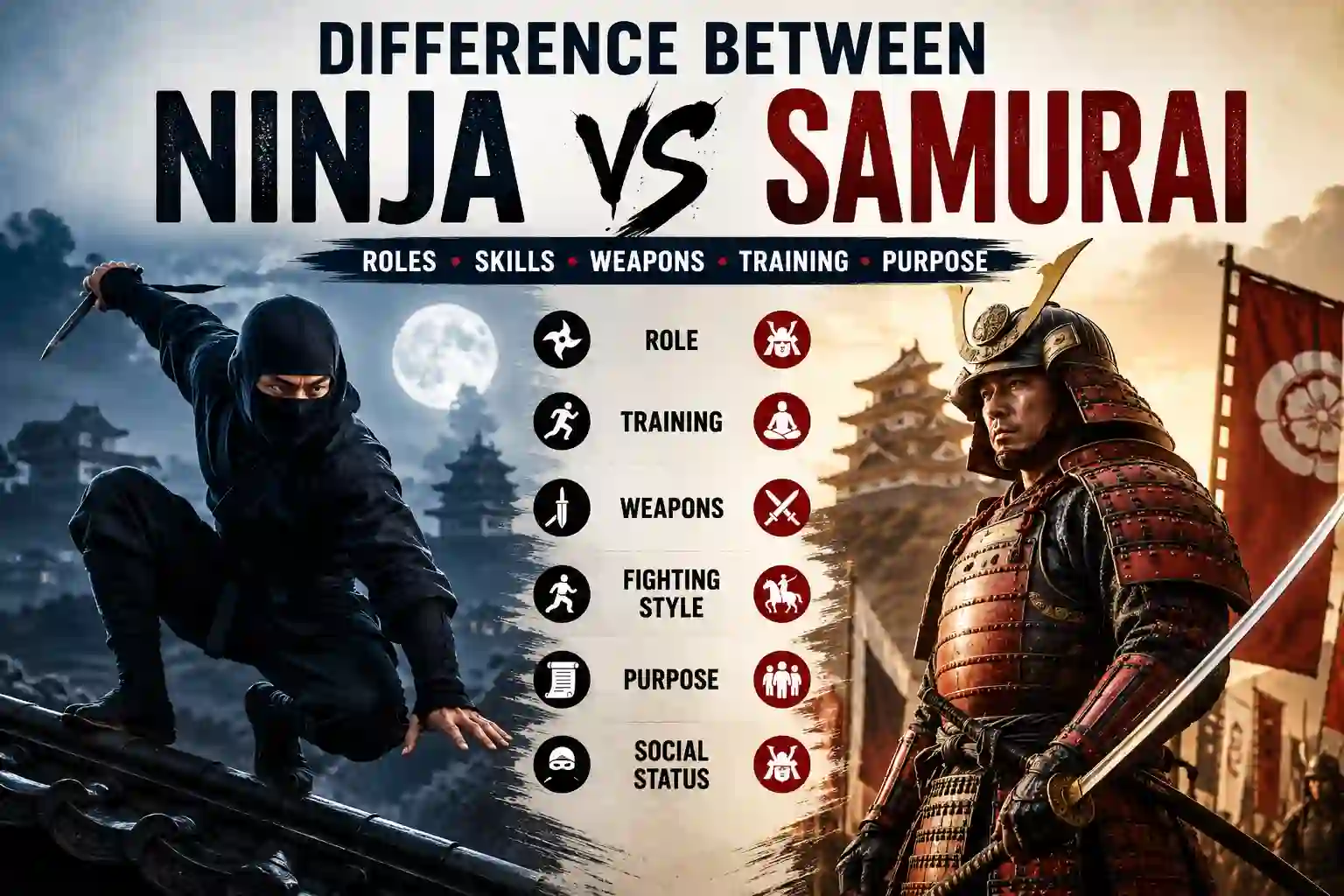
The main difference between ninja and samurai was their role. Samurai were trained warriors who served lords and fought in wars. Ninja, also called shinobi, worked in secret. They gathered information, entered enemy areas, and used surprise and stealth. They were not always enemies. In some cases, ninja worked for samurai leaders.
Quick Comparison Table
| Feature | Ninja | Samurai |
| Main job | Secret missions | Fighting and military service |
| Other name | Shinobi | Bushi |
| Main skill | Stealth and spying | Combat and warfare |
| Work style | Hidden and secret | Often open and direct |
| Social class | Not one fixed class | Warrior class |
| Weapons | Many types of tools and weapons | Swords, bows, spears, and guns |
| Armor | Usually avoided heavy armor | Often used armor in battle |
| Main goal | Get information and complete secret tasks | Serve a lord and fight for him |
Introduction
Ninja and samurai are two famous figures from Japanese history.
Movies and games often show them as enemies. But real history is more complex.
Samurai were part of Japan’s warrior class. They fought in wars and served powerful lords. Some also worked in government and managed land. The Metropolitan Museum of Art says samurai had a major role in Japan from about the 12th to the 19th century.
Ninja had a different role. They were known as shinobi. They worked in secret and helped gather information. They could also enter enemy areas, spy, and carry out other secret missions. Mie University says gathering information was a key part of shinobi work.
What Is a Ninja?
A ninja is the word most people use today for a shinobi.
Historical shinobi worked on secret military tasks.
What did ninja do?
Ninja could:
- Gather information.
- Watch enemy forces.
- Enter enemy areas.
- Use disguises.
- Carry out secret attacks.
- Damage enemy plans.
- Report information to their leaders.
Their main strength was not always fighting. It was getting useful information and completing a task without being noticed.
The Mie University International Ninja Research Center says that getting information was an important part of shinobi work.
The Ninja Official Council also lists tasks such as spying, entering enemy areas, sabotage, night attacks, and surprise attacks.
Did ninja always wear black?
No.
The famous black ninja suit is mostly a modern image.
A person working in secret needed to avoid being seen. A disguise could be more useful than a special black suit.
What Is a Samurai?
A samurai was a member of Japan’s warrior class.
Samurai served powerful lords and military leaders. They fought in wars and protected land.
But fighting was not their only job.
What did samurai do?
Samurai could:
- Fight in wars.
- Protect land.
- Serve a lord.
- Lead soldiers.
- Manage land.
- Work in government.
- Train in martial arts.
Samurai were skilled with weapons such as bows and swords. Horse riding was also an important skill, especially in earlier periods.
Samurai also became linked with Japanese culture. Some studied writing, tea, art, and other subjects.
Core Difference Between Ninja and Samurai
The easiest way to understand the difference between ninja and samurai is to look at their main jobs.
Ninja worked in secret
Ninja were linked with secret work.
They could enter places without being seen. They could watch enemies and bring back information.
Their work often used:
- Stealth
- Disguise
- Surprise
- Spying
- Secret entry
Samurai served as warriors
Samurai were trained for military service.
They could fight in battles and serve powerful leaders.
Their work could include:
- Fighting
- Protecting land
- Leading soldiers
- Serving a lord
- Government work
They were not exact opposites
This is important.
A ninja was not simply the opposite of a samurai.
Some people linked to ninja work could also have links to the warrior class. Mie University notes that the social position of people involved in shinobi work could vary.
So, the two groups could overlap.
Key Differences Between Ninja and Samurai
1. Main Job
The biggest difference was their main role.
Ninja:
- Worked on secret missions.
- Gathered information.
- Watched enemies.
- Used stealth.
- Used surprise.
Samurai:
- Served military leaders.
- Fought in wars.
- Protected land.
- Could lead soldiers.
- Could work in government.
The Ninja Official Council says that shinobi often tried to avoid direct fighting when possible because their main task was to complete their mission and return safely.
2. Secret Work vs. Open Warfare
Samurai are strongly linked with battles.
Ninja are strongly linked with secret work.
But this does not mean every samurai fought in the same way. It also does not mean ninja never fought.
The main difference was their special role.
3. Social Status
Samurai were part of a recognized warrior class.
Ninja were not one single social class.
People involved in shinobi work could come from different backgrounds. Their position could also change over time and place.
4. Weapons and Tools
Samurai used many weapons.
These included:
- Swords
- Bows
- Spears
- Guns in later periods
Samurai also used armor during battle. The Metropolitan Museum of Art has many examples of samurai armor, swords, bows, and other military items.
Ninja used tools that helped with secret work.
These could help with:
- Climbing
- Hiding
- Disguise
- Entering places
- Communication
- Gathering information
There was no single set of tools used by every ninja.
5. Fighting Style
Samurai were trained for direct combat.
They learned skills such as:
- Sword fighting
- Archery
- Horse riding
- Spear fighting
- Military tactics
Ninja focused more on:
- Stealth
- Surprise
- Disguise
- Spying
- Secret entry
- Unusual tactics
The Smithsonian also describes ninja as secret agents who took part in covert military work.
6. Armor and Appearance
Samurai often wore armor in battle.
Their armor gave them protection while still allowing them to move and fight. Samurai armor also became an important part of Japanese art and history.
Ninja doing secret work had different needs.
Heavy armor could make secret movement harder. A person on a secret mission needed to move quietly and avoid attention.
Similarities Between Ninja and Samurai
Ninja and samurai were different, but they also had things in common.
Both were linked to war
Both worked in the military world of historical Japan.
Both could serve powerful leaders
Samurai often served lords. Ninja could also work for lords and military leaders.
Both needed training
Both needed skills that could help them complete dangerous missions.
Both became famous in popular culture
Stories, plays, movies, TV shows, and games changed the way people see ninja and samurai.
Some modern images are very different from historical reality.
Were Ninja and Samurai Enemies?
Not always.
- This is one of the biggest myths about ninja and samurai.
- There was no permanent war between “the ninja” and “the samurai.”
- Ninja could work for military leaders. Those leaders could also be samurai.
- A lord could use a samurai army for open warfare and use people skilled in secret work for spying or other missions.
So, ninja and samurai could sometimes work on the same side.
Common Misconceptions
Myth: Every ninja was an assassin
Not true.
Ninja could take part in many types of secret work.
They could gather information, watch enemy forces, enter enemy areas, and carry out other missions.
Myth: Samurai only used swords
Not true.
Samurai used many weapons.
These included bows, spears, swords, and firearms in later periods.
Myth: Every ninja wore black
This is mostly a modern image.
People working in secret needed to blend into their surroundings. A black suit was not a rule for all historical ninja.
Myth: Ninja and samurai were always enemies
No.
Ninja could work for military leaders and lords. Some people involved in shinobi work also had links to the warrior class.
Myth: Bushido was always the same
The idea of bushido, or the warrior code, changed over time.
The Metropolitan Museum of Art notes that the ideal of bushido became more formal during the Edo period.
It should not be seen as one fixed set of rules followed in exactly the same way by every samurai.
FAQs
Were ninja and samurai the same?
No.
Samurai were members of Japan’s warrior class. Ninja, or shinobi, were linked with secret work such as spying, gathering information, and entering enemy areas. However, the two groups were not always completely separate. Some people connected to shinobi work also had links to the warrior class.
Who was stronger, a ninja or a samurai?
There is no simple answer.
They had different jobs.
Samurai trained for war and direct fighting. Ninja focused more on secret missions, information, and surprise. A fight between two individuals would depend on many things, such as training, weapons, place, and the goal of the mission.
Did samurai use ninja?
Yes.
Military leaders could use people skilled in secret work.
Ninja could gather information, enter enemy areas, and perform other secret tasks. This could help a military leader make better plans. So, ninja were not always enemies of samurai.
Did ninja use swords?
Yes, ninja could use swords and other weapons.
But the sword was not what made someone a ninja.
Their special skills were linked more with stealth, information gathering, disguise, surprise, and secret missions.
Where did ninja come from?
The areas of Iga and Kōka are strongly linked with the history of shinobi.
Mie University identifies these areas as important in the history of shinobi traditions.
When did samurai exist?
Samurai became an important military class in medieval Japan.
They remained important for many centuries. The Metropolitan Museum of Art describes samurai as a major military elite from about the 12th through the 19th centuries.
Are modern ninja like historical ninja?
Not completely.
Modern ninja are strongly shaped by movies, TV, games, and stories.
Historical shinobi were real people who carried out secret military tasks. But many popular ninja features are based on later stories and entertainment.
Conclusion
The difference between ninja and samurai is mainly about their roles. Samurai were members of Japan’s warrior class. They served lords, fought in wars, and could also work in government. Ninja, or shinobi, focused on secret tasks. They gathered information, entered enemy areas, and used stealth and surprise. The two were not always enemies. Ninja could work for military leaders, including samurai leaders. The easiest way to remember it is simple: samurai were mainly military warriors, while ninja were specialists in secret work and information gathering.

Hi! I am Arshad Ullah presently working as linguist in Punjab Education Department. I have done MA in English Literature while M.Phil in Applied Linguistics. I have taught creative writing to the post graduation classes for 15 years. Presently I am working as content writer, and offering classes for blog writing. On this site, I research each topic from authoritative sources and edit every comparison for accuracy and clear, simple language.