Last year, Ali lost his grandfather. First, his family had a funeral at the mosque. Later, they held a memorial dinner to remember his life. Many people asked about the difference between funeral and memorial because both events honored the same person.
The difference between funeral and memorial is simple, but many English learners still mix them up. A funeral usually happens before burial or cremation. A memorial happens later and focuses more on remembering the person.
Knowing the difference between funeral and memorial helps in daily English, movies, books, and real-life conversations. It also helps you speak politely during serious moments.
What is “Funeral”?
A funeral is a ceremony held after a person dies. Family and friends gather to pray, mourn, and say goodbye. The body is usually present during the event.
A funeral may include:
- Prayers
- Burial or cremation
- Religious customs
- Speeches about the person
History of Funeral
Funerals are very old traditions. Ancient people in Egypt, China, and Rome held funeral ceremonies thousands of years ago. They believed the dead should be honored with respect. Egyptians even buried people with valuable items for the afterlife. Over time, religions added special funeral prayers and customs. Today, funerals happen in almost every culture around the world. Some are simple, while others are large ceremonies. Even though traditions change, the main purpose stays the same: to honor the dead and support the family.
What is “Memorial”?
A memorial is an event that remembers a person who has died. The body is usually not present. It can happen days, weeks, or months later.
A memorial may include:
- Stories and memories
- Photos and videos
- Music
- Speeches
History of Memorial
Memorial events also have a long history. In ancient times, people built statues, stones, and monuments to remember important people. Over the years, memorial gatherings became more personal and emotional. Families started holding events where people shared stories and celebrated memories. Today, memorials can happen in homes, parks, churches, or online. Some memorials are serious, while others are joyful celebrations of life. The main goal is to remember and honor the person in a meaningful way.
Funeral vs Memorial
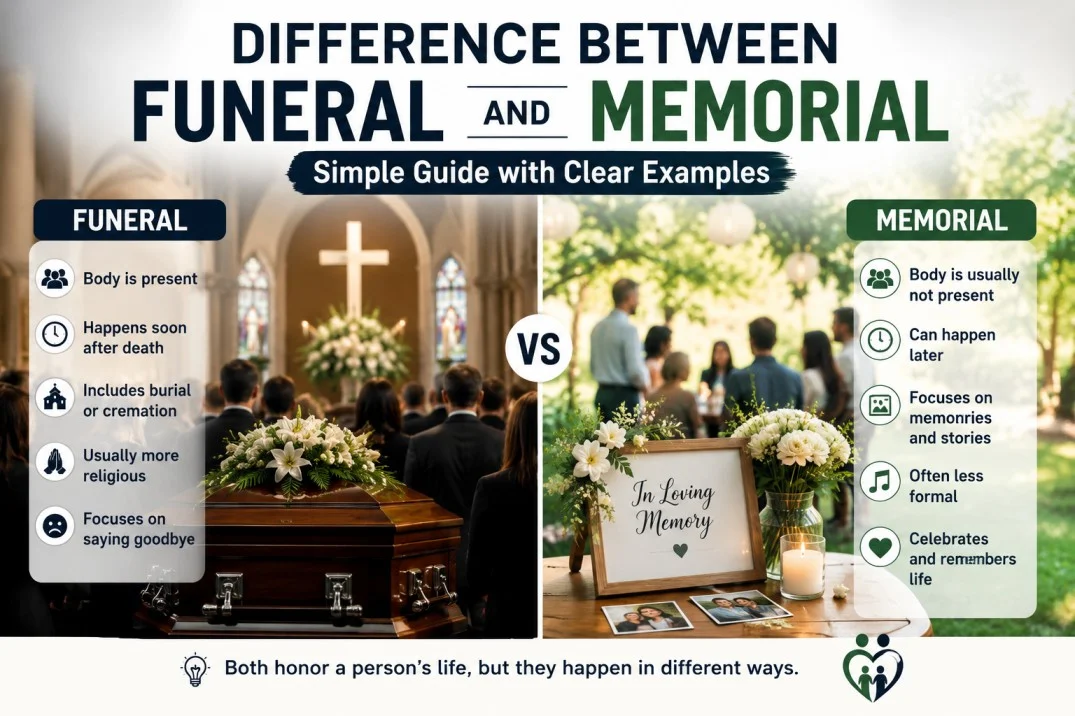
A funeral is a ceremony connected to burial or cremation. A memorial is mainly a gathering to remember someone.
Both events honor a person who has died, but they happen in different ways. Let’s understand them in more detail.
How “Funeral” Works
Key Features
- The body is usually present
- Happens soon after death
- Includes burial or cremation
- Often follows religious traditions
- Family and friends gather together
Example Sentences
🔵 We attended my uncle’s funeral yesterday.
🔵 Her funeral was held at the local church.
Uses
- Religious ceremonies
- Family traditions
- Formal announcements
- News reports
- Daily conversations
How “Memorial” Works
Key Features
- The body is usually not present
- Can happen later
- Focuses on memories and celebration
- Often less formal
- May include photos and music
Example Sentences
🟢 They planned a memorial for their grandmother next month.
🟢 The memorial celebrated his life and achievements.
Uses
- Celebration of life events
- Public remembrance
- School or workplace gatherings
- Online tribute events
Which One Should You Use?
Use “funeral” when talking about burial, cremation, or a formal goodbye ceremony. Use “memorial” when talking about remembering or celebrating someone’s life later.
10 Differences Between Funeral and Memorial
1. Presence of the Body
Funeral: The body is usually present.
🔴 The funeral included a viewing before burial.
🔴 Family members stood beside the coffin.
Memorial: The body is usually absent.
🔴 The memorial happened two months later.
🔴 People shared memories at the memorial.
2. Timing
Funeral: Happens soon after death.
🔴 The funeral was held the next day.
🔴 They arranged the funeral quickly.
Memorial: Can happen much later.
🔴 The memorial took place after summer.
🔴 Friends joined the memorial weeks later.
3. Main Purpose
Funeral: Focuses on saying goodbye.
🔴 The funeral helped the family mourn.
🔴 Everyone prayed during the funeral.
Memorial: Focuses on remembering life.
🔴 The memorial celebrated her kindness.
🔴 Guests shared happy stories.
4. Religious Style
Funeral: Often very religious.
🔴 The funeral followed Islamic traditions.
🔴 A priest led the funeral prayers.
Memorial: May be less religious.
🔴 The memorial included songs and speeches.
🔴 Friends organized a simple memorial.
5. Mood
Funeral: Usually serious and sad.
🔴 People wore black clothes at the funeral.
🔴 Many cried during the service.
Memorial: Can feel warm and hopeful.
🔴 People smiled while sharing memories.
🔴 The memorial felt peaceful.
6. Location
Funeral: Often held in a mosque, church, or cemetery.
🔴 The funeral happened at the cemetery.
🔴 They went to the mosque for the funeral.
Memorial: Can happen anywhere.
🔴 The memorial was in a park.
🔴 They held a memorial at home.
7. Formality
Funeral: More formal.
🔴 Everyone followed formal traditions.
🔴 The funeral had strict customs.
Memorial: Often more relaxed.
🔴 Guests dressed casually at the memorial.
🔴 Music played during the event.
8. Activities
Funeral: Includes burial or cremation.
🔴 The funeral ended with burial.
🔴 They attended the cremation service.
Memorial: Includes speeches and memories.
🔴 Friends told funny stories at the memorial.
🔴 Photos were shown during the memorial.
9. Cultural Role
Funeral: Strong cultural traditions.
🔴 Their culture requires quick funerals.
🔴 Funeral customs differ by religion.
Memorial: More personal and flexible.
🔴 Each memorial looked different.
🔴 Families planned unique memorials.
10. Emotional Focus
Funeral: Focuses on loss.
🔴 The funeral was emotional and quiet.
🔴 Everyone mourned together.
Memorial: Focuses on memories and legacy.
🔴 The memorial honored his achievements.
🔴 Guests remembered happy moments.
Why People Get Confused About Their Use
People get confused because both events happen after someone dies. Both also include family, friends, prayers, and speeches. In movies and daily talk, people sometimes use the words loosely. That is why English learners often think they mean the same thing.
Table: Difference and Similarity
| Feature | Funeral | Memorial | Similarity |
| Body Present | Usually yes | Usually no | Both honor the dead |
| Timing | Soon after death | Later | Both gather people |
| Purpose | Goodbye ceremony | Remembering life | Both show respect |
| Style | Formal | Flexible | Both may include speeches |
| Religion | Often religious | Sometimes non-religious | Both may include prayers |
| Mood | Sad and serious | Warm and reflective | Both can be emotional |
Which is Better in What Situation?
A funeral is better when the family wants a formal goodbye with burial or cremation. It is also important in many religions and traditions.
A memorial is better when people want more time to gather and celebrate memories. It can feel more personal and relaxed for friends and family.
How Are “Funeral” and “Memorial” Used in Metaphors and Similes?
🟣 “The meeting felt like a funeral.”
Meaning: The meeting was very sad or silent.
🟣 “The event became a memorial of lost dreams.”
Meaning: It reminded people of something gone forever.
🟣 “The room was quiet like a funeral.”
Meaning: Very silent and serious.
Connotative Meaning
Funeral
- Usually negative or sad
🟣 “The funeral atmosphere made everyone emotional.”
🟣 “He spoke softly at the funeral.”
Memorial
- Often neutral or positive
🟣 “The memorial celebrated her beautiful life.”
🟣 “The memorial brought comfort to the family.”
Idioms or Proverbs
🟣 “A funeral for old habits”
Meaning: Ending bad behaviors.
Example: “Starting a new life felt like a funeral for old habits.”
🟣 “Living memorial”
Meaning: Something that keeps memories alive.
Example: “The school became a living memorial to the teacher.”
Works in Literature
🟣 As I Lay Dying — William Faulkner (1930)
🟣 The Loved One — Evelyn Waugh (1948)
🟣 Lincoln in the Bardo — George Saunders (2017)
Movies Related to the Keywords
🟣 The Funeral (1996, USA)
🟣 Death at a Funeral (2007, UK)
🟣 Coco (2017, USA)
🟣 Steel Magnolias (1989, USA)
Frequently Asked Questions
Is a funeral the same as a memorial?
No. A funeral usually includes the body, while a memorial focuses on remembrance.
Can a memorial happen before burial?
Yes, sometimes families hold memorial events before burial.
Is a funeral always religious?
No. Some funerals are non-religious.
Can a memorial be happy?
Yes. Many memorials celebrate the person’s life with positive memories.
Which word is more formal?
“Funeral” is usually more formal than “memorial.”
Final Words
Understanding these words can help you speak kindly and clearly in emotional situations. Keep learning simple vocabulary step by step. Small differences in words can make your English stronger and more natural.
Conclusion
The difference between funeral and memorial is mainly about purpose and timing. A funeral is a formal ceremony connected to burial or cremation, while a memorial focuses on remembering and celebrating a person’s life. Both are important ways to honor loved ones. By learning the difference between funeral and memorial, you can use the correct word in conversations, writing, and real-life situations. Simple vocabulary knowledge like this improves both confidence and communication skills.

Hi! I am Arshad Ullah presently working as linguist in Punjab Education Department. I have done MA in English Literature while M.Phil in Applied Linguistics. I have taught creative writing to the post graduation classes for 15 years. Presently I am working as content writer, and offering classes for blog writing.