Maria visited her grandmother in Mexico every summer. One day, she heard her cousin say “abuela.” Later, her little niece said “abuelita.” Maria felt confused. Were both words the same? Many English learners ask about the difference between abuela and abuelita because both words relate to grandmothers in Spanish.
Understanding the difference between abuela and abuelita helps you speak more naturally and politely. These words may look similar, but they can show different feelings and emotions. In daily talk, family members often choose one word over the other based on love, closeness, or respect. This guide will explain everything in a very simple way with easy examples and clear comparisons.
What is “Abuela”?
“Abuela” is the Spanish word for “grandmother.” People use it to talk about their grandma in a normal and respectful way. It is common in Spain, Mexico, and many Latin American countries.
The word comes from old Spanish and Latin roots. Long ago, families used “abuela” as the formal family word for a grandmother. Over time, it stayed popular because it sounds respectful and warm. Many Spanish-speaking children still grow up calling their grandmother “abuela.” The word carries family love, tradition, and respect. In books and movies, “abuela” often represents wisdom, care, and family unity.
What is “Abuelita”?
“Abuelita” also means “grandmother,” but it sounds sweeter and more affectionate. The ending “-ita” in Spanish often adds love or tenderness. So, “abuelita” means something close to “dear grandma” or “little grandma.”
The word developed from “abuela” through a Spanish grammar style called a diminutive. Spanish speakers often add “-ito” or “-ita” to show affection. Over many years, families started using “abuelita” to express closeness and emotional warmth. Children especially use it when speaking lovingly to their grandmother. Today, “abuelita” is very common in homes, songs, movies, and family stories across Spanish-speaking cultures.
Abuela vs Abuelita
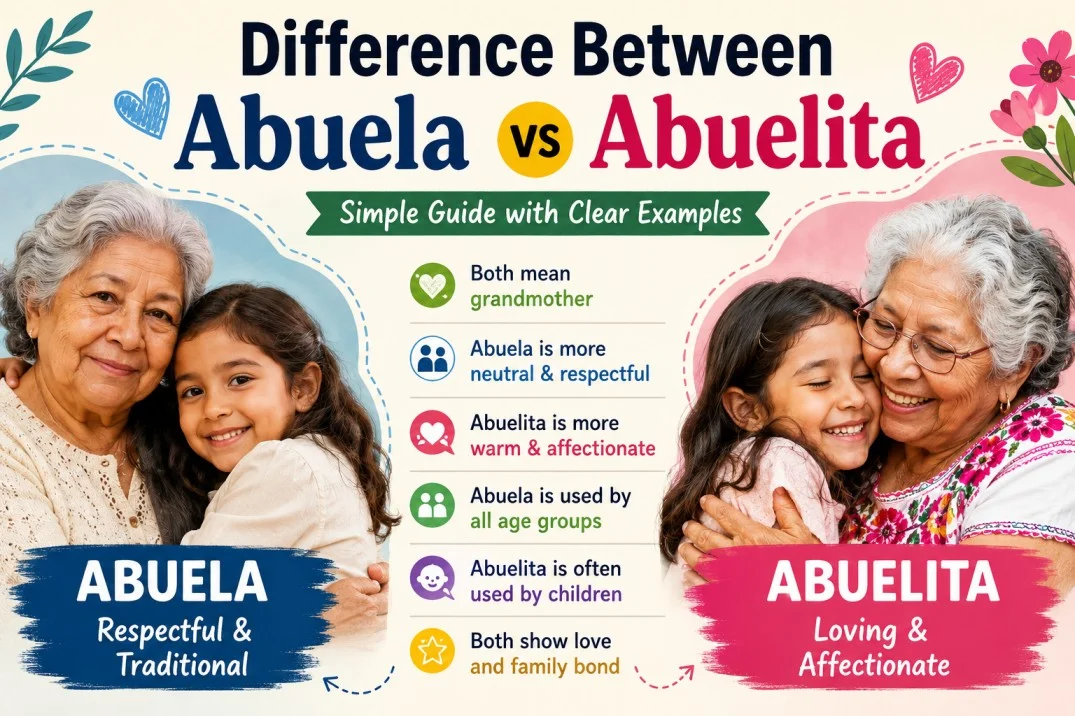
“Abuela” means grandmother in a normal and respectful way.
“Abuelita” means grandmother in a loving and affectionate way.
Now let’s explore the full differences in simple detail.
How “Abuela” Works
Key Features
- Formal and respectful tone
- Common in normal conversations
- Used by adults and children
- Shows family connection
- Popular in many Spanish-speaking countries
Example Sentences
🔵 My abuela makes the best soup every Sunday.
🔵 We visited our abuela during the holidays.
Uses
- Family conversations
- School writing
- Storybooks
- Formal speaking
- Daily life discussions
How “Abuelita” Works
Key Features
- Warm and loving tone
- Shows affection and closeness
- Often used by children
- Sounds softer and sweeter
- Common in emotional conversations
Example Sentences
🟢 My abuelita hugged me before school.
🟢 I love baking cookies with my abuelita.
Uses
- Family talks
- Childhood memories
- Emotional stories
- Loving messages
- Friendly conversations
Which One Should You Use?
Use “abuela” when you want a normal and respectful word for grandmother. Use “abuelita” when you want to sound more loving, sweet, or emotional. Both are correct. The best choice depends on the feeling you want to show.
10 Differences Between Abuela and Abuelita
1. Tone
Abuela: More neutral and respectful.
🔴 My abuela lives in Madrid.
🔴 Our abuela loves gardening.
Abuelita: More loving and emotional.
🔴 My abuelita kissed my forehead.
🔴 We miss our abuelita very much.
2. Emotional Feeling
Abuela: Shows respect.
🔴 My abuela taught me Spanish.
🔴 Her abuela is very wise.
Abuelita: Shows affection.
🔴 I called my abuelita before bed.
🔴 His abuelita made hot chocolate.
3. Formality
Abuela: Slightly more formal.
🔴 The children visited their abuela.
🔴 My abuela attended the wedding.
Abuelita: More casual and cute.
🔴 Abuelita told us funny stories.
🔴 I hugged my abuelita tightly.
4. Common Users
Abuela: Used by all age groups.
🔴 Adults often say abuela.
🔴 Teenagers may use abuela in public.
Abuelita: Often used by children.
🔴 The little boy shouted, “Abuelita!”
🔴 Young kids love saying abuelita.
5. Word Style
Abuela: Basic word form.
🔴 Abuela cooked dinner tonight.
🔴 We thanked our abuela.
Abuelita: Diminutive form.
🔴 Abuelita smiled warmly.
🔴 I sat beside my abuelita.
6. Feeling of Closeness
Abuela: General family bond.
🔴 My abuela lives nearby.
🔴 We visited abuela often.
Abuelita: Strong emotional closeness.
🔴 I cried when abuelita left.
🔴 Abuelita always comforted me.
7. Use in Stories
Abuela: Used in neutral storytelling.
🔴 The boy lived with his abuela.
🔴 His abuela shared advice.
Abuelita: Used in emotional stories.
🔴 Abuelita sang lullabies softly.
🔴 Everyone loved abuelita’s hugs.
8. Sound
Abuela: Sounds direct and simple.
🔴 My abuela is kind.
🔴 We called our abuela yesterday.
Abuelita: Sounds softer and sweeter.
🔴 Abuelita baked sweet bread.
🔴 I miss my abuelita deeply.
9. Cultural Feeling
Abuela: Traditional family word.
🔴 Abuela kept old traditions alive.
🔴 My abuela taught family recipes.
Abuelita: Warm cultural affection.
🔴 Abuelita filled the home with love.
🔴 Everyone gathered around abuelita.
10. Translation Feeling
Abuela: Simply “grandmother.”
🔴 My abuela enjoys knitting.
🔴 Their abuela is healthy.
Abuelita: “Dear grandma” feeling.
🔴 I love you, abuelita.
🔴 Abuelita made me smile.
Why People Get Confused About Their Use
People get confused because both words mean “grandmother.” Also, both come from the same root word. The biggest difference is emotion. “Abuela” sounds normal and respectful, while “abuelita” sounds more loving and affectionate. English does not always show this small emotional change clearly, so learners may mix them up.
Table: Difference and Similarity
| Feature | Abuela | Abuelita | Similarity |
| Meaning | Grandmother | Loving grandmother | Both mean grandmother |
| Tone | Neutral | Affectionate | Both are warm words |
| Formality | More formal | More casual | Both are polite |
| Emotion | Respect | Love and closeness | Both show family connection |
| Common Users | Adults and children | Mostly children | Both used in families |
| Language | Spanish | Spanish | Same language origin |
Which is Better in What Situation?
“Abuela” is better when you want a respectful and simple word. It works well in formal talks, writing, and normal family conversations. Adults often use it in public settings.
“Abuelita” is better when you want to express warmth and love. It sounds sweeter and more emotional. Children and close family members use it often at home.
How Are “Abuela” and “Abuelita” Used in Metaphors and Similes?
🟣 “She was like an abuelita, always caring for everyone.”
🟣 “His abuela was the heart of the family.”
🟣 “Warm as an abuelita’s kitchen” means very comforting.
🟣 “Wise like an abuela” means full of life experience.
Connotative Meaning
Abuela
- Neutral to positive
- Respectful and traditional
🟣 “My abuela taught me patience.”
Abuelita
- Very positive and emotional
- Sweet and loving feeling
🟣 “My abuelita always made me feel safe.”
Idioms or Proverbs
🟣 “Abuela knows best.”
Meaning: Older people often give wise advice.
Example: “I followed my abuela’s cooking tips.”
🟣 “Love like an abuelita.”
Meaning: Deep and caring love.
Example: “She cared for us with love like an abuelita.”
Works in Literature
🟣 The House on Mango Street by Sandra Cisneros (1984) mentions strong grandmother figures.
🟣 Bless Me, Ultima by Rudolfo Anaya (1972) shows family wisdom and elder care.
🟣 Abuela by Arthur Dorros (1991) focuses on a loving grandmother relationship.
Movies Related to the Keywords
🟣 Coco — 2017, USA
🟣 Encanto — 2021, USA
🟣 Roma — 2018, Mexico
Frequently Asked Questions
Is “abuelita” rude?
No. It is loving and affectionate.
Can adults say “abuelita”?
Yes. Adults also use it to show closeness.
Does “abuela” sound cold?
No. It is respectful and normal.
Which word is more common in families?
Both are common, but children often prefer “abuelita.”
Are both words Spanish?
Yes. Both are Spanish words for grandmother.
Final Words
Small word changes can show big emotions. Learning these differences helps you speak more naturally and understand culture better. Keep practicing with real examples, and soon these words will feel easy and natural.
Conclusion
The difference between abuela and abuelita is mainly about emotion and tone. “Abuela” is respectful and neutral, while “abuelita” sounds warmer and more affectionate. Both words are correct and widely used in Spanish-speaking families. By understanding these small language details, you can communicate more clearly and sound more natural in conversations. Learning emotional meaning in words also helps you understand culture and family traditions better. Keep practicing simple examples daily, and your vocabulary will grow step by step.

Hi! I am Arshad Ullah presently working as linguist in Punjab Education Department. I have done MA in English Literature while M.Phil in Applied Linguistics. I have taught creative writing to the post graduation classes for 15 years. Presently I am working as content writer, and offering classes for blog writing.