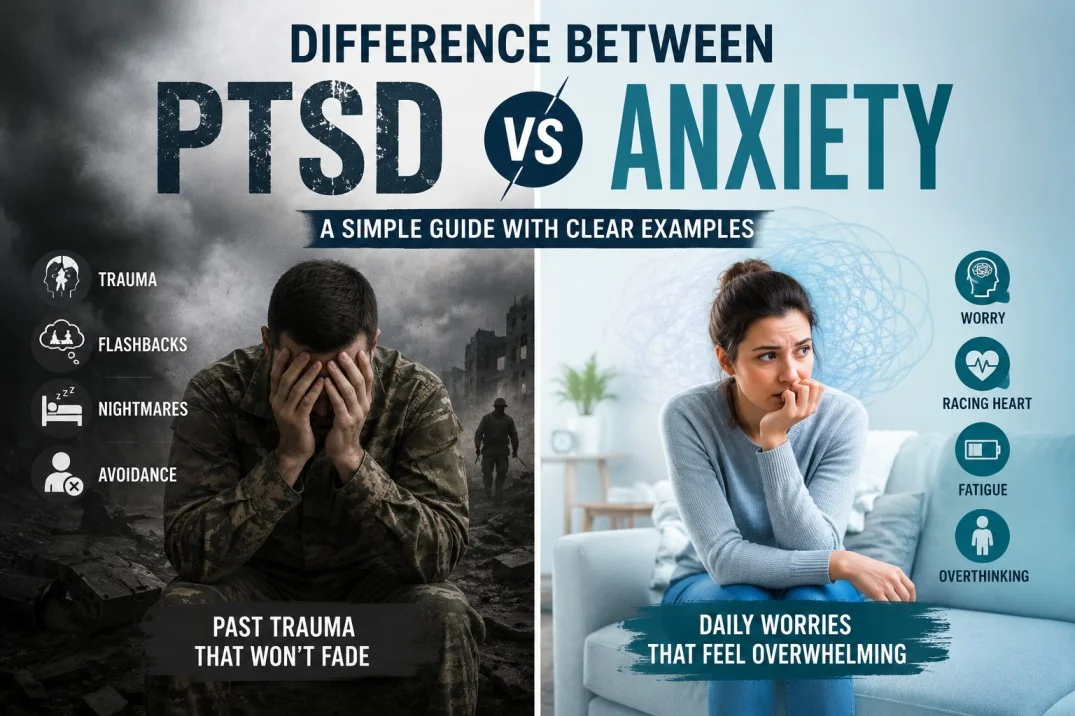
Ali started feeling nervous every time he heard loud sounds. He also could not sleep well after a bad car accident. At first, he thought it was just stress. Later, he learned there was a big difference between PTSD and anxiety. Many people face the same confusion every day.
The difference between PTSD and anxiety is important because both affect thoughts, feelings, and daily life. Still, they are not the same condition. Understanding the difference between PTSD and anxiety can help students, English learners, and everyday readers use these words correctly.
In simple words, anxiety is a strong feeling of fear or worry. PTSD usually happens after a shocking or traumatic event. This guide will explain both in very easy English with examples, tables, and real-life situations.
What is “PTSD”?
Post-Traumatic Stress Disorder, or PTSD, is a mental health condition that develops after a person sees or experiences a traumatic event. This event may include war, accidents, violence, disasters, or abuse. A person with PTSD may relive painful memories again and again.
PTSD can cause nightmares, fear, flashbacks, and emotional pain. Some people also avoid places or people that remind them of the event.
History of PTSD
The idea of PTSD has existed for many years. In the past, soldiers returning from war showed signs of fear, stress, and emotional pain. During World War I, doctors called it “shell shock.” Later, experts studied trauma more deeply. In 1980, the American Psychiatric Association officially added PTSD to its medical guide. Since then, doctors have learned more about trauma and mental health. Today, PTSD is recognized around the world as a serious condition that can affect both children and adults after painful experiences.
What is “Anxiety”?
Anxiety Disorder is a mental health condition that causes strong worry, fear, or nervous feelings. Everyone feels anxious sometimes, especially before exams or interviews. However, anxiety becomes a disorder when the fear stays for a long time and affects daily life.
People with anxiety may feel restless, tired, shaky, or unable to focus. Some may also experience panic attacks or fast heartbeat.
History of Anxiety
Anxiety has been part of human life for centuries. Ancient doctors and philosophers wrote about fear and nervous feelings long ago. In the 1800s, medical experts began studying anxiety more carefully. Over time, psychologists learned that anxiety can affect both the mind and body. Today, anxiety disorders are among the most common mental health conditions in the world. Modern treatment includes therapy, relaxation methods, and medicine. Awareness about anxiety has also grown because many people now openly talk about mental health.
PTSD vs Anxiety
PTSD is a trauma-related mental health condition, while anxiety is a general feeling of fear or worry that may or may not come from trauma.
Although they share some symptoms, they work differently. Let us now understand each one in detail.
How PTSD Works
PTSD usually starts after a deeply painful or frightening experience.
Key Features
- Happens after trauma
- Causes flashbacks and nightmares
- Makes people avoid reminders of trauma
- Can create emotional numbness
- May lead to fear and anger
Examples
🔵 She still feels scared after the earthquake and avoids crowded places.
🔵 The soldier had nightmares from his war experience.
Uses
- Mental health education
- Medical discussions
- Daily conversations about trauma
- Counseling and therapy settings
- School psychology lessons
How Anxiety Works
Anxiety creates strong fear, worry, or stress, even during normal situations.
Key Features
- Causes excessive worry
- May happen without trauma
- Includes nervousness and panic
- Can affect sleep and focus
- Often linked to stress
Examples
🟢 He feels anxious before every exam.
🟢 Sara’s anxiety makes it hard for her to speak in public.
Uses
- School and education
- Workplace discussions
- Health and wellness topics
- Everyday emotional conversations
- Therapy and self-help programs
Which one should you use?
Use “PTSD” when talking about trauma after a shocking event. Use “anxiety” when discussing general fear, worry, or stress. PTSD is more specific, while anxiety is broader and more common in daily life.
10 Differences Between PTSD and Anxiety
1. Cause
PTSD: Usually caused by trauma.
🔴 He developed PTSD after the accident.
🔴 The fire left her emotionally damaged.
Anxiety: Often caused by stress or worry.
🔴 Exams increase his anxiety.
🔴 She feels anxious about money problems.
2. Flashbacks
PTSD: Flashbacks are common.
🔴 He relives the painful event often.
🔴 Loud sounds trigger old memories.
Anxiety: Flashbacks are rare.
🔴 She worries about the future instead.
🔴 Anxiety makes him overthink daily tasks.
3. Triggers
PTSD: Trauma reminders trigger symptoms.
🔴 The hospital reminded her of the accident.
🔴 War movies upset the veteran.
Anxiety: Everyday stress triggers symptoms.
🔴 Crowds make him nervous.
🔴 Work pressure increases her anxiety.
4. Nightmares
PTSD: Trauma nightmares are common.
🔴 He wakes up screaming at night.
🔴 Bad dreams disturb her sleep.
Anxiety: Sleep problems may happen too.
🔴 She cannot sleep before meetings.
🔴 Anxiety keeps him awake.
5. Emotional Response
PTSD: Often causes emotional numbness.
🔴 He feels disconnected from people.
🔴 She avoids emotional talks.
Anxiety: Causes fear and nervousness.
🔴 He worries constantly.
🔴 She feels tense all day.
6. Memory Impact
PTSD: Painful memories return often.
🔴 He remembers every detail of the crash.
🔴 The smell triggered old memories.
Anxiety: Focuses more on future fears.
🔴 She fears failing exams.
🔴 He worries about tomorrow.
7. Avoidance
PTSD: People avoid trauma reminders.
🔴 She stopped driving after the accident.
🔴 He avoids crowded streets.
Anxiety: Avoidance comes from fear or stress.
🔴 He avoids public speaking.
🔴 She dislikes interviews.
8. Physical Symptoms
PTSD: Includes panic and shock reactions.
🔴 Sudden sounds scare him badly.
🔴 She shakes during flashbacks.
Anxiety: Includes rapid heartbeat and sweating.
🔴 Anxiety made her hands cold.
🔴 He breathes fast during stress.
9. Duration
PTSD: May last months or years after trauma.
🔴 The trauma affected him for years.
🔴 She still struggles after the event.
Anxiety: Can come and go.
🔴 Stress increased his anxiety this week.
🔴 She felt calm after rest.
10. Treatment
PTSD: Often needs trauma-focused therapy.
🔴 Counseling helped him recover slowly.
🔴 Therapy reduced her flashbacks.
Anxiety: Managed with relaxation and support.
🔴 Meditation helped her anxiety.
🔴 Exercise reduced his stress.
Why People Get Confused About Their Use
People often confuse PTSD and anxiety because both involve fear, stress, and emotional pain. They can also happen together. A person with PTSD may feel anxious, and a person with anxiety may feel panic or fear. Because the symptoms look similar, many people think they are the same thing. However, PTSD is linked to trauma, while anxiety can happen without a traumatic event.
Table: Difference and Similarity
| Feature | PTSD | Anxiety | Similarity |
| Main Cause | Trauma | Stress or worry | Both affect emotions |
| Flashbacks | Common | Rare | Both involve fear |
| Nightmares | Frequent | Possible | Both disturb sleep |
| Focus | Past trauma | Future worries | Both affect thinking |
| Triggers | Trauma reminders | Daily stress | Both can be triggered |
| Treatment | Trauma therapy | Stress management | Both may need therapy |
| Emotional Effect | Numbness | Nervousness | Both affect mood |
Which is Better in What Situation?
PTSD is the correct word when discussing mental health after a shocking event like war, abuse, or accidents. It explains trauma-related emotional pain clearly and accurately.
Anxiety is better for everyday fear, nervousness, or stress. It fits common situations like exams, interviews, work pressure, or social fear. It is also more common in daily conversation.
How Are “PTSD” and “Anxiety” Used in Metaphors and Similes?
🟣 “His PTSD was like a shadow following him everywhere.”
🟣 “Her anxiety felt like a storm inside her mind.”
🟣 “The fear hit him like lightning after the accident.”
🟣 “Anxiety wrapped around her like a tight rope.”
Connotative Meaning
PTSD: Mostly negative and serious.
🟣 “The movie showed the painful side of PTSD.”
🟣 “PTSD changed his daily life.”
Anxiety: Usually negative but sometimes neutral.
🟣 “A little anxiety before exams is normal.”
🟣 “Her anxiety became worse during stress.”
Idioms or Proverbs
🟣 “On edge” — feeling nervous or anxious.
Example: “He was on edge before the interview.”
🟣 “Scared stiff” — extremely frightened.
Example: “The loud explosion scared her stiff.”
🟣 “Fight or flight” — reacting quickly to danger.
Example: “His body went into fight or flight mode.”
Works in Literature
🟣 The Things They Carried — The Things They Carried by Tim O’Brien (1990)
🟣 Mrs Dalloway — Mrs Dalloway by Virginia Woolf (1925)
🟣 Speak — Speak by Laurie Halse Anderson (1999)
Movies Related to the Keywords
🟣 American Sniper — 2014, United States
🟣 The Perks of Being a Wallflower — 2012, United States
🟣 Silver Linings Playbook — 2012, United States
Frequently Asked Questions
1. Is PTSD the same as anxiety?
No. PTSD comes after trauma, while anxiety is general fear or worry.
2. Can PTSD cause anxiety?
Yes. Many people with PTSD also experience anxiety.
3. Is anxiety always bad?
No. Small amounts of anxiety can help people stay alert and careful.
4. Can children have PTSD?
Yes. Children can develop PTSD after traumatic events.
5. Which is more common, PTSD or anxiety?
Anxiety is more common in everyday life.
Final Words
Mental health words can feel confusing at first. Still, learning them step by step makes understanding easier. PTSD and anxiety both affect emotions, but they come from different causes. Knowing the right meaning helps people communicate better and show more care toward others.
Conclusion
The difference between PTSD and anxiety becomes clearer when we look at their causes, symptoms, and daily effects. PTSD usually develops after trauma, while anxiety is linked to fear, stress, or worry. Both can affect sleep, emotions, and daily activities, but they are not identical. Understanding these terms helps students, English learners, and readers use them correctly in speaking and writing. Simple knowledge about mental health also builds empathy and awareness. By learning these differences, people can communicate more clearly and better understand what others may be experiencing emotionally.

Hi! I am Arshad Ullah presently working as linguist in Punjab Education Department. I have done MA in English Literature while M.Phil in Applied Linguistics. I have taught creative writing to the post graduation classes for 15 years. Presently I am working as content writer, and offering classes for blog writing. On this site, I research each topic from authoritative sources and edit every comparison for accuracy and clear, simple language.









1 thought on “Difference Between PTSD and Anxiety — Simple Guide 2026”