Jake started a new job at a car repair shop. On his first day, he saw two workers wearing different clothes. One wore a full-body suit. The other wore pants with shoulder straps. Jake asked, “What is the difference between coveralls and overalls?”
Many people ask this question. The difference between coveralls and overalls can confuse beginners because both are work clothes. They also sound alike. However, they are not the same.
Learning the difference between coveralls and overalls is useful for workers, students, and English learners. It helps you choose the right clothing for work, safety, and comfort. In this guide, you will learn simple meanings, examples, and key differences in very easy English.
What is “Coveralls”?
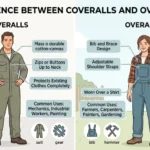
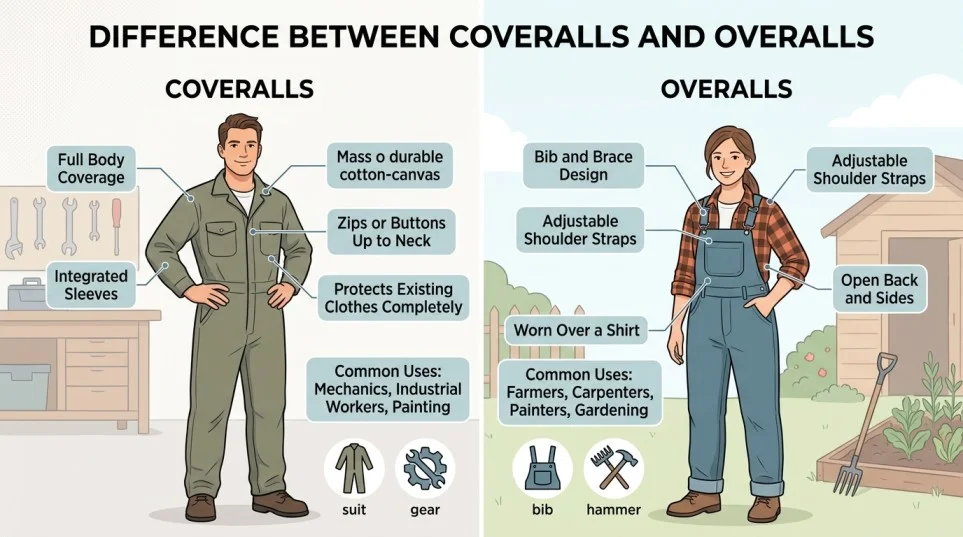
Coveralls are one-piece work clothes. They cover the whole body, including the arms and legs. Workers wear them to protect their clothes and skin from dirt, oil, paint, or chemicals.
Coveralls usually have long sleeves and a front zipper. Mechanics, factory workers, and painters often wear them.
History of Coveralls
Coveralls became popular in the early 1900s during the industrial age. Factory workers needed strong clothing for hard jobs. Companies made one-piece suits to keep workers safe and clean. During World War II, pilots and military workers also used coveralls. Later, many industries started using them because they were easy to wear and protective. Today, coveralls are common in factories, farms, workshops, and laboratories around the world.
What is “Overalls”?
Overalls are pants with a front bib and shoulder straps. They usually do not cover the arms. People wear them over a shirt.
Farmers, painters, and construction workers often use overalls because they are comfortable and easy to move in.
History of Overalls
Overalls first appeared in the 1700s and became famous in the 1800s in America. Farmers and railroad workers needed strong clothing for outdoor work. Denim overalls became very popular because they lasted a long time. Many workers liked the large pockets and loose fit. Over time, overalls also became a fashion item. Today, people wear them for work, gardening, and casual style.
Coveralls vs Overalls
Coveralls are full-body protective suits. Overalls are protective pants with straps.
Now, let’s explore the main differences in simple detail.
How “Coveralls” Works
Key Features
- One-piece clothing
- Covers arms and legs
- Often has a zipper
- Gives full-body protection
- Used in dirty or dangerous jobs
Example Sentences
🔵 The mechanic wore coveralls to protect his clothes from oil.
🔵 She used white coveralls while painting the walls.
Uses
- Factory work
- Car repair
- Painting
- Chemical labs
- Industrial jobs
How “Overalls” Works
Key Features
- Two shoulder straps
- Open sides near the arms
- Worn over shirts
- Comfortable and loose
- Often made from denim
Example Sentences
🟢 The farmer wore blue overalls in the field.
🟢 My little brother likes wearing denim overalls.
Uses
- Farming
- Gardening
- Construction work
- Casual fashion
- Home painting
Which One Should You Use?
Use coveralls when you need full protection from dirt, chemicals, or dust. They are best for risky jobs.
Use overalls when you want comfort and freedom to move. They are great for outdoor work and casual wear.
10 Differences Between Coveralls and Overalls
1. Body Coverage
Coveralls: Cover the full body, including arms and legs.
🔴 He wore coveralls while welding metal.
🔴 The cleaner used coveralls in the factory.
Overalls: Cover only the lower body and chest.
🔴 She wore overalls while gardening.
🔴 The child played outside in overalls.
2. Sleeves
Coveralls: Usually have long sleeves.
🔴 The worker zipped his sleeves tightly.
🔴 Her coveralls protected her arms.
Overalls: Usually sleeveless.
🔴 He wore a T-shirt under his overalls.
🔴 The straps rested on her shoulders.
3. Protection Level
Coveralls: Give higher protection.
🔴 Painters use coveralls to avoid stains.
🔴 Fire-safe coveralls protect workers.
Overalls: Give light protection.
🔴 Farmers use overalls for comfort.
🔴 Gardeners wear overalls outdoors.
4. Design
Coveralls: One-piece design.
🔴 The zipper closed the whole suit.
🔴 His coveralls fit like a jumpsuit.
Overalls: Two-piece style with straps.
🔴 The straps crossed on the back.
🔴 Her overalls had large pockets.
5. Comfort
Coveralls: Can feel warm and tight.
🔴 Workers wear them in cold weather.
🔴 Heavy coveralls protect from sparks.
Overalls: Feel loose and airy.
🔴 He moved easily in overalls.
🔴 Denim overalls are comfortable.
6. Common Jobs
Coveralls: Used in factories and repair shops.
🔴 Mechanics often wear coveralls.
🔴 Painters use white coveralls.
Overalls: Used in farming and gardening.
🔴 Farmers wear overalls daily.
🔴 Garden workers like loose overalls.
7. Material
Coveralls: Often made from thick protective fabric.
🔴 Flame-resistant coveralls save workers.
🔴 Chemical-proof coveralls are common in labs.
Overalls: Often made from denim or cotton.
🔴 Blue denim overalls are popular.
🔴 Cotton overalls feel soft.
8. Fashion Use
Coveralls: Mostly workwear.
🔴 The company gave workers matching coveralls.
🔴 Safety coveralls are not very stylish.
Overalls: Also used in fashion.
🔴 Teenagers wear stylish overalls today.
🔴 Fashion brands sell colorful overalls.
9. Ease of Wearing
Coveralls: Take more time to wear.
🔴 He zipped up his coveralls carefully.
🔴 Workers change into coveralls before work.
Overalls: Easy to wear quickly.
🔴 She wore overalls over her shirt.
🔴 Kids can wear overalls easily.
10. Main Purpose
Coveralls: Mainly for safety and protection.
🔴 The worker stayed clean in coveralls.
🔴 Coveralls blocked chemical spills.
Overalls: Mainly for comfort and simple protection.
🔴 He wore overalls while planting seeds.
🔴 Overalls kept her clothes clean.
Why People Get Confused About Their Use
People get confused because the words sound similar. Both are work clothes. Both protect normal clothing from dirt. Also, some people use the names incorrectly in daily speech. However, coveralls are full-body suits, while overalls are strap pants worn over clothes.
Table: Difference and Similarity
| Feature | Coveralls | Overalls | Similarity |
| Design | One-piece suit | Pants with straps | Both are workwear |
| Sleeves | Long sleeves | No sleeves | Both protect clothes |
| Protection | Full-body | Partial-body | Used in work jobs |
| Comfort | More protective | More flexible | Durable clothing |
| Common Users | Mechanics, painters | Farmers, gardeners | Used outdoors |
| Fashion Use | Rare | Common | Practical clothing |
Which is Better in What Situation?
Coveralls are better for dangerous or dirty jobs. They protect the full body from dust, oil, paint, and chemicals. Mechanics, factory workers, and welders often choose coveralls for safety.
Overalls are better for light work and comfort. Farmers, gardeners, and painters use them because they are easy to wear and allow free movement. Many people also wear overalls as fashion clothing today.
How Are “Coveralls” and “Overalls” Used in Metaphors and Similes?
🟣 “He wore stress like heavy coveralls.” — means carrying emotional weight.
🟣 “She felt as comfortable as old overalls.” — means feeling relaxed and natural.
🟣 “The team covered mistakes like protective coveralls.” — means hiding problems.
Connotative Meaning
Coveralls
- Usually show hard work, safety, and industry.
🟣 “The coveralls showed he worked long hours.”
Overalls
- Often show comfort, farming life, and simplicity.
🟣 “Her overalls gave her a friendly country look.”
Idioms or Proverbs
🟣 “Roll up your sleeves.”
Meaning: Get ready to work hard.
Example: “The workers rolled up their sleeves before fixing the truck.”
🟣 “Dirty work.”
Meaning: Hard or unpleasant work.
Example: “Cleaning the factory was dirty work.”
Works in Literature
🟣 The Grapes of Wrath — The Grapes of Wrath by John Steinbeck (1939) shows farmers wearing overalls during hard times.
🟣 Of Mice and Men — Of Mice and Men by John Steinbeck (1937) includes working-class clothing like overalls.
Movies Related to the Keywords
🟣 Modern Times (1936, USA) shows factory workers in coveralls.
🟣 The Simple Life of Noah Dearborn (1999, USA) features classic denim overalls.
Frequently Asked Questions
1. Are coveralls and overalls the same?
No. Coveralls are full-body suits, while overalls are pants with straps.
2. Which is safer?
Coveralls are safer because they cover more of the body.
3. Can overalls be fashionable?
Yes. Many people wear denim overalls as fashion clothes.
4. Who usually wears coveralls?
Mechanics, painters, and factory workers often wear coveralls.
5. Are overalls comfortable?
Yes. They are loose and easy to move in.
Final Words
Learning new vocabulary becomes easier when you understand real-life examples. Coveralls and overalls may look similar, but their purpose and design are different. Once you know the basics, you can use both words correctly and confidently.
Conclusion
The difference between coveralls and overalls is simple when you look at their design and use. Coveralls protect the whole body and are best for dangerous or dirty jobs. Overalls are more comfortable and are often used for farming, gardening, or fashion. Both are useful work clothes, but they serve different needs. By learning the difference between coveralls and overalls, you can improve your English vocabulary and choose the right clothing for the right situation.

Hi! I am Arshad Ullah presently working as linguist in Punjab Education Department. I have done MA in English Literature while M.Phil in Applied Linguistics. I have taught creative writing to the post graduation classes for 15 years. Presently I am working as content writer, and offering classes for blog writing.