Maria was baking a cake for her family. She picked up two types of sugar. One felt rough in her hand. The other felt soft and smooth. Her mother smiled and said, “One is coarse sugar, and the other is fine sugar.”
This small moment shows the difference between coarse and fine in daily life. We see these words in food, sand, fabric, hair, art, and even language. Still, many people mix them up.
Understanding the difference between coarse and fine helps students, English learners, and workers use the right word at the right time. These words are simple, but they can change the meaning of a sentence.
In this guide, you will learn their meanings, uses, examples, and much more in very easy English.
What is “Coarse”?
“Coarse” means rough, thick, or not smooth. It often describes something with large particles or a hard texture.
For example, coarse sand feels rough in your hand. Coarse cloth may scratch your skin.
History of “Coarse”
The word “coarse” comes from old French and Latin words. In the past, people used it to describe rough fabric or simple materials. Later, English speakers started using it for many things like food, language, and behavior. For example, “coarse salt” means large salt crystals, while “coarse language” means rude words. Over time, the word became common in daily English. Today, people use it in science, cooking, fashion, and normal conversation. Even farmers and builders use the word when talking about rough materials or surfaces.
What is “Fine”?
“Fine” means smooth, thin, soft, or very small in texture. It can also mean excellent or good quality.
For example, fine powder feels soft and light. Fine silk feels smooth on the skin.
History of “Fine”
The word “fine” also comes from old French and Latin roots. Long ago, it meant pure or high quality. Rich people used the word for expensive clothes, jewelry, and art. Later, the meaning grew wider. People began using it for small particles, smooth surfaces, and beautiful things. For example, “fine flour” means soft flour with tiny grains. “Fine art” means beautiful and skilled artwork. Today, “fine” is one of the most common English words. It is used in cooking, science, fashion, education, and everyday speech.
Coarse vs Fine
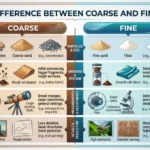
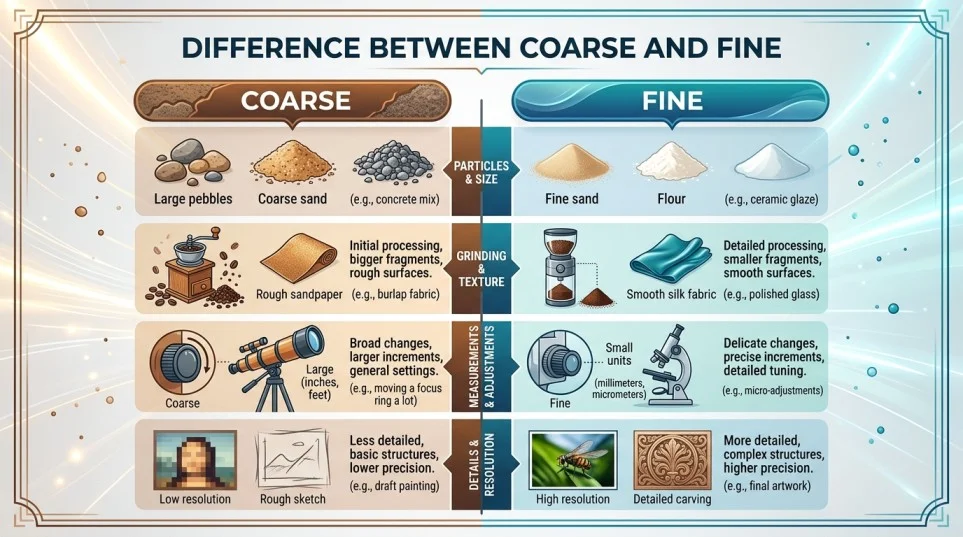
Coarse means rough or thick, while fine means smooth or small.
These two words are opposites in many situations. Now, let us look deeper into their meanings and uses.
How “Coarse” Works
Coarse describes things that are rough, large, or not smooth.
Key Features
- Rough texture
- Thick particles
- Hard feeling
- Less smooth
- Often bigger in size
Example Sentences
🔵 The wall had a coarse surface.
🔵 He used coarse salt for cooking.
Uses
- Cooking
- Building materials
- Hair texture
- Fabric description
- Speaking about rude language
How “Fine” Works
Fine describes things that are smooth, soft, thin, or small.
Key Features
- Smooth texture
- Tiny particles
- Soft feeling
- Thin and delicate
- Often high quality
Example Sentences
🟢 The artist used fine brushes.
🟢 She wore a fine silk dress.
Uses
- Art and painting
- Cooking powder or flour
- Clothing
- Jewelry
- Writing and printing
Which One Should You Use?
Use “coarse” when something feels rough or thick. Use “fine” when something feels smooth, soft, or delicate.
For example, coarse sand is rough, but fine sand is soft. Coarse hair is thick, while fine hair is thin.
10 Differences Between Coarse and Fine
1. Texture
Coarse
Coarse means rough to touch.
🔴 The rope felt coarse.
🔴 The towel had a coarse texture.
Fine
Fine means smooth to touch.
🔴 The fabric felt fine and soft.
🔴 Fine paper is smooth for writing.
2. Particle Size
Coarse
Coarse particles are large.
🔴 Coarse sugar melts slowly.
🔴 The road used coarse gravel.
Fine
Fine particles are very small.
🔴 Fine flour is soft.
🔴 Fine dust covered the table.
3. Hair Type
Coarse
Coarse hair is thick and strong.
🔴 His beard is coarse.
🔴 Coarse hair needs more care.
Fine
Fine hair is thin and soft.
🔴 Her fine hair blows easily.
🔴 Fine hair looks silky.
4. Fabric
Coarse
Coarse fabric feels rough.
🔴 The sackcloth was coarse.
🔴 Workers wore coarse clothes long ago.
Fine
Fine fabric feels soft and rich.
🔴 Fine cotton feels comfortable.
🔴 She bought fine silk curtains.
5. Language
Coarse
Coarse language sounds rude.
🔴 The movie had coarse jokes.
🔴 Teachers dislike coarse words.
Fine
Fine language sounds polite.
🔴 Her speech was fine and kind.
🔴 He used fine manners.
6. Appearance
Coarse
Coarse things may look simple.
🔴 The stone had a coarse look.
🔴 The painting looked coarse.
Fine
Fine things look detailed.
🔴 The watch had fine details.
🔴 Fine art takes skill.
7. Cooking
Coarse
Coarse food pieces are larger.
🔴 Coarse salt is crunchy.
🔴 The chef used coarse pepper.
Fine
Fine food pieces are smaller.
🔴 Fine sugar mixes quickly.
🔴 Fine spices spread evenly.
8. Quality
Coarse
Coarse may mean lower quality.
🔴 The cloth looked coarse and cheap.
🔴 Coarse paper tears easily.
Fine
Fine often means better quality.
🔴 The hotel served fine food.
🔴 She bought fine jewelry.
9. Art
Coarse
Coarse art may lack detail.
🔴 The drawing looked coarse.
🔴 Coarse lines covered the page.
Fine
Fine art has careful detail.
🔴 The museum showed fine paintings.
🔴 Fine sketches need patience.
10. Feeling
Coarse
Coarse feels hard or rough.
🔴 The sandpaper was coarse.
🔴 His hands felt coarse after work.
Fine
Fine feels soft and light.
🔴 The powder was fine and soft.
🔴 Fine sand slipped through her fingers.
Why People Get Confused About Their Use
People get confused because both words describe texture, quality, or size. Sometimes they are used in physical ways, and sometimes in emotional or social ways. For example, “fine” can mean smooth, but it can also mean excellent. “Coarse” can mean rough, but it can also describe rude speech. This makes learners unsure about the correct meaning.
Table: Difference and Similarity
| Feature | Coarse | Fine | Similarity |
| Texture | Rough | Smooth | Both describe touch |
| Size | Large particles | Small particles | Both describe material |
| Hair | Thick | Thin | Both describe hair |
| Fabric | Hard and rough | Soft and smooth | Both describe cloth |
| Language | Rude | Polite | Both describe speech |
| Cooking | Large grains | Tiny grains | Both used in food |
| Quality | Simple | High quality | Both compare standards |
Which is Better in What Situation?
Coarse is better when you need strong texture or grip. Builders use coarse sand in construction. Cooks use coarse salt for some recipes. Thick hair and rough materials are also called coarse.
Fine is better when you need softness or detail. Artists use fine brushes for painting. Fine powder mixes easily in cooking. Fine fabric feels more comfortable and elegant.
How Are “Coarse” and “Fine” Used in Metaphors and Similes?
🟣 “His voice was as coarse as sandpaper.”
🟣 “Her skin felt as fine as silk.”
🟣 “The speech moved from coarse anger to fine wisdom.”
🟣 “Fine ideas can grow from coarse beginnings.”
Connotative Meaning
Coarse
Usually negative or neutral.
🟣 “He used coarse language.”
🟣 “The cloth felt coarse.”
Fine
Usually positive.
🟣 “She wore fine jewelry.”
🟣 “He did a fine job.”
Idioms or Proverbs
🟣 Fine line — a very small difference
Example: There is a fine line between joking and hurting someone.
🟣 Fine feathers make fine birds — good clothes improve appearance
Example: He dressed well because he believed fine feathers make fine birds.
🟣 Coarse manners — rude behavior
Example: People disliked his coarse manners.
Works in Literature
🟣 Great Expectations by Charles Dickens (1861) uses “fine” to describe high society.
🟣 The Grapes of Wrath by John Steinbeck (1939) describes coarse working conditions.
🟣 Pride and Prejudice by Jane Austen (1813) uses “fine” for beauty and manners.
Movies Related to the Keywords
🟣 A Fine Madness — 1966, United States
🟣 Fine Dead Girls — 2002, Croatia
🟣 Coarse Salt — 2008, Italy
Frequently Asked Questions
1. What is the main difference between coarse and fine?
Coarse means rough or thick. Fine means smooth or thin.
2. Is coarse always bad?
No. Sometimes coarse materials are useful and strong.
3. Can fine mean excellent?
Yes. “Fine” can also mean very good.
4. What is coarse hair?
Coarse hair is thick and rough.
5. What is fine sand?
Fine sand has very tiny and soft grains.
Final Words
Learning simple word pairs can improve your English quickly. “Coarse” and “fine” are easy words, but they have many uses in daily life. Practice them with real examples around you. Soon, you will use them naturally and confidently.
Conclusion
The difference between coarse and fine is mainly about texture, size, and quality. Coarse things are rough, thick, or large, while fine things are smooth, thin, or delicate. These words are common in cooking, clothing, art, language, and daily conversation. By learning the meanings, examples, and uses in this guide, English learners can avoid confusion and speak more clearly. Keep practicing with simple objects around you, like sand, sugar, cloth, or hair. The more you use these words, the easier they become. Understanding the difference between coarse and fine will help you improve both your vocabulary and communication skills.

Hi! I am Arshad Ullah presently working as linguist in Punjab Education Department. I have done MA in English Literature while M.Phil in Applied Linguistics. I have taught creative writing to the post graduation classes for 15 years. Presently I am working as content writer, and offering classes for blog writing.