Last night, I called my friends for dinner. I asked, “Is everyone here?” Then someone said, “Yes, everybody is ready!” Both sounded right. But are they the same? This is where many learners get confused.
The difference between everyone and everybody is very small. Still, knowing it helps you speak better. In daily life, we use these words all the time. So it is important to understand the difference between everyone and everybody clearly.
In this guide, you will learn simple meanings, examples, and real uses. This will help you use both words with confidence.
What is “everyone”?
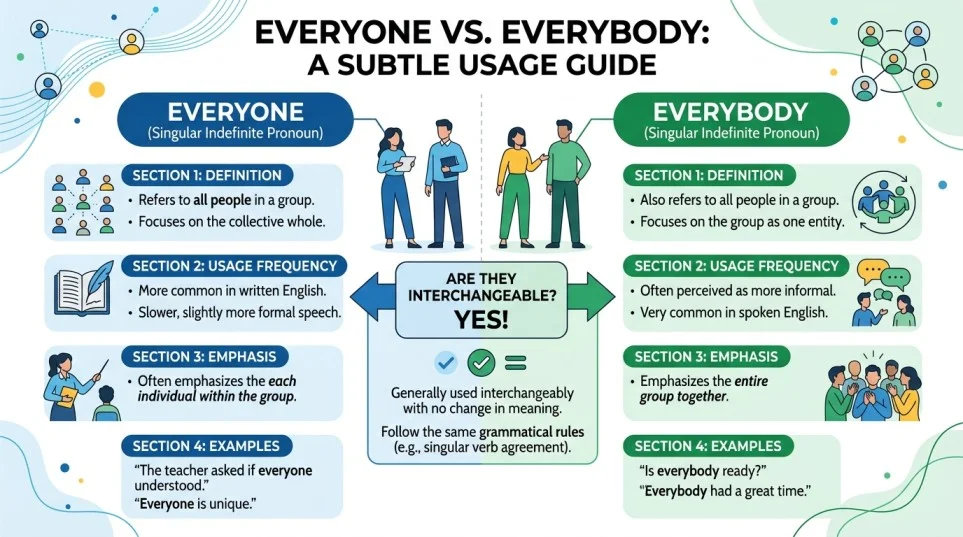
Everyone means all people in a group. It talks about every single person together.
History of “everyone”:
The word “everyone” comes from two parts: “every” and “one.” In early English, people used “every one” as two words. Over time, it became one word. In Middle English, it meant each person in a group. Today, it is common in both formal and informal English. It is often used in writing, speeches, and polite talk. It sounds slightly more formal than “everybody,” but both are correct.
What is “everybody”?
Everybody also means all people in a group. It has the same basic meaning as “everyone.”
History of “everybody”:
The word “everybody” comes from “every” and “body.” In old English use, “body” meant a person. So “everybody” meant every person. It became popular in spoken English. Over time, it became more casual and friendly. Today, it is widely used in daily conversation, songs, and informal speech. It feels more relaxed than “everyone,” but both words mean the same thing.
Everyone vs Everybody
Everyone: all people (slightly formal)
Everybody: all people (more casual)
Now, let’s explore how they work in real life.
How “Everyone” Works
Key Features:
- Refers to all people in a group
- Slightly formal tone
- Used in writing and polite speech
Examples:
🔵 Everyone enjoyed the movie.
🔵 Everyone must follow the rules.
Uses:
- School writing
- Office communication
- Public speaking
How “Everybody” Works
Key Features:
- Refers to all people
- More casual and friendly
- Common in speech
Examples:
🟢 Everybody is dancing at the party.
🟢 Everybody loves ice cream.
Uses:
- Daily conversation
- Friendly chats
- Songs and stories
Which one should you use?
Use everyone in formal situations. Use everybody in casual talk. Both are correct and natural.
10 Differences Between Everyone and Everybody
1. Formality
Everyone: more formal
🔴 Everyone is present today.
🔴 Everyone should listen carefully.
Everybody: more casual
🔴 Everybody is here.
🔴 Everybody is happy.
2. Tone
Everyone: polite tone
🔴 Everyone is invited.
🔴 Everyone agrees.
Everybody: friendly tone
🔴 Everybody is excited.
🔴 Everybody laughed.
3. Writing Style
Everyone: used in formal writing
🔴 Everyone must submit work.
🔴 Everyone followed instructions.
Everybody: used in informal writing
🔴 Everybody had fun.
🔴 Everybody joined in.
4. Spoken English
Everyone: less common in casual talk
🔴 Everyone is coming.
🔴 Everyone knows that.
Everybody: very common in speech
🔴 Everybody is coming.
🔴 Everybody knows that.
5. Sound and Feel
Everyone: slightly serious
🔴 Everyone stayed quiet.
🔴 Everyone listened.
Everybody: light and fun
🔴 Everybody cheered.
🔴 Everybody danced.
6. Use in Speeches
Everyone: preferred
🔴 Everyone deserves respect.
🔴 Everyone has rights.
Everybody: less formal
🔴 Everybody deserves love.
🔴 Everybody matters.
7. Emotional Effect
Everyone: calm
🔴 Everyone remained calm.
🔴 Everyone understood.
Everybody: lively
🔴 Everybody laughed loudly.
🔴 Everybody shouted.
8. Popular Use
Everyone: common in books
🔴 Everyone agreed with him.
🔴 Everyone followed the plan.
Everybody: common in songs
🔴 Everybody sing along!
🔴 Everybody clap your hands!
9. Grammar Use
Everyone: singular pronoun
🔴 Everyone is ready.
🔴 Everyone has a ticket.
Everybody: also singular
🔴 Everybody is ready.
🔴 Everybody has a ticket.
10. Meaning
Everyone: all people
🔴 Everyone passed the test.
🔴 Everyone was happy.
Everybody: all people
🔴 Everybody passed the test.
🔴 Everybody was happy.
Why People Get Confused About Their Use
People get confused because both words have the same meaning. They can replace each other in most sentences. The only real difference is tone and style.
Table: Difference and Similarity
| Feature | Everyone | Everybody | Similarity |
| Meaning | All people | All people | Same meaning |
| Tone | Formal | Casual | Both friendly |
| Use | Writing | Speaking | Both common |
| Grammar | Singular | Singular | Same rule |
| Context | Formal | Informal | Both flexible |
Which is Better in What Situation?
Everyone:
Use “everyone” in school, office, or formal writing. It sounds polite and clear. It is best for speeches and official messages.
Everybody:
Use “everybody” in daily talk. It feels natural and friendly. It is great for chatting, storytelling, and fun moments.
How Are “Everyone” and “Everybody” Used in Metaphors and Similes?
🟣 Everyone is like stars in the sky (each person matters)
🟣 Everybody joined like waves in the sea (togetherness)
Connotative Meaning
- Positive: unity, togetherness
🟣 Everyone worked as a team.
🟣 Everybody helped each other. - Negative: pressure, generalization
🟣 Everyone is watching you.
🟣 Everybody is judging him. - Neutral: simple group meaning
🟣 Everyone is here.
🟣 Everybody is ready.
Idioms or Proverbs
🟣 “Everyone has their day” (everyone gets a chance)
Example: Everyone has their day, so keep trying.
🟣 “Everybody knows” (common knowledge)
Example: Everybody knows the answer.
Works in Literature
🟣 An Inspector Calls — J.B. Priestley (1945)
🟣 Our Town — Thornton Wilder (1938)
Movies Related to the Keywords
🟣 Everybody’s Fine (2009, USA)
🟣 Everyone Says I Love You (1996, USA)
Frequently Asked Questions
1. Are everyone and everybody the same?
Yes, both mean all people.
2. Which is more formal?
Everyone is more formal.
3. Can I use them in writing?
Yes, both are correct.
4. Are they singular or plural?
They are singular.
5. Which is more common in speech?
Everybody is more common.
Final Words
Learning small differences like this makes your English better. Keep practicing daily. Try using both words in sentences.
Conclusion
Now you clearly understand the difference between everyone and everybody. Both words mean the same, but their tone is slightly different. “Everyone” sounds more formal, while “everybody” feels more casual.
Learning this difference between everyone and everybody helps you speak and write with more confidence. It also helps you choose the right word for the right situation. Keep practicing these simple words in daily life. Over time, your English will become natural and strong.

Hi! I am Arshad Ullah presently working as linguist in Punjab Education Department. I have done MA in English Literature while M.Phil in Applied Linguistics. I have taught creative writing to the post graduation classes for 15 years. Presently I am working as content writer, and offering classes for blog writing.