One day, a child saw a dog crying when its owner left. The child said, “The dog feels sad.” Later, the same child solved a puzzle and said, “I used my brain.” This shows two ideas: feeling and thinking. That is the difference between sentience and sapience. Many people mix them up. But they are not the same.
The difference between sentience and sapience helps us understand animals, humans, and even robots. It also helps in study, science, and daily talk.
So, let’s learn both in a very simple way.
What is “Sentience”?
Sentience means the ability to feel.
It includes emotions like pain, joy, fear, and love.
What is “Sapience”?
Sapience means the ability to think wisely.
It includes reasoning, logic, and deep understanding.
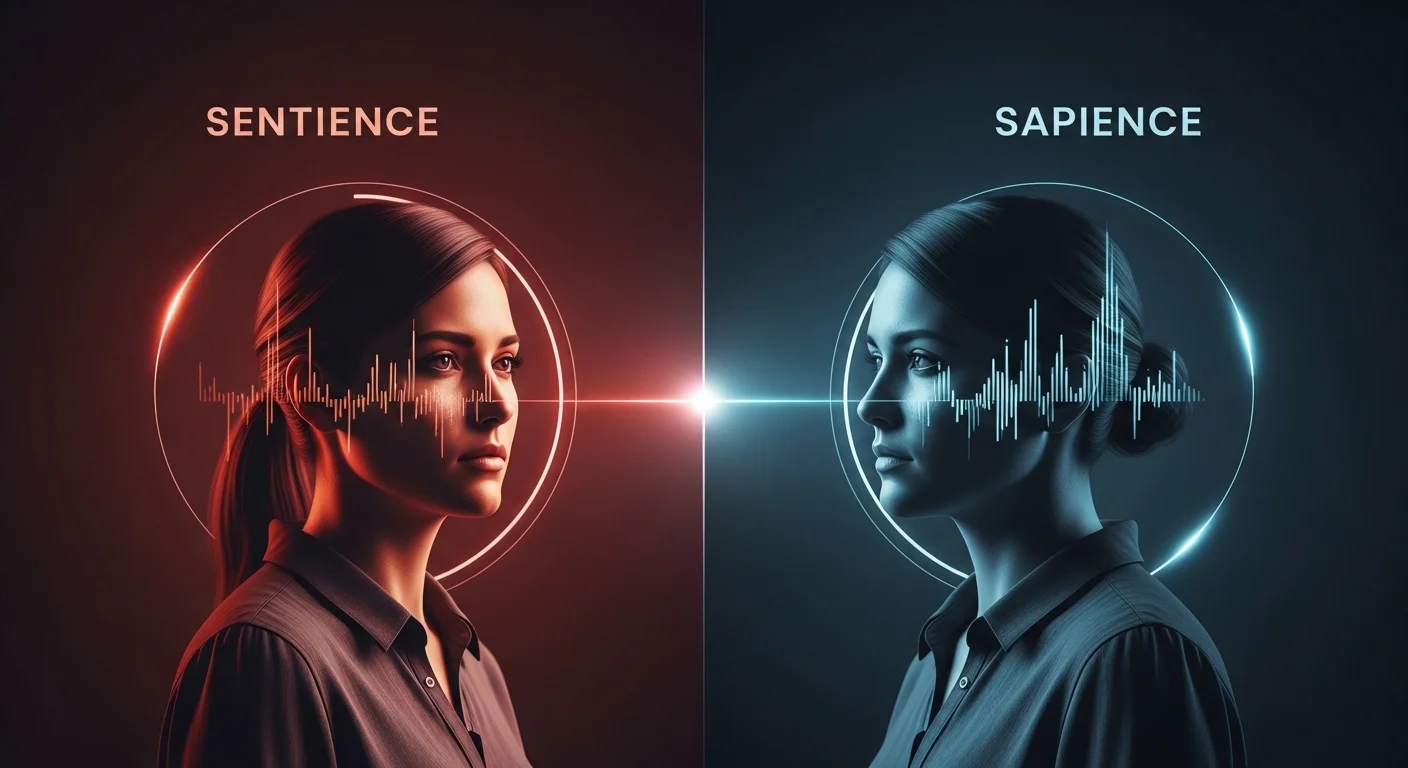
Sentience vs Sapience
Sentience = feeling emotions
Sapience = thinking with wisdom
Now, let’s explore how they work in real life.
How “Sentience” Works
Key Features:
- Ability to feel pain and pleasure
- Emotional response to events
- Seen in humans and animals
- Linked to senses and feelings
🔵 The cat felt scared during the storm.
🔵 She felt happy when she saw her friend.
Uses:
- Understanding animal rights
- Emotional intelligence in daily life
- Caring for others
How “Sapience” Works
Key Features:
- Ability to think and reason
- Problem-solving skills
- Planning and decision-making
- Mostly seen in humans
🟢 He solved the math problem using logic.
🟢 She made a wise choice in her career.
Uses:
- Education and learning
- Work decisions
- Critical thinking
Which one should you use?
Use sentience when talking about feelings.
Use sapience when talking about thinking and wisdom.
10 Differences Between Sentience and Sapience
1. Basic Meaning
Sentience: ability to feel
🔴 The dog felt pain after injury.
Sapience: ability to think wisely
🔴 He made a smart plan.
2. Focus
Sentience: emotions
🔴 She felt sad after the movie.
Sapience: logic
🔴 He analyzed the situation.
3. Found In
Sentience: humans and animals
🔴 The cow felt fear.
Sapience: mostly humans
🔴 The scientist solved a problem.
4. Type of Ability
Sentience: emotional ability
🔴 The baby felt comfort.
Sapience: intellectual ability
🔴 She understood a complex idea.
5. Role in Life
Sentience: helps us feel
🔴 He felt love for his family.
Sapience: helps us decide
🔴 She chose the best option.
6. Related To
Sentience: senses
🔴 The child felt heat.
Sapience: brain thinking
🔴 He used logic in debate.
7. Development
Sentience: develops early
🔴 Babies feel pain.
Sapience: develops later
🔴 Adults make wise choices.
8. Example in Animals
Sentience: animals feel emotions
🔴 The dog felt joy.
Sapience: limited in animals
🔴 The monkey solved a simple task.
9. Use in Language
Sentience: used in emotional context
🔴 Her feelings showed sentience.
Sapience: used in intellectual context
🔴 His wisdom showed sapience.
10. Importance
Sentience: builds empathy
🔴 He cared for others’ feelings.
Sapience: builds intelligence
🔴 She made smart decisions.
Why People Get Confused About Their Use
People confuse these words because both relate to the mind. Also, both are used when talking about humans and animals. But one is about feeling, and the other is about thinking.
Table: Difference and Similarity
| Feature | Sentience | Sapience | Similarity |
| Meaning | Feeling | Thinking wisely | Both relate to mind |
| Focus | Emotions | Logic | Both involve brain |
| Found In | Humans & animals | Mostly humans | Both seen in humans |
| Function | Feel pain/joy | Solve problems | Help survival |
| Nature | Emotional | Intellectual | Both important |
Which is Better in What Situation?
Sentience:
Sentience is better when emotions matter. For example, in relationships, care, and kindness. It helps us understand others’ feelings and build strong bonds.
Sapience:
Sapience is better in decision-making. It helps in studies, work, and solving problems. It guides us to make smart and wise choices.
How Are “Sentience” and “Sapience” Used in Metaphors and Similes?
🟣 “Her heart showed sentience like a soft flower.”
🟣 “His mind worked with sapience like a sharp knife.”
Connotative Meaning
- Sentience: positive (care, empathy)
🟣 She showed deep sentience toward animals. - Sapience: positive (wisdom, intelligence)
🟣 His sapience helped him succeed.
Idioms or Proverbs
🟣 “Follow your heart” (sentience – emotions guide you)
🟣 “Think before you act” (sapience – use wisdom)
Works in Literature
🟣 Frankenstein — Mary Shelley (1818)
🟣 Animal Farm — George Orwell (1945)
Movies Related to the Keywords
🟣 Ex Machina — 2014, UK
🟣 A.I. Artificial Intelligence — 2001, USA
Frequently Asked Questions
1. What is the main difference?
Sentience is feeling. Sapience is thinking.
2. Can animals have sapience?
Some animals show basic thinking, but not full sapience.
3. Do humans have both?
Yes, humans have both feeling and thinking.
4. Which is more important?
Both are important for a balanced life.
5. Is sentience emotional intelligence?
Yes, it is closely related to emotions and empathy.
Final Words
Understanding feelings and thoughts makes life better. Learn both, and use them wisely in daily life.
Conclusion
The difference between sentience and sapience is simple but important. Sentience is about feeling emotions like joy and pain. Sapience is about thinking with wisdom and logic. Both play key roles in human life. Sentience helps us care, while sapience helps us decide. When you know this difference, you can use each word correctly. It also helps you understand people, animals, and even machines better. Keep learning and use these words with confidence.

Hi! I am Arshad Ullah presently working as linguist in Punjab Education Department. I have done MA in English Literature while M.Phil in Applied Linguistics. I have taught creative writing to the post graduation classes for 15 years. Presently I am working as content writer, and offering classes for blog writing. On this site, I research each topic from authoritative sources and edit every comparison for accuracy and clear, simple language.