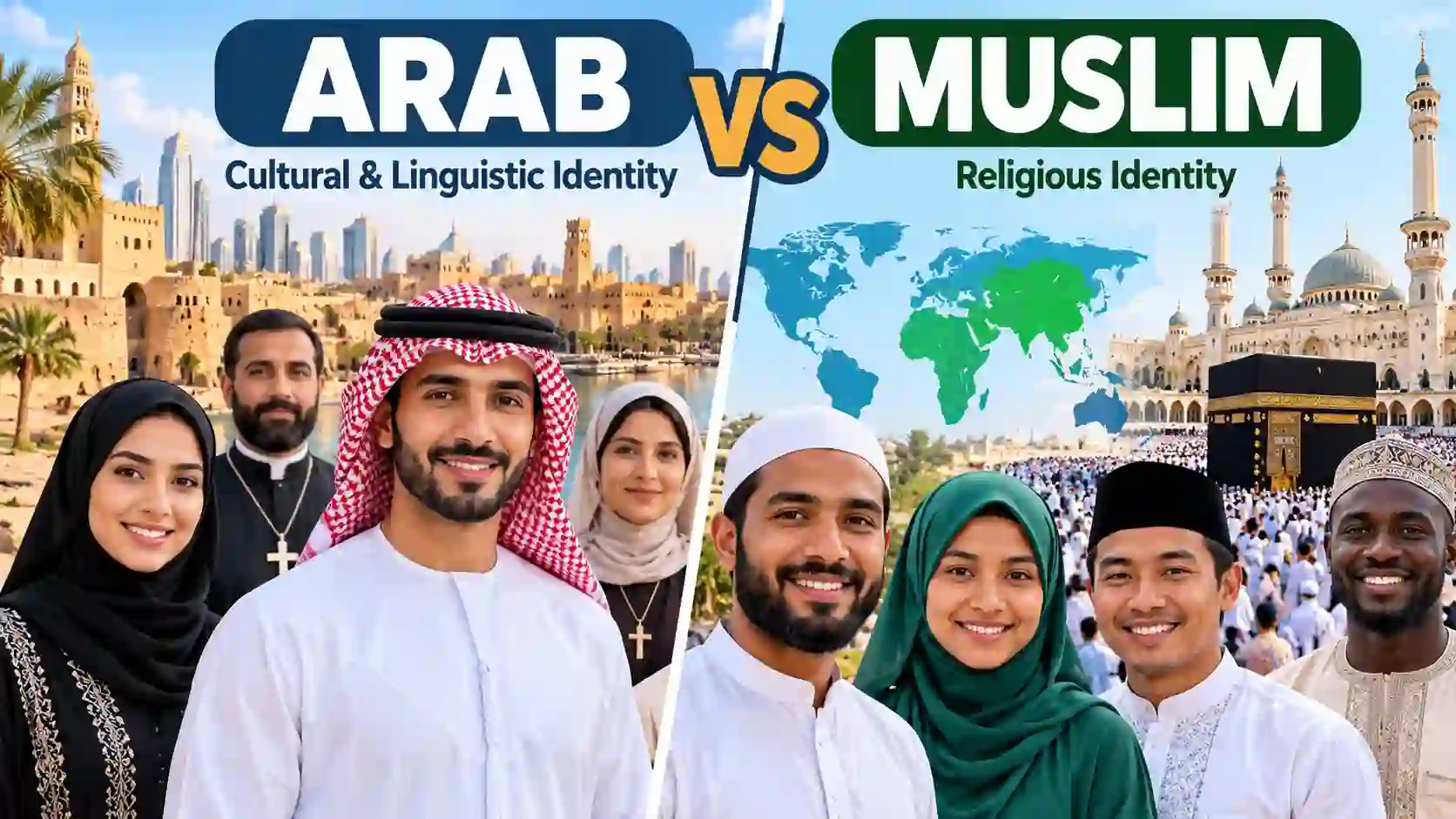
The main difference between Arab and Muslim is that Arab usually describes a cultural and linguistic identity linked to Arabic-speaking peoples, while Muslim describes a person who follows Islam. Many Arabs are Muslim, but not all Arabs are Muslim. Likewise, most Muslims are not Arabs; Muslims live across Asia, Africa, Europe, and the Americas.
| Attribute | Arab | Muslim |
| What it describes | Cultural/linguistic identity | Religious identity |
| Main connection | Arabic language and Arab culture | Islam |
| Religion required? | No | Yes, by definition |
| Language required? | Arabic is a major defining connection, but identity is broader than language alone | No |
| Geographic focus | Middle East and North Africa, broadly | Worldwide |
| Can a person be both? | Yes | Yes |
| Can a person be Arab but not Muslim? | Yes | — |
| Can a person be Muslim but not Arab? | — | Yes |
Introduction
The words Arab and Muslim are often confused because they overlap in many countries. But they describe two different things.
Arab is mainly connected with language, culture, history, and identity. Muslim is connected with religion.
This means a person can be Arab, Muslim, both, or neither. Britannica notes that Arabs today are not exclusively Muslim and that Arab communities include people from different religious backgrounds.
What Is an Arab?
An Arab is generally a person who belongs to the Arabic-speaking cultural world and identifies with Arab culture and heritage.
Arabic is the main language that connects Arab communities across a large region. The Arab world extends across parts of the Middle East and North Africa. Britannica describes modern Arabs as Arabic-speaking peoples living across a broad area from North Africa to Iraq and the Arabian Peninsula.
Main Characteristics of Arabs
- Arabic is an important part of Arab identity.
- Arab communities are found in the Middle East and North Africa.
- Arab culture includes many different local traditions.
- Arabs do not all have the same religious beliefs.
- Most Arabs are Muslim, but some Arabs are Christian or follow other religions.
The Arab League currently has 22 member states, showing the broad geographic and political scope of the Arab world.
What Is a Muslim?
A Muslim is a person who follows Islam.
Muslim identity is therefore religious, not a language or ethnic identity. Islam began in the Arabian Peninsula in the 7th century and later spread across many parts of the world. Today, Muslims live on every inhabited continent.
Main Characteristics of Muslims
- Muslims follow Islam.
- Muslims believe in one God and accept Muhammad as God’s Prophet.
- Muslims may speak many different languages.
- Muslims come from many ethnic and cultural backgrounds.
- Muslims live in Asia, Africa, the Middle East, Europe, and the Americas.
Pew Research Center’s 2025 analysis estimated about 2.0 billion Muslims worldwide in 2020, representing about 26% of the world’s population.
Core Difference Between Arab and Muslim
Difference 1: Culture vs. Religion
This is the most important difference.
Arab refers mainly to a cultural and linguistic identity.
Muslim refers to a religious identity.
For example:
- An Arab Christian is Arab but not Muslim.
- A Pakistani Muslim is Muslim but not Arab.
- An Egyptian Muslim can be both Arab and Muslim.
This is why the two terms should not be treated as synonyms.
Difference 2: Language
Arabic has a central role in Arab identity.
A Muslim does not need to speak Arabic.
Muslims around the world speak languages such as:
- Indonesian
- Urdu
- Bengali
- Turkish
- Persian
- English
- Hausa
- French
Pew’s global research shows that Muslims are spread across many regions, with the largest share living in the Asia-Pacific region rather than the Arab world.
Difference 3: Geography
Arab identity is strongly connected with the Arab world, which includes countries across North Africa and the Middle East.
Muslim identity has no single geographic region.
For example, Indonesia, Pakistan, India, Bangladesh, and Nigeria have some of the world’s largest Muslim populations, even though these countries are not Arab countries.
Difference 4: Religion
Being Arab does not automatically mean being Muslim.
Most Arabs are Muslim, but Arab communities also include Christians and other religious groups.
Being Muslim, however, specifically means belonging to the religion of Islam.
Difference 5: Ethnic and Cultural Background
Arab identity is not best understood as one single biological “race.” Modern Arab populations have diverse ancestral and cultural backgrounds. A scholarly review describes Arabs as a broad panethnic population with different ancestral origins, religious backgrounds, and historical identities.
Muslims are even more diverse because Islam is a worldwide religion.
Similarities
What Arabs and Muslims Have in Common
There is significant overlap between the two groups.
- Many Arabs are Muslims.
- Arabic has an important place in Islamic history.
- The Qur’an is written in Arabic.
- Islam began in the Arabian Peninsula.
- Many important Islamic sites are located in the Arab world.
However, this overlap does not make Arab and Muslim the same thing.
Practical Examples
Consider these examples:
Example 1: Arab Muslim
A person from Saudi Arabia who identifies with Arab culture and follows Islam can be both Arab and Muslim.
Example 2: Arab Christian
An Arabic-speaking Christian from Lebanon can be Arab but not Muslim.
Example 3: Pakistani Muslim
A Muslim from Pakistan can be Muslim but not Arab.
Example 4: Indonesian Muslim
An Indonesian who follows Islam is Muslim, but Indonesian identity is not Arab identity.
These examples show why religion and cultural identity should be kept separate.
Common Misconceptions
Misconception 1: All Arabs Are Muslim
False.
Most Arabs are Muslim, but not every Arab follows Islam. Arab communities also include Christians and other religious groups.
Misconception 2: All Muslims Are Arab
False.
Most Muslims are not Arab. Muslims form a worldwide religious community, and a large share of the global Muslim population lives in Asia.
Misconception 3: Arabic Is the Language of Every Muslim
False.
Arabic has special importance in Islam, but Muslims around the world speak many different languages.
Misconception 4: Arab and Middle Eastern Mean Exactly the Same Thing
False.
The terms overlap, but they are not identical. The Middle East contains people and communities with different languages, cultures, religions, and identities.
Are Arab and Muslim Interchangeable?
No.
They should not normally be used interchangeably.
Use Arab when discussing Arab language, culture, identity, or Arab societies.
Use Muslim when discussing people who follow Islam.
For example:
- Arab culture is correct when talking about Arab cultural traditions.
- Muslim culture can be correct when discussing cultural traditions shaped by Islam, but it covers a much wider and more diverse population.
- Arab Muslims refers specifically to Arabs who are Muslim.
FAQs
Is every Arab a Muslim?
No. Most Arabs are Muslim, but not all. Arab identity is connected mainly with Arabic-speaking culture and identity, while Muslim identity is religious. Arab Christian communities and other religious minorities exist within the Arab world.
Is every Muslim an Arab?
No. Most Muslims are not Arabs. Large Muslim populations live in countries such as Indonesia, Pakistan, India, Bangladesh, and Nigeria. These populations are Muslim but are not generally classified as Arab.
Can someone be both Arab and Muslim?
Yes. In fact, many people are both. For example, a Muslim who identifies as Arab and lives in an Arab country can be described as an Arab Muslim.
Can an Arab be Christian?
Yes. Arab identity does not require a person to follow Islam. There are Arab Christian communities in several Middle Eastern countries and elsewhere in the Arab world.
Is Pakistan an Arab country?
No. Pakistan is a Muslim-majority country, but Pakistanis are not generally classified as Arabs. Pakistan is part of South Asia, while Arab identity is associated mainly with the Arabic-speaking Arab world.
Why are Arabs and Muslims often confused?
The confusion comes partly from history. Islam began in the Arabian Peninsula, and Arabic became central to Islamic religious life. Islam later spread far beyond the Arab world, creating a worldwide Muslim population.
Conclusion
The simplest way to remember the difference between Arab and Muslim is this: Arab describes a cultural and linguistic identity, while Muslim describes a religious identity. Many Arabs are Muslim, but Arab and Muslim are not synonyms. An Arab can follow Islam, Christianity, or another faith. A Muslim can come from Pakistan, Indonesia, Nigeria, Turkey, Europe, or many other places without being Arab. Understanding this difference helps avoid a common mistake: treating a regional or cultural identity as if it were a religion.

Hi! I am Arshad Ullah presently working as linguist in Punjab Education Department. I have done MA in English Literature while M.Phil in Applied Linguistics. I have taught creative writing to the post graduation classes for 15 years. Presently I am working as content writer, and offering classes for blog writing. On this site, I research each topic from authoritative sources and edit every comparison for accuracy and clear, simple language.