Homicide is the broad legal term for one person causing the death of another person. Manslaughter is a specific type of unlawful killing in which the level or type of criminal responsibility is lower than murder. In simple terms, manslaughter can be a form of homicide, but not every homicide is manslaughter. Exact definitions and categories vary by jurisdiction.
Quick Comparison Table
| Attribute | Homicide | Manslaughter |
| Basic meaning | One person causes another person’s death | An unlawful killing with less culpability than murder |
| Legal category | Broad category | Specific criminal offense |
| Can include murder? | Yes | No; it is distinct from murder |
| Can include manslaughter? | Yes | Yes, by definition it is a type of homicide |
| Intent | Depends on the type of homicide | May involve intent, recklessness, negligence, or other circumstances |
| Example | Murder, manslaughter, or a lawful killing may be classified as homicide | A reckless or grossly negligent act that causes death |
| Exact rules | Vary by jurisdiction | Vary by jurisdiction |
The term homicide describes the fact or legal category of one person causing another person’s death. It does not automatically mean that the person committed murder or another crime. Some homicides may be legally justified, such as certain acts of self-defense.
Introduction
The words homicide and manslaughter are often confused because both involve the death of another person.
The key difference is their legal scope.
Homicide is a broad term. It can cover different kinds of killings. Manslaughter is a particular offense involving a killing where the law assigns less culpability than murder.
The exact rules depend on the country or state. For example, U.S. jurisdictions can have different definitions of manslaughter, while England and Wales use their own legal framework.
What Is Homicide?
Homicide generally means one person causes the death of another person.
It is important to understand that homicide is not always the name of a single criminal charge.
Depending on the circumstances, a homicide may be:
- Murder
- Manslaughter
- A lawful or justified killing
- Another specific homicide offense recognized by local law
Cornell’s Legal Information Institute describes homicide as a manner of death in which one person causes the death of another through an act or omission. It also notes that not every homicide is murder or unlawful.
Homicide Is the Bigger Category
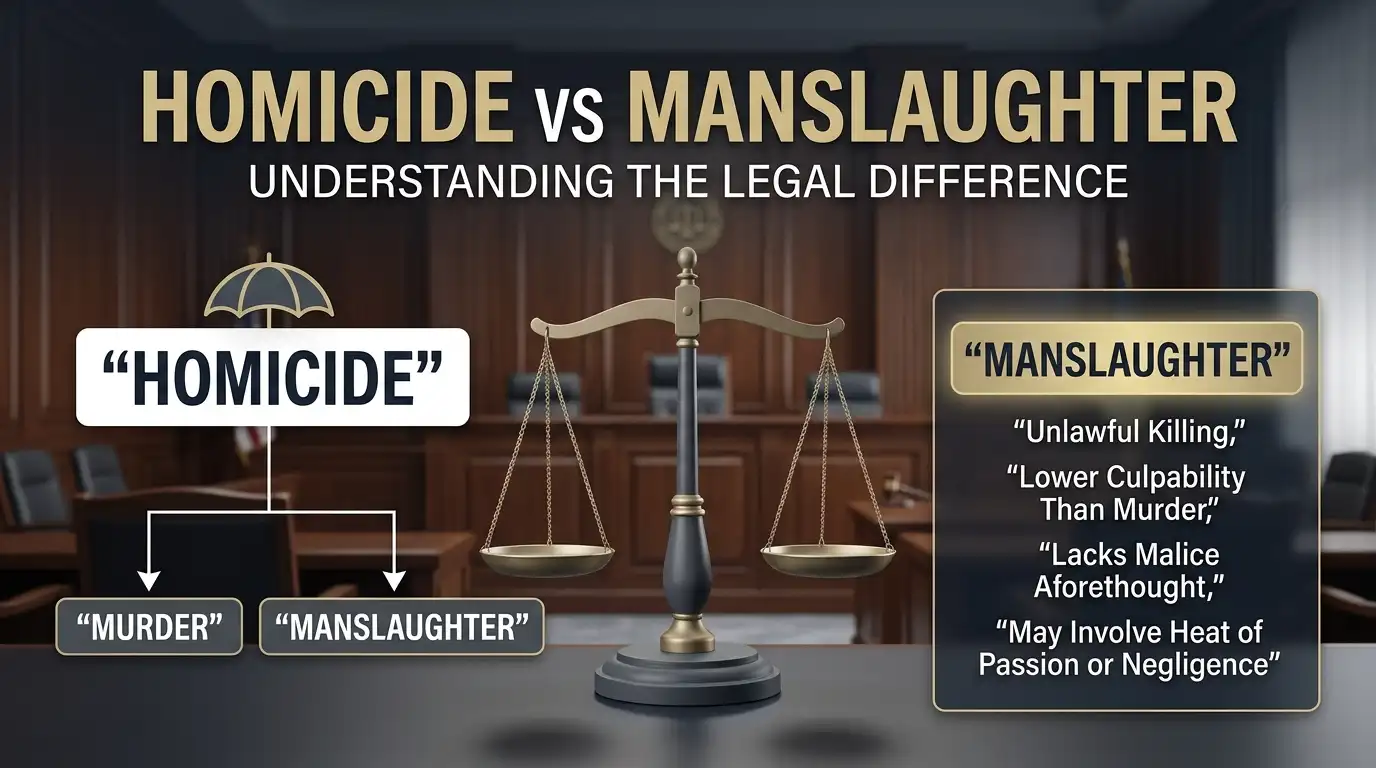
Think of homicide as an umbrella term.
For example:
Homicide
→ Murder
→ Manslaughter
→ Other forms of homicide recognized by law
This is why saying that someone died from “homicide” does not, by itself, tell you what criminal offense occurred.
What Is Manslaughter?
Manslaughter is a form of unlawful killing that generally involves less criminal culpability than murder.
The exact definition varies between legal systems. In U.S. law, manslaughter can include different forms of killing, including voluntary and involuntary manslaughter.
In England and Wales, the Crown Prosecution Service identifies several forms of manslaughter, including:
- Manslaughter following certain partial defenses to murder
- Gross negligence manslaughter
- Unlawful and dangerous act manslaughter
Core Difference Between Homicide and Manslaughter
1. Scope
The biggest difference is scope.
Homicide is the broader concept. Manslaughter is a specific type within that broader category.
So:
All manslaughter is homicide, but not all homicide is manslaughter.
For example, murder is a homicide, but murder is not manslaughter.
2. Criminal Responsibility
Manslaughter generally involves a lower level of culpability than murder.
The reason can depend on the case. It may involve:
- Reckless behavior
- Gross negligence
- An unlawful act that causes death
- A killing that would otherwise meet the requirements for murder but is reduced because a legally recognized partial defense applies
The precise rules differ by jurisdiction.
3. Intent
Intent is an important issue, but it does not provide a simple universal dividing line between homicide and manslaughter.
Some forms of manslaughter can involve an intentional killing. For example, U.S. law recognizes voluntary manslaughter in circumstances such as a killing committed in the heat of passion following adequate provocation.
Other forms can involve no intent to kill.
For example, involuntary manslaughter can involve causing death through negligent or reckless conduct, depending on the jurisdiction.
4. Examples
Consider these simplified examples:
Example 1: Murder
A person intentionally kills another person with the required criminal intent.
This may be classified as murder under the applicable law. Murder is a type of homicide.
Example 2: Gross negligence
A person’s extremely serious breach of a duty of care causes another person’s death.
In England and Wales, this may constitute gross negligence manslaughter if the required legal elements are proven.
Example 3: Unlawful and dangerous act
A person intentionally commits an unlawful act that carries a risk of harm, and the act causes someone’s death.
In England and Wales, this can form the basis of unlawful act manslaughter when the required elements are established.
Similarities Between Homicide and Manslaughter
Homicide and manslaughter are connected because both concern one person’s death caused by another person.
They may also involve:
- A criminal investigation
- Evidence about how the death occurred
- Questions about the person’s actions and state of mind
- Medical or forensic evidence
- A determination of whether the killing was lawful
- Different possible criminal charges depending on the facts
The exact legal process and offenses depend on the jurisdiction.
Homicide vs. Manslaughter: An Easy Way to Remember
A simple way to remember the difference is:
Homicide = the broad category of one person causing another person’s death.
Manslaughter = a specific form of unlawful killing with less culpability than murder.
Another useful comparison is:
Homicide → category
Manslaughter → specific offense within that category
This distinction prevents a common mistake: treating “homicide” and “manslaughter” as two completely separate types of killing.
Common Misconceptions
Is Every Homicide Murder?
No.
Homicide is broader than murder. A homicide can include murder, manslaughter, or a killing that is legally justified, depending on the jurisdiction and circumstances.
Is Manslaughter Always Accidental?
No.
Some forms of manslaughter can involve an intentional killing. For example, U.S. law recognizes voluntary manslaughter in certain heat-of-passion cases.
Is Homicide Always a Crime?
No.
Some killings can be legally justified. Self-defense is one example recognized in some circumstances.
Is Manslaughter the Same Everywhere?
No.
Legal definitions differ between jurisdictions. U.S. states can have different rules, and the law in England and Wales uses its own categories and requirements.
FAQs
What is the main difference between homicide and manslaughter?
Homicide is the broader term for one person causing another person’s death. Manslaughter is a particular form of unlawful killing. Manslaughter generally involves less culpability than murder, but its exact meaning depends on the jurisdiction.
Is manslaughter a type of homicide?
Yes. Manslaughter is generally considered a type of homicide. The relationship is similar to a category and one of its specific forms: homicide is broader, while manslaughter is more specific.
Can homicide be legal?
Yes. Some killings may be legally justified under applicable law, such as certain killings in self-defense. Whether a particular killing is lawful depends on the facts and the law of the relevant jurisdiction.
Can manslaughter be intentional?
Yes. In some legal systems, voluntary manslaughter can involve an intentional killing under circumstances that reduce the offense from murder. For example, U.S. law recognizes voluntary manslaughter in certain heat-of-passion situations.
Is accidental death always manslaughter?
No. An accidental death does not automatically establish manslaughter. The prosecution generally must prove the legal elements required for the particular offense. The relevant test can include negligence, recklessness, an unlawful act, or other factors depending on the jurisdiction.
What is the difference between murder and manslaughter?
Murder generally involves a higher level of criminal culpability than manslaughter. Manslaughter can apply when the required elements for murder are absent or when a legally recognized circumstance reduces what would otherwise be murder to manslaughter. The rules vary by jurisdiction.
Conclusion
The main difference between homicide and manslaughter is their legal scope. Homicide is the broad category covering situations in which one person causes another person’s death. Manslaughter is a specific form of unlawful killing that generally carries less culpability than murder. Manslaughter can involve different circumstances, including reckless conduct, gross negligence, unlawful acts, or certain intentional killings reduced by legally recognized circumstances. Because criminal law differs between countries and states, the exact definition should always be checked against the law of the relevant jurisdiction.

Hi! I am Arshad Ullah presently working as linguist in Punjab Education Department. I have done MA in English Literature while M.Phil in Applied Linguistics. I have taught creative writing to the post graduation classes for 15 years. Presently I am working as content writer, and offering classes for blog writing. On this site, I research each topic from authoritative sources and edit every comparison for accuracy and clear, simple language.