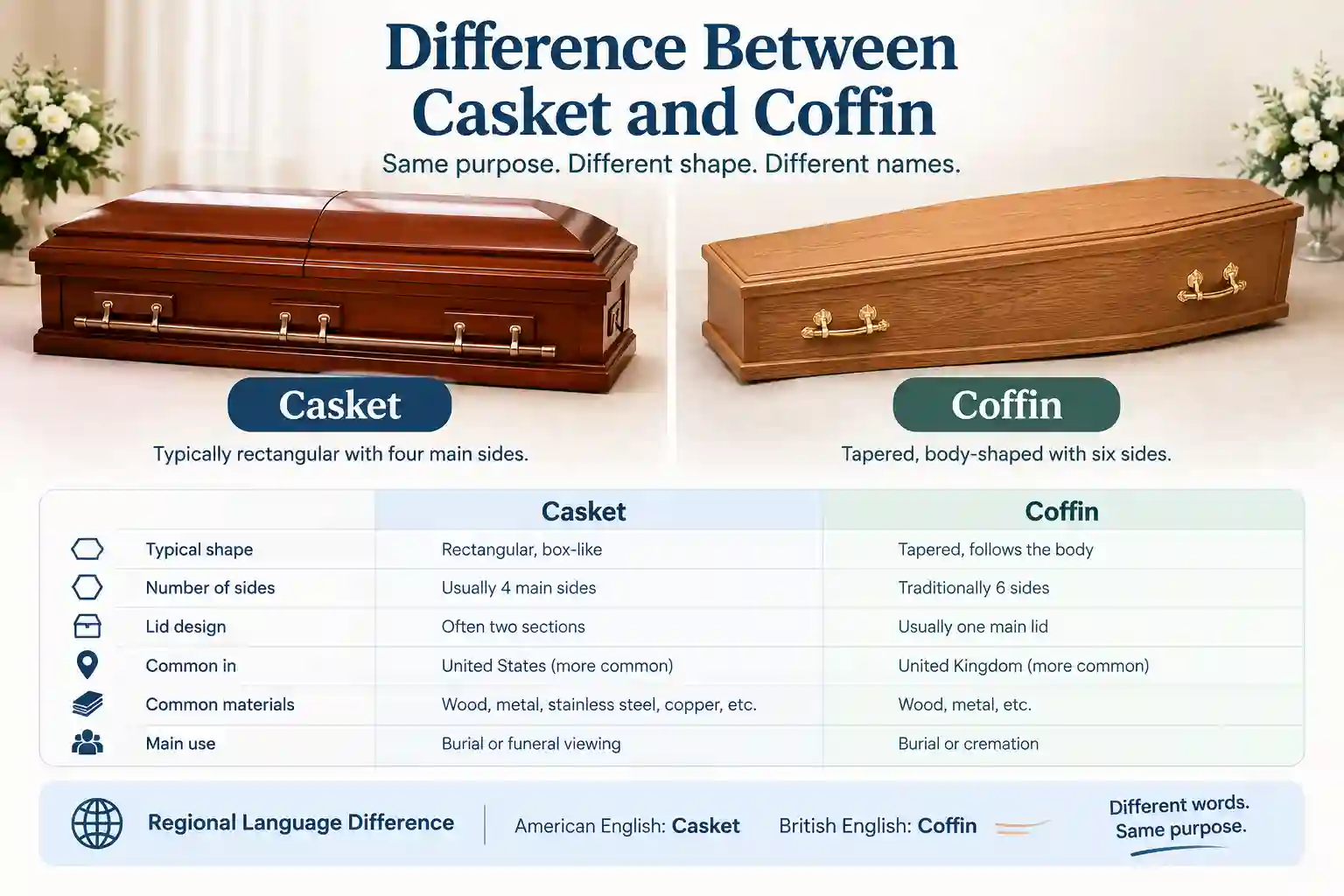
A casket and a coffin are both containers used for a dead person’s body. The main difference is their shape and common regional use. A coffin traditionally has a tapered, six-sided shape that follows the body, while a casket is usually rectangular with four sides and a wider, more box-like design. In the United States, casket is the more common term, while coffin is more common in British English.
Quick Comparison Table
| Feature | Casket | Coffin |
| Basic meaning | Container for a dead body | Container for a dead body |
| Typical shape | Rectangular | Tapered, body-shaped |
| Number of sides | Usually 4 main sides | Traditionally 6 sides |
| Common U.S. term | Casket | Coffin is also understood |
| Common British term | Less common for a body | Coffin |
| Design | Usually wider and more box-like | Usually narrower at the head and foot |
| Lid | Often divided into two sections | Usually one main lid |
| Main use | Burial or funeral viewing | Burial or funeral use |
The National Funeral Directors Association (NFDA) specifically distinguishes the traditional terms by shape: it describes a casket as a four-sided burial container and a coffin as having six sides.
Introduction
The words casket and coffin are often used as if they mean exactly the same thing. In everyday speech, that is often true.
Both refer to a container used to hold a dead person’s body for burial or, in some cases, cremation. Cambridge Dictionary also notes that casket is the U.S. term for what British English commonly calls a coffin.
However, there is a useful difference in traditional funeral terminology. The two types have different shapes, and the word casket has a different regional history of use.
Understanding these differences makes it easier to understand funeral terms in American and British English.
What Is a Casket?
A casket is a container used for a dead person’s body. In American English, it is the usual term for the container used at many funerals.
Cambridge defines a casket, in its U.S. usage, as a long box in which a dead person is buried or burned. The word can also mean a small decorative box for valuable objects such as jewelry.
Main Characteristics of a Casket
A traditional casket usually has:
- A rectangular shape
- Four main vertical sides
- A wider, box-like appearance
- A lid that may be divided into two sections
- Handles on the sides for carrying
- Designs made from wood, metal, or other materials
The two-section lid is useful when a family wants to display only the upper part of the body during a viewing.
Casket in American English
In the United States, casket is the normal funeral term.
For example:
The family chose a wooden casket for the funeral.
The casket was placed in the funeral home before the service.
The NFDA also uses the term casket in its professional funeral-service materials.
What Is a Coffin?
A coffin is a container in which a dead person’s body is placed for burial or cremation. Cambridge and Collins both give this basic meaning.
The traditional coffin has a shape that follows the general form of the human body.
Main Characteristics of a Coffin
A traditional coffin usually has:
- A narrower head area
- A wider shoulder area
- A narrower foot area
- A tapered body-shaped design
- Six sides in the standard funeral terminology
- A simple wooden construction in many traditional examples
This shape is one of the clearest physical differences between a traditional coffin and a modern casket.
Difference Between Casket and Coffin
1. Shape
The shape is the main physical difference.
A traditional coffin is tapered. It is narrower at the head and feet and wider around the shoulders.
A casket is normally rectangular. Its sides remain more or less parallel from one end to the other.
The NFDA uses this distinction in its funeral terminology: a coffin has six sides, while a casket has four sides.
2. Number of Sides
Traditional coffins generally have six sides.
A typical casket has four main sides and has a rectangular box shape.
This is why the terms six-sided coffin and four-sided casket are useful when explaining the traditional difference.
3. Regional Usage
Regional English is another important difference.
In American English, the word casket is widely used for a burial container.
In British English, coffin is the usual word.
Cambridge lists casket as the U.S. term and coffin as the British term.
Collins gives a similar distinction, describing casket as another name for coffin mainly in U.S. English.
4. Appearance
Caskets often have a more formal, rectangular appearance.
They may be made from:
- Wood
- Steel
- Stainless steel
- Copper
- Other materials
Coffins traditionally have a simpler, tapered appearance.
However, modern funeral products vary greatly, so appearance alone does not always tell you which term a manufacturer or funeral provider will use.
5. Lid Design
Many modern caskets have a split lid.
The upper section can be opened during a viewing while the lower section remains closed.
Traditional coffins commonly have a simpler single lid, although designs can vary.
Therefore, the lid is a useful clue, but it is not as basic a distinction as the overall shape.
6. Word Meaning and History
The words also have different linguistic histories.
Coffin entered English through Old French and ultimately traces back to the Greek word kophinos, meaning a basket. Collins gives this historical development for the word.
Casket originally had another meaning. It referred to a small box or chest used for valuable objects. Collins traces the word to Middle English and Old French cassette, meaning a little box. In American English, it later became a common term for a burial container.
Similarities Between Casket and Coffin
Despite their differences, caskets and coffins have the same basic purpose.
What They Have in Common
Both:
- Hold a dead person’s body.
- Can be used during funeral services.
- Can be used for burial.
- May be made from wood or metal.
- Can be opened or closed depending on the design and funeral arrangements.
- Can be simple or highly decorated.
- Are available in different sizes and styles.
Cambridge defines both terms as containers for a dead body, while Collins treats casket as a U.S. term for a coffin.
Why Does a Casket Look Different From a Coffin?
The traditional coffin was designed with a shape that broadly followed the human body.
The casket developed as a more rectangular container. This gave it a different appearance and allowed more space around the body.
Modern funeral practices have also produced many variations. As a result, the traditional shape difference is useful for understanding the terms, but real funeral containers do not always fit a simple visual rule.
Casket vs. Coffin in American and British English
One of the easiest ways to understand the difference is to look at regional English.
| English variety | More common term |
| American English | Casket |
| British English | Coffin |
| Canadian English | Both may occur |
| Australian English | Coffin is commonly used |
| General international English | Both are understood |
The exact choice can vary by country, funeral industry, and context.
Cambridge specifically labels the burial meaning of casket as U.S. and gives coffin as the corresponding British term.
Is a Casket the Same as a Coffin?
In everyday American English, the two words can refer to the same basic object.
However, funeral professionals may use the words more precisely. In that context:
- Casket = usually a rectangular, four-sided container.
- Coffin = traditionally a six-sided, tapered container.
The distinction is therefore both regional and physical. Collins explicitly notes that casket can mean coffin, especially in U.S. English.
Can a Coffin Be Used for Cremation?
Yes. A coffin can be used to contain a body before cremation, although exact requirements depend on the crematory and local rules.
Cambridge defines a coffin as a box in which a dead body is buried or burned, showing that the term is not limited only to burial.
The same general point applies to caskets. Funeral arrangements may use a casket before cremation, depending on the service and the type of container allowed.
Common Misconceptions
Misconception 1: Caskets and Coffins Are Completely Different Objects
Not necessarily.
In everyday language, especially in the United States, casket and coffin can refer to the same general type of burial container. The stronger distinction is the traditional difference in shape and regional vocabulary.
Misconception 2: Every Coffin Has Exactly Six Sides
The six-sided design is the traditional definition used to distinguish a coffin from a four-sided casket. However, funeral products can vary in construction and terminology.
The NFDA’s professional terminology uses the six-sided versus four-sided distinction, so it is best understood as a traditional industry distinction, rather than a rule that every object sold under every regional use of the word must follow.
Misconception 3: Casket Always Means a Funeral Container
No.
The word casket also means a small decorative box for valuable objects, especially jewelry. This older meaning remains in dictionaries.
For example:
She kept the necklace in a small jewelry casket.
Here, casket has nothing to do with a funeral.
Practical Examples
Example of “Casket”
The family chose a simple wooden casket.
The funeral director helped them select a casket.
The casket was carried into the church.
Example of “Coffin”
The coffin was lowered into the grave.
The old church displayed a historic wooden coffin.
The family chose a traditional coffin for the burial.
Example of the Regional Difference
American English:
The body was placed in a casket.
British English:
The body was placed in a coffin.
Both sentences describe essentially the same basic purpose.
Which Word Should You Use?
The best word depends mainly on where you are writing and what style you want.
Use “Casket” When:
- You are writing for an American audience.
- You are discussing modern U.S. funeral services.
- You are describing a rectangular funeral container.
- You are using American funeral-industry terminology.
Use “Coffin” When:
- You are writing for a British audience.
- You are describing a traditional tapered container.
- You are discussing historical burial practices.
- You want the traditional British English term.
Neither word is universally “better.” The appropriate choice depends on regional English and context.
Casket vs. Coffin: A Simple Way to Remember
Think of the difference like this:
Casket → rectangular box
Coffin → tapered, body-shaped box
And remember the regional difference:
American English → casket is common
British English → coffin is common
This simple rule will help with most everyday uses.
FAQs
Is a casket bigger than a coffin?
There is no universal size rule that makes one larger than the other. The main traditional difference is their shape. A casket is usually rectangular, while a coffin is tapered and follows the general shape of the body. Both are made in different sizes to accommodate different bodies and funeral requirements.
Why are coffins shaped like a person?
Traditional coffins are tapered, with a wider middle section around the shoulders and narrower ends. This shape broadly follows the human body. Modern caskets are usually rectangular instead. The shape is therefore one of the easiest physical ways to distinguish a traditional coffin from a casket.
Is “casket” an American word?
In the funeral sense, casket is especially common in American English. British English generally uses coffin for the same basic object. Dictionaries such as Cambridge and Collins identify this regional difference.
Can you call a coffin a casket?
In many contexts, yes. The two terms can refer to the same general type of funeral container. However, funeral professionals may use the words to distinguish a rectangular casket from a traditional six-sided coffin.
Is a casket always rectangular?
A modern casket is normally rectangular, and this is the traditional feature that separates it from a tapered coffin. However, designs can vary, so shape should be treated as a common distinction rather than an absolute rule for every product.
What is the difference between a coffin and a casket in British English?
In British English, coffin is the normal word for the container used for a dead body. Casket is less common in this sense and can also mean a small decorative box for valuables.
Do coffins and caskets have the same purpose?
Yes. Their basic purpose is to contain a dead person’s body for burial or, where permitted and appropriate, cremation. The main differences are traditional shape, terminology, and regional usage.
Conclusion
The main difference between a casket and a coffin is their traditional shape and terminology. A casket is normally rectangular and has four main sides, while a traditional coffin is tapered and has six sides. The terms also differ by region: casket is especially common in American English, while coffin is the usual British English word. In everyday speech, however, the two words can refer to the same basic type of funeral container.

Hi! I am Arshad Ullah presently working as linguist in Punjab Education Department. I have done MA in English Literature while M.Phil in Applied Linguistics. I have taught creative writing to the post graduation classes for 15 years. Presently I am working as content writer, and offering classes for blog writing. On this site, I research each topic from authoritative sources and edit every comparison for accuracy and clear, simple language.