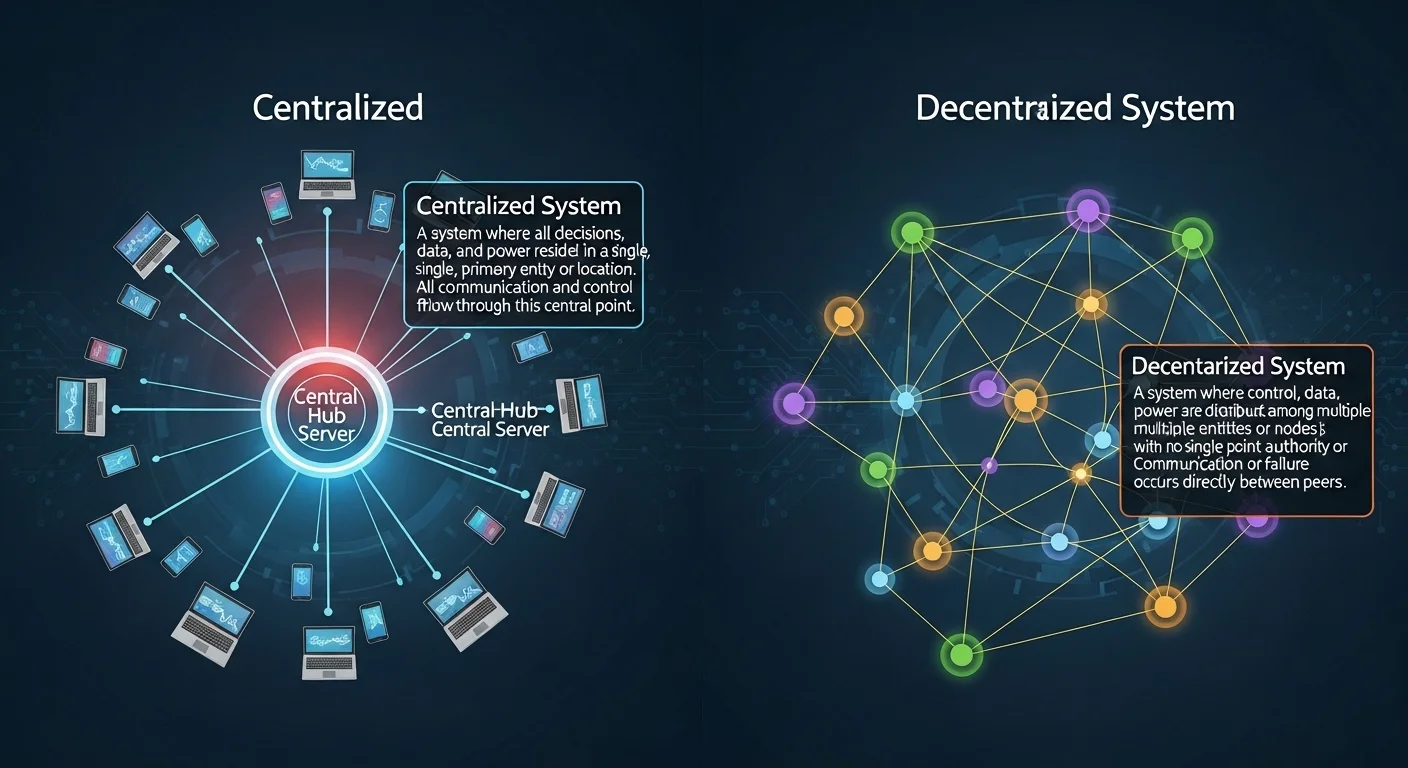
A small shop owner once tried two ways to run his business. First, he made all the decisions himself. This is called centralized. Then, he allowed his team to make decisions too. This is called decentralized. Both ways worked, but in different ways.
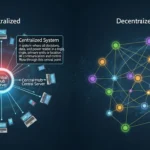
The difference between centralized and decentralized systems is about control. In a centralized system, one person or group has power. In a decentralized system, power is shared.
Understanding the difference between centralized and decentralized helps us see how businesses, governments, and even apps work. The difference between centralized and decentralized also affects speed, trust, and freedom.
In daily life, the difference between centralized and decentralized shapes how we make decisions and solve problems.
Centralized vs Decentralized
The main difference is simple:
Centralized = control in one place
Decentralized = control spread across many places
Why Is This Difference Important in Society?
Knowing this difference helps both learners and experts. It improves decision-making. It also helps us choose better systems for work, school, and technology.
In society, centralized systems bring order and control. Decentralized systems bring freedom and flexibility. Both are useful in different ways. So, understanding them helps build fair and strong systems.
Pronunciation
- Centralized
- US: /ˈsɛn.trə.laɪzd/
- UK: /ˈsen.trə.laɪzd/
- Decentralized
- US: /diːˈsɛn.trə.laɪzd/
- UK: /diːˈsen.trə.laɪzd/
Let’s explore the main differences in detail.
A List of 10 Differences Between Centralized & Decentralized
1. Control
- Centralized: One authority controls everything
🔴 Example: A school principal makes all decisions
🔴 Sentence: The system is centralized, so only the boss decides. - Decentralized: Many people share control
🟣 Example: Teachers decide in their own classes
🟣 Sentence: The system is decentralized, so teams decide together.
2. Decision Speed
- Centralized: Decisions may be slow
🔴 Example: Waiting for approval from top manager
🔴 Sentence: Centralized systems can delay action. - Decentralized: Decisions are faster
🟣 Example: Teams solve issues quickly
🟣 Sentence: Decentralized systems respond fast.
3. Flexibility
- Centralized: Less flexible
🔴 Example: Fixed rules for all branches
🔴 Sentence: A centralized system is strict. - Decentralized: More flexible
🟣 Example: Different branches use different methods
🟣 Sentence: A decentralized system adapts easily.
4. Risk
- Centralized: High risk if one point fails
🔴 Example: Server crash stops everything
🔴 Sentence: Centralized systems have a single risk point. - Decentralized: Risk is spread
🟣 Example: One failure does not stop all
🟣 Sentence: Decentralized systems are safer.
5. Communication
- Centralized: Top-down communication
🔴 Example: Orders come from leaders
🔴 Sentence: Communication flows one way. - Decentralized: Open communication
🟣 Example: Teams share ideas
🟣 Sentence: Communication flows both ways.
6. Cost
- Centralized: Can be costly to maintain
🔴 Example: Big main office expenses
🔴 Sentence: Centralized systems need strong infrastructure. - Decentralized: Often lower cost
🟣 Example: Shared resources
🟣 Sentence: Decentralized systems save money.
7. Innovation
- Centralized: Less innovation
🔴 Example: Ideas must be approved
🔴 Sentence: Centralized systems limit creativity. - Decentralized: More innovation
🟣 Example: Everyone shares ideas
🟣 Sentence: Decentralized systems boost creativity.
8. Accountability
- Centralized: Clear responsibility
🔴 Example: One leader is answerable
🔴 Sentence: Centralized systems define roles clearly. - Decentralized: Shared responsibility
🟣 Example: Teams share outcomes
🟣 Sentence: Decentralized systems divide responsibility.
9. Transparency
- Centralized: Less transparent
🔴 Example: Decisions are hidden
🔴 Sentence: Centralized systems may lack openness. - Decentralized: More transparent
🟣 Example: Open records
🟣 Sentence: Decentralized systems build trust.
10. Scalability
- Centralized: Hard to scale
🔴 Example: One system handles all
🔴 Sentence: Centralized systems grow slowly. - Decentralized: Easy to scale
🟣 Example: Add more nodes or teams
🟣 Sentence: Decentralized systems grow fast.
Nature and Behaviour
- Centralized: Structured, controlled, stable, and organized
- Decentralized: Flexible, open, adaptive, and dynamic
Why People Get Confused About Their Use
People confuse them because both aim to manage systems. Also, some systems mix both styles. This makes the difference less clear.
Table: Difference and Similarity
| Feature | Centralized | Decentralized | Similarity |
| Control | One place | Many places | Both manage systems |
| Speed | Slow | Fast | Both make decisions |
| Flexibility | Low | High | Both adapt to needs |
| Risk | High | Low | Both handle risk |
| Purpose | Order | Freedom | Both improve efficiency |
Which Is Better in What Situation?
Centralized systems are better when control and safety are needed. For example, in banks or the military, strong control is important. It ensures order and reduces confusion. It also helps in clear decision-making.
Decentralized systems are better when flexibility and speed are needed. For example, in tech startups or creative teams, freedom helps growth. It allows fast changes and new ideas. So, the best choice depends on the situation.
H3: How Are the Keywords Used in Metaphors and Similes?
🟣 Centralized is like a “single brain” controlling the body
🟣 Decentralized is like a “team of minds” working together
🟣 Centralized works like a king ruling a kingdom
🟣 Decentralized works like a group sharing power
Connotative Meaning
- Centralized
- Positive: Organized, strong
- Negative: Rigid, controlling
- Example: A centralized system ensures discipline
- Decentralized
- Positive: Free, innovative
- Negative: Uncontrolled, scattered
- Example: A decentralized system encourages creativity
Idioms and Proverbs
🟣 “Too many cooks spoil the broth” (decentralized risk)
Example: Too many opinions slowed the project.
🟣 “One hand rules all” (centralized idea)
Example: The company followed one leader.
Works in Literature
🟣 1984 by George Orwell (Dystopian, 1949) — shows centralized power
🟣 The Dispossessed by Ursula K. Le Guin (Sci-fi, 1974) — shows decentralized society
Movies Based on the Concepts
🟣 The Matrix (1999, USA) — centralized control system
🟣 Snowden (2016, USA) — power and data control
FAQs
1. What is the main difference?
Centralized has one control point; decentralized has many.
2. Which is safer?
Decentralized is safer due to shared risk.
3. Which is faster?
Decentralized systems are faster.
4. Are both used today?
Yes, many systems use a mix of both.
5. Which is better?
It depends on needs and goals.
How Are Both Useful for Surroundings?
Both systems help organize our world. Centralized systems bring order in schools, banks, and governments. Decentralized systems support teamwork, innovation, and technology like the internet. Together, they balance control and freedom.
Final Words
Centralized and decentralized systems are both important. They serve different needs. Choosing the right one depends on goals and context.
Conclusion
The difference between centralized and decentralized systems is simple but powerful. One focuses on control, while the other focuses on sharing power. Both have strengths and limits. In real life, many systems combine both styles. This balance helps create stability and growth. By understanding these concepts, we can make better choices in work, study, and daily life. It also helps us understand modern systems like businesses and technology. In the end, the right system depends on the situation and needs.

Hi! I am Arshad Ullah presently working as linguist in Punjab Education Department. I have done MA in English Literature while M.Phil in Applied Linguistics. I have taught creative writing to the post graduation classes for 15 years. Presently I am working as content writer, and offering classes for blog writing.