I still remember the first time I saw the terms PT and PTT on a blood test report. At first, I thought they meant the same thing. Many people make the same mistake because the names look very similar.
The confusion becomes even bigger when a doctor orders both tests. People often wonder why two tests are needed if they both measure blood clotting.
Understanding the difference between PT and PTT is important because these tests help doctors evaluate how well your blood clots. Choosing the wrong interpretation can lead to misunderstandings about your health condition, medications, or treatment plan.
This guide explains everything in simple English with practical examples so you can clearly understand the real difference.
What Is PT?
Definition
PT (Prothrombin Time) is a blood test that measures how long it takes blood to clot.
Purpose
Doctors use PT to check whether the body’s clotting system is working properly.
How It Works
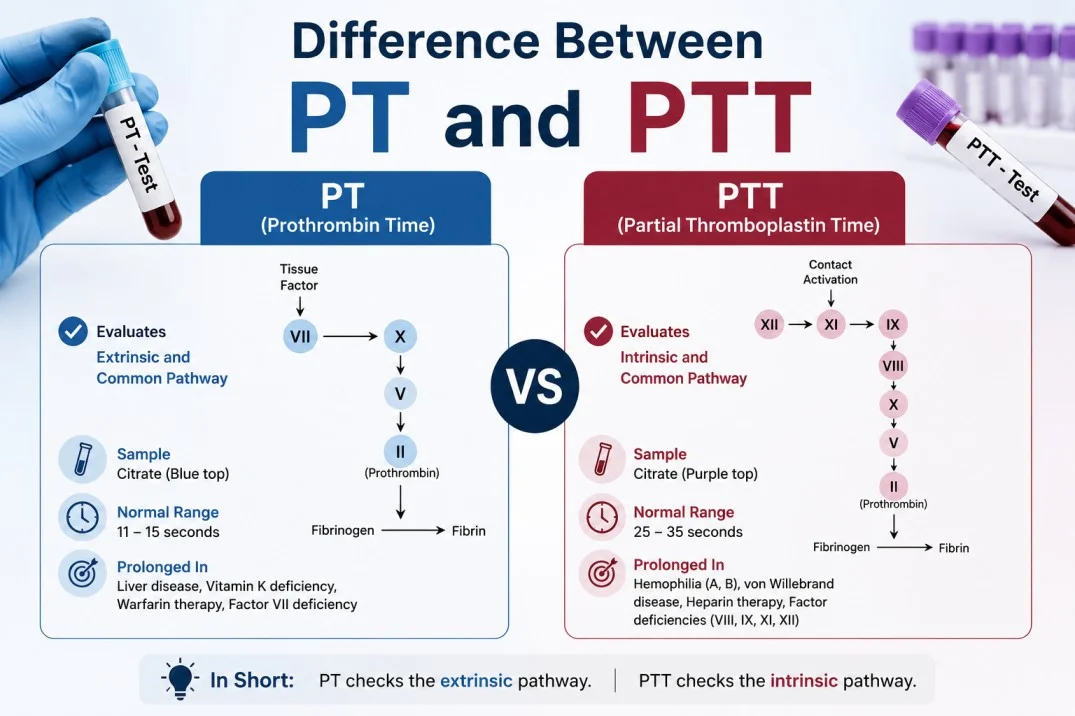
The test measures the clotting factors involved in what doctors call the extrinsic pathway and the common pathway of blood coagulation.
Who Uses It?
PT is commonly used for:
- Monitoring warfarin treatment
- Checking liver function
- Evaluating bleeding disorders
- Preparing for surgery
Real-World Example
If a patient takes warfarin, doctors regularly use PT and INR tests to make sure the medication is working safely.
Practical Meaning
A longer PT time may indicate:
- Liver disease
- Vitamin K deficiency
- Blood clotting disorders
- Effects of blood-thinning medication
What Is PTT?
Definition
PTT (Partial Thromboplastin Time) is another blood clotting test.
Purpose
It measures how long blood takes to clot through a different clotting pathway.
How It Works
PTT evaluates the intrinsic pathway and part of the common pathway.
Who Uses It?
Doctors often order PTT for:
- Monitoring heparin therapy
- Investigating unexplained bleeding
- Diagnosing clotting disorders
- Pre-surgical evaluations
Real-World Example
A patient receiving heparin treatment may need frequent PTT tests to ensure the medicine is not causing excessive bleeding.
Practical Meaning
A prolonged PTT result may suggest:
- Hemophilia
- Certain clotting factor deficiencies
- Lupus anticoagulant
- Effects of heparin therapy
Quick Comparison Table
| Feature | PT | PTT |
| Full Name | Prothrombin Time | Partial Thromboplastin Time |
| Main Purpose | Tests extrinsic pathway | Tests intrinsic pathway |
| Blood Clotting Evaluation | Yes | Yes |
| Common Medication Monitored | Warfarin | Heparin |
| Used Before Surgery | Yes | Yes |
| Detects Clotting Disorders | Yes | Yes |
| Difficulty | Simple blood test | Simple blood test |
| Cost | Similar | Similar |
| Turnaround Time | Fast | Fast |
| Popularity | Very common | Very common |
| Best Use Case | Monitoring warfarin | Monitoring heparin |
| Main Advantage | Easy medication monitoring | Detailed clotting analysis |
| Main Limitation | Doesn’t assess all pathways | Doesn’t assess all pathways |
Biggest Difference Between PT and PTT
The biggest difference is that they measure different clotting pathways.
- PT evaluates the extrinsic clotting pathway.
- PTT evaluates the intrinsic clotting pathway.
Many people first assume both tests are duplicates. They are not.
In real-world medical practice, doctors often order both because together they provide a more complete picture of how blood clots.
This matters more than many beginners realize because a problem may appear in one pathway while the other remains normal.
Key Differences Explained
1. Clotting Pathway Measured
PT
- Measures the extrinsic pathway.
- Focuses mainly on factors affected by warfarin.
PTT
- Measures the intrinsic pathway.
- Evaluates different clotting factors.
Example
A patient may have a normal PT but an abnormal PTT if the problem exists only in the intrinsic pathway.
2. Medication Monitoring
PT
- Commonly used for warfarin therapy.
PTT
- Commonly used for heparin therapy.
Example
Doctors adjust warfarin doses using PT and INR results.
3. Clotting Factors Assessed
PT
- Primarily evaluates Factors I, II, V, VII, and X.
PTT
- Evaluates Factors VIII, IX, XI, XII, and others.
Impact
Different disorders affect different factors.
4. Disease Detection
PT
- Often helps identify liver disease.
- Detects vitamin K deficiency.
PTT
- Helps diagnose hemophilia.
- Identifies inherited clotting disorders.
Example
Hemophilia patients often show abnormal PTT results.
5. Sensitivity to Warfarin
PT
- Highly sensitive.
PTT
- Less useful for warfarin monitoring.
Real-World Impact
PT remains the standard test for warfarin users.
6. Sensitivity to Heparin
PT
- Less sensitive.
PTT
- Highly sensitive.
Example
Hospitals often rely on PTT to manage heparin treatment safely.
7. Diagnostic Focus
PT
- More focused on acquired clotting problems.
PTT
- More useful for inherited clotting conditions.
Impact
Doctors choose tests based on symptoms and medical history.
8. Laboratory Interpretation
PT
- Frequently reported alongside INR.
PTT
- Usually reported independently.
Why It Matters
INR helps standardize PT results worldwide.
9. Use in Liver Disease
PT
- Often changes early in liver disease.
PTT
- May change later depending on severity.
Example
Doctors frequently monitor PT in patients with liver problems.
10. Role in Surgery Preparation
PT
- Evaluates surgical bleeding risk.
PTT
- Also evaluates bleeding risk from another angle.
Practical Benefit
Using both tests reduces surprises during surgery.
11. Conditions They Detect Best
PT
- Warfarin effects
- Vitamin K deficiency
- Liver dysfunction
PTT
- Hemophilia
- Heparin effects
- Factor deficiencies
Similarities Between PT and PTT
Although they differ, they also share many similarities.
- Both are blood clotting tests.
- Both help detect bleeding disorders.
- Both are commonly ordered before surgery.
- Both require a blood sample.
- Both help doctors assess treatment safety.
- Both contribute to diagnosing clotting abnormalities.
These similarities explain why many people confuse them.
Pros and Cons
Pros of PT
- Fast and widely available
- Excellent for warfarin monitoring
- Useful for liver disease assessment
- Commonly used worldwide
Cons of PT
- Does not evaluate all clotting factors
- Cannot replace PTT
- May miss intrinsic pathway disorders
Pros of PTT
- Detects many clotting disorders
- Essential for heparin monitoring
- Useful in diagnosing hemophilia
- Provides detailed clotting information
Cons of PTT
- More sensitive to laboratory variation
- Not ideal for warfarin monitoring
- Interpretation can be more complex
Which Is Better for Different Situations?
For Warfarin Users
PT is usually the better choice.
For Heparin Users
PTT is typically preferred.
For Surgery Screening
Doctors often use both.
For Diagnosing Bleeding Disorders
PTT may provide more detailed information.
For Liver Disease Monitoring
PT is often more valuable.
For Long-Term Treatment Monitoring
The best test depends on the medication being used.
Common Mistakes People Make
Many people make avoidable mistakes when interpreting these tests.
Thinking PT and PTT Are the Same
They measure different clotting pathways.
Ignoring Medication Effects
Blood thinners can strongly influence results.
Self-Diagnosing
Only a healthcare professional can interpret results correctly.
Looking at One Test Alone
Doctors often consider PT, PTT, INR, symptoms, and medical history together.
Assuming an Abnormal Result Means Serious Disease
Many temporary conditions can affect clotting times.
Expert Recommendation
Choose PT If:
- You take warfarin
- Liver disease is suspected
- Vitamin K deficiency is being evaluated
- INR monitoring is required
Choose PTT If:
- You take heparin
- Hemophilia is suspected
- Intrinsic pathway disorders are being investigated
- Detailed clotting evaluation is needed
Avoid Relying Only on PT If:
- An inherited bleeding disorder is suspected
- Doctors need intrinsic pathway information
Avoid Relying Only on PTT If:
- Warfarin monitoring is required
- INR assessment is necessary
Final Verdict
The difference between PT and PTT comes down to the part of the clotting system each test measures. PT focuses mainly on the extrinsic pathway and is commonly used to monitor warfarin therapy. PTT focuses on the intrinsic pathway and is often used for heparin monitoring and diagnosing inherited clotting disorders.
After understanding both tests, the confusion becomes much easier to clear up. Neither test is universally better. Each serves a specific purpose. In many situations, doctors use both together because they provide a fuller picture of how blood clotting works.
For everyday patients, the most important thing is knowing that PT and PTT complement each other rather than compete with each other. Understanding their roles can help you feel more confident when discussing blood test results with your healthcare provider.
FAQs
What is the main difference between PT and PTT?
PT measures the extrinsic clotting pathway, while PTT measures the intrinsic clotting pathway. Both evaluate blood clotting but focus on different parts of the coagulation system.
Which is better, PT or PTT?
Neither is better overall. PT is better for monitoring warfarin therapy, while PTT is better for monitoring heparin therapy and diagnosing certain clotting disorders.
Is PTT the same as aPTT?
No. aPTT stands for Activated Partial Thromboplastin Time. It is a refined version of the traditional PTT test and is more commonly used today.
Which test is used for warfarin?
PT, often combined with INR, is the standard test for monitoring warfarin treatment.
Which test is used for heparin?
PTT or aPTT is commonly used to monitor heparin therapy and ensure proper dosing.
Can PT and PTT both be abnormal?
Yes. Severe liver disease, clotting factor deficiencies, or complex bleeding disorders can cause abnormalities in both tests.
Are PT and PTT interchangeable?
No. They measure different clotting pathways and provide different clinical information.
What mistake should beginners avoid?
The biggest mistake is assuming an abnormal result automatically means a serious illness. Test results must always be interpreted in the context of symptoms, medications, and medical history.
Conclusion
PT and PTT are two important blood tests that help doctors understand how well blood clots. While their names sound similar, they evaluate different clotting pathways and serve different medical purposes. PT is mainly used for monitoring warfarin and assessing liver-related clotting issues, while PTT is commonly used for heparin monitoring and diagnosing inherited bleeding disorders such as hemophilia.
Many people become confused when both tests are ordered together, but they actually provide complementary information. One small difference most people overlook is that each test focuses on a different group of clotting factors. That distinction can help doctors identify the exact cause of a bleeding or clotting problem.
The best approach is not choosing one over the other. Instead, understand that each test hasits own role in providing a complete picture of your clotting health.

Hi! I am Arshad Ullah presently working as linguist in Punjab Education Department. I have done MA in English Literature while M.Phil in Applied Linguistics. I have taught creative writing to the post graduation classes for 15 years. Presently I am working as content writer, and offering classes for blog writing. On this site, I research each topic from authoritative sources and edit every comparison for accuracy and clear, simple language.