When I first looked at college degree options, I thought BFA and BA were almost the same. Both seemed related to arts, creativity, and learning. But after digging deeper, I found that they are very different.
Many students face the same confusion. They want to study art, design, music, theater, or creative subjects, but they do not know whether to choose a Bachelor of Fine Arts (BFA) or a Bachelor of Arts (BA).
Choosing the wrong degree can affect your classes, career path, skills, and future opportunities. Some students later wish they had picked a program with more practical training. Others wish they had more flexibility to study different subjects.
This guide explains everything in simple English with practical examples so you can clearly understand the real difference.
What Is BFA?
Bachelor of Fine Arts (BFA)
A BFA is a professional degree focused mainly on creative and performing arts.
Students spend most of their time developing practical artistic skills. The program is designed for people who want to become professional artists, designers, actors, dancers, musicians, photographers, or creative professionals.
Main Purpose
The goal of a BFA is to help students master their craft through hands-on training.
Common BFA Majors
- Graphic Design
- Painting
- Sculpture
- Photography
- Acting
- Dance
- Music
- Animation
- Film Production
How It Works
Most classes focus on studio work, projects, performances, portfolios, and creative practice.
Who Chooses BFA?
Students who:
- Love creative work
- Want industry-ready skills
- Plan artistic careers
- Enjoy practical learning
Real-World Example
A graphic design student in a BFA program may spend several hours each day creating designs, building portfolios, and working on creative projects.
What Is BA?
Bachelor of Arts (BA)
A BA is a broader academic degree that combines arts education with general education subjects.
Instead of focusing only on practical skills, a BA explores theory, history, culture, communication, and critical thinking.
Main Purpose
The goal of a BA is to provide a well-rounded education.
Common BA Majors
- Fine Arts
- English
- History
- Psychology
- Communication
- Sociology
- Political Science
- Music
- Theater Studies
How It Works
Students study their major while also taking courses in other subjects.
Who Chooses BA?
Students who:
- Want flexibility
- Enjoy academics
- May pursue graduate studies
- Want broader career options
Real-World Example
A BA student in art may study art history, cultural studies, and theory alongside some studio classes.
Quick Comparison Table
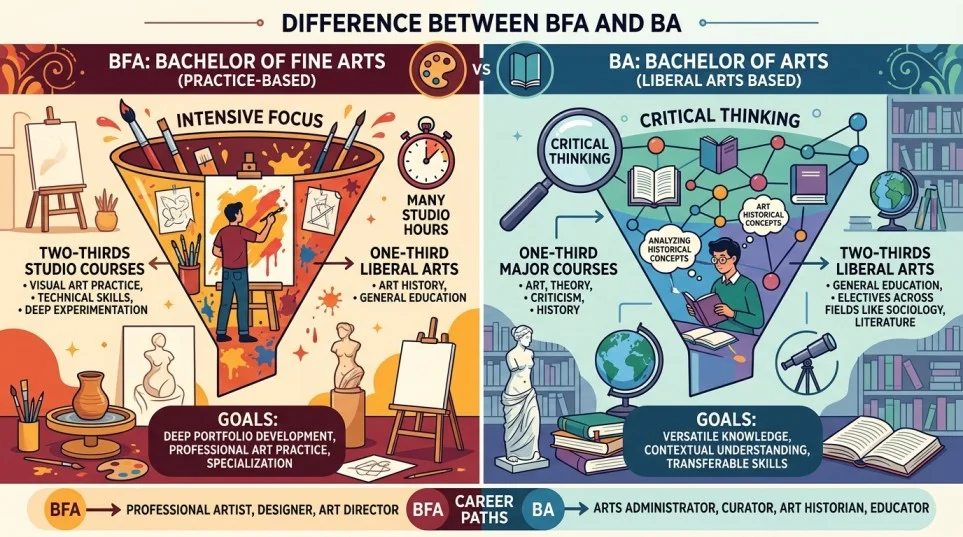
| Feature | BFA | BA |
| Full Form | Bachelor of Fine Arts | Bachelor of Arts |
| Main Focus | Practical artistic training | Broad academic education |
| Learning Style | Hands-on | Theory and academics |
| Studio Classes | Many | Fewer |
| General Education | Less | More |
| Flexibility | Lower | Higher |
| Portfolio Development | Strong focus | Moderate focus |
| Career Preparation | Creative professions | Various professions |
| Difficulty | Intensive creative work | Balanced coursework |
| Time on Major | Usually 65–75% | Usually 25–50% |
| Best For | Professional artists | Students wanting flexibility |
| Main Advantage | Specialized skills | Broad knowledge |
| Main Drawback | Less flexibility | Less intensive training |
Biggest Difference
The biggest difference between BFA and BA is specialization.
A BFA focuses heavily on practical artistic training. A BA provides a broader education with a mix of arts and other subjects.
This matters more than many beginners realize.
If your goal is to become a professional designer, actor, artist, or performer, a BFA often provides stronger hands-on experience.
If you want flexibility, multiple career paths, or graduate school options, a BA may be the better choice.
Key Differences Explained
1. Focus of Study
BFA
- Focuses mainly on artistic skills
- Intensive creative training
- Career-oriented
BA
- Focuses on arts plus general education
- More academic learning
- Broader knowledge base
2. Course Structure
BFA
- More studio classes
- Practical assignments
- Portfolio projects
BA
- Mix of major and elective courses
- More classroom discussions
- More theory-based learning
3. Flexibility
BFA
- Structured curriculum
- Fewer electives
BA
- More freedom to explore other subjects
- Easier to add minors or second majors
Example
A BA student may combine art with marketing or psychology.
4. Time Spent on Major
BFA
- Majority of credits focus on art
BA
- Fewer credits dedicated to art
This often surprises many students.
5. Career Preparation
BFA
- Direct preparation for creative careers
BA
- Preparation for a wider range of careers
6. Portfolio Development
BFA
- Strong emphasis on building professional portfolios
BA
- Some portfolio work but less intensive
Example
Employers in design often review portfolios before resumes.
7. Academic Depth
BFA
- Focus on practical mastery
BA
- Stronger focus on research and theory
8. Graduate School Opportunities
BFA
- Good for specialized arts programs
BA
- Often preferred for diverse graduate studies
9. Learning Environment
BFA
- Studio-centered
- Workshop-based
BA
- Lecture-centered
- Discussion-based
10. Workload Style
BFA
- Long creative projects
- Performances and exhibitions
BA
- Essays, exams, research papers
11. Career Flexibility
BFA
- Stronger focus on creative industries
BA
- Wider range of career options
Many people first assume specialization is always better. In reality, flexibility can be valuable depending on your goals.
Similarities Between Them
Although they are different, BFA and BA share several similarities.
- Both are undergraduate degrees.
- Both typically take four years.
- Both can lead to graduate studies.
- Both teach critical thinking.
- Both help students develop communication skills.
- Both can support careers in arts and creative fields.
These similarities are one reason many students confuse them.
Pros and Cons
Pros of BFA
- Strong practical training
- Better portfolio development
- Industry-focused skills
- Professional preparation
- More hands-on learning
Cons of BFA
- Less flexibility
- Fewer electives
- Narrower academic exposure
- Can be demanding
Pros of BA
- Flexible curriculum
- Broader education
- More career options
- Easier double major opportunities
- Strong academic foundation
Cons of BA
- Less specialized training
- Smaller portfolio focus
- Fewer studio hours
- May require extra skill development
Which Is Better for Different Situations?
For Aspiring Artists
BFA is usually the better choice.
For Students Who Want Flexibility
BA is often better.
For Graphic Designers
BFA often provides stronger practical training.
For Future Teachers
BA may provide broader educational preparation.
For Graduate School
Both can work, depending on the program.
For Career Changers
BA offers more flexibility.
For Students Unsure About Their Future
BA is often the safer option.
For Industry-Focused Careers
BFA usually provides stronger professional preparation.
Common Mistakes People Make
Thinking BFA Is Always Better
Specialization is not always the right choice.
Ignoring Career Goals
Students sometimes pick a degree without considering future plans.
Following Friends
What works for someone else may not work for you.
Overlooking Flexibility
Some students later regret choosing a program with limited options.
Focusing Only on Degree Names
The curriculum matters more than the title.
Ignoring Portfolio Requirements
Creative careers often depend on skills and portfolios.
Expert Recommendation
Choose BFA If:
- You want a creative career
- You enjoy hands-on learning
- You want strong portfolio development
- You are committed to an artistic field
Choose BA If:
- You want flexibility
- You enjoy academic learning
- You may change careers later
- You want broader education
Avoid BFA If:
- You are unsure about your career goals
- You want many elective choices
- You prefer theory-based learning
Avoid BA If:
- You need intensive artistic training
- You want maximum studio experience
- You need a strong professional portfolio
Final Verdict
The difference between BFA and BA comes down to focus and flexibility.
A BFA is designed for students who want deep, hands-on artistic training. It helps build practical skills, strong portfolios, and career-ready experience. For aspiring designers, artists, actors, musicians, and other creative professionals, it can be an excellent choice.
A BA offers a broader educational experience. It combines arts education with other subjects and gives students more freedom to explore different interests. This flexibility can open doors to a wider range of careers and graduate programs.
Neither degree is automatically better. The best choice depends on your goals, learning style, and future plans. Think about where you want to be in five or ten years. Once you understand your destination, choosing between a BFA and a BA becomes much easier.

Hi! I am Arshad Ullah presently working as linguist in Punjab Education Department. I have done MA in English Literature while M.Phil in Applied Linguistics. I have taught creative writing to the post graduation classes for 15 years. Presently I am working as content writer, and offering classes for blog writing. On this site, I research each topic from authoritative sources and edit every comparison for accuracy and clear, simple language.