Imagine a teacher saying, “The White House made a statement today.” The building did not speak. The people inside did. This is a common figure of speech in English. Now think about someone saying, “We need more hands in the kitchen.” They mean people, not just hands.
These two examples show the difference between metonymy and synecdoche. Many students mix them up because both replace one word with another. Still, they work in different ways.
Learning the difference between metonymy and synecdoche can improve your writing, speaking, and reading skills. You will also understand poems, movies, books, and daily conversations more easily. In this guide, you will learn both terms in very simple English with clear examples and easy tips.
What is “Metonymy”?
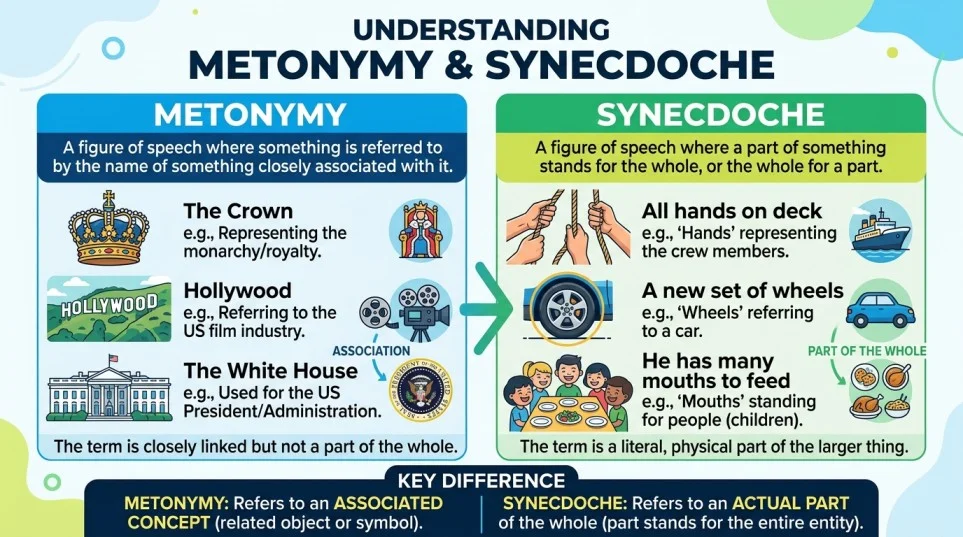
Metonymy is a figure of speech where one thing is called by the name of something closely related to it.
For example, “Hollywood” can mean the American film industry.
In metonymy, the two things are connected, but one is not a part of the other.
History of Metonymy
The word “metonymy” comes from a Greek word that means “change of name.” Ancient Greek writers and speakers used metonymy in speeches and poems to make language stronger and more colorful. Later, Roman writers also used it in literature. Over time, English writers adopted metonymy in stories, politics, and journalism. Today, people use it every day without noticing it. Words like “the Crown” for a king or queen and “Wall Street” for the financial world are common examples. Metonymy helps people speak in a short, smart, and creative way.
What is “Synecdoche”?
Synecdoche is a figure of speech where a part of something stands for the whole thing, or the whole stands for a part.
For example, “wheels” can mean a car.
In synecdoche, there is always a part-and-whole relationship.
History of Synecdoche
The word “synecdoche” comes from a Greek word meaning “understanding one thing with another.” Ancient speakers and poets used it to create strong images in language. Greek and Roman literature often used body parts, tools, or objects to represent larger ideas. English writers later added synecdoche to poems, novels, and speeches. Famous authors like William Shakespeare used it in dramatic ways. Today, people still use synecdoche in daily speech. Saying “all hands on deck” is one example. The phrase uses “hands” to mean workers or sailors.
Metonymy vs Synecdoche
Metonymy uses a related idea to represent something.
Synecdoche uses a part or whole to represent something.
Both make language creative and interesting. Now, let us explore how each one works in real life.
How “Metonymy” Works
Key Features
- Uses related ideas or objects
- No part-and-whole connection
- Common in media and politics
- Makes speech shorter and stronger
- Often symbolic
Examples
🔵 “The White House announced new rules.”
🔵 “Silicon Valley loves new technology.”
Uses
Metonymy is common in education, news, movies, politics, and business. Teachers use it in literature lessons. Journalists use it in headlines. People also use it in daily talk for shorter expressions.
How “Synecdoche” Works
Key Features
- Uses a part for the whole
- Can also use the whole for a part
- Creates vivid images
- Common in poems and stories
- Easy to remember
Examples
🟢 “We need more hands at work.”
🟢 “Nice wheels you bought!”
Uses
Synecdoche appears in literature, speeches, songs, and daily conversation. Writers use it to create emotion and imagery. People also use it casually in speech.
Which One Should You Use?
Use metonymy when two things are closely connected, like a place and an industry.
Use synecdoche when one thing is physically part of another thing, like “hands” for workers.
10 Differences Between Metonymy and Synecdoche
1. Basic Meaning
Metonymy
A related thing replaces another thing.
🔴 “The Crown approved the law.”
🔴 “Hollywood released many movies.”
Synecdoche
A part replaces the whole.
🔴 “We need strong arms here.”
🔴 “New faces joined the team.”
2. Relationship Type
Metonymy
Uses connection or association.
🔴 “The pen is powerful.”
🔴 “Wall Street is nervous.”
Synecdoche
Uses part-and-whole relation.
🔴 “All eyes were on her.”
🔴 “Many mouths need food.”
3. Physical Connection
Metonymy
No physical part is needed.
🔴 “The White House spoke today.”
🔴 “The stage welcomed her.”
Synecdoche
Usually involves a physical part.
🔴 “Four wheels stopped outside.”
🔴 “Extra hands arrived.”
4. Usage Style
Metonymy
Often symbolic and formal.
🔴 “The throne made a decision.”
🔴 “Downing Street responded.”
Synecdoche
Often visual and descriptive.
🔴 “The ship lost many sails.”
🔴 “Fresh blood joined the company.”
5. Common Places
Metonymy
Used in news and politics.
🔴 “Washington reacted quickly.”
🔴 “The Kremlin answered.”
Synecdoche
Used in poems and stories.
🔴 “The classroom had many bright minds.”
🔴 “Strong backs built the road.”
6. Focus
Metonymy
Focuses on association.
🔴 “Broadway loves musicals.”
🔴 “The bench gave the verdict.”
Synecdoche
Focuses on part and whole.
🔴 “New boots entered the army.”
🔴 “The farm needs more hands.”
7. Meaning Depth
Metonymy
Can sound smart or indirect.
🔴 “The suits made the decision.”
🔴 “The palace stayed silent.”
Synecdoche
Feels direct and visual.
🔴 “The engine roared ahead.”
🔴 “The team needs fresh legs.”
8. Everyday Use
Metonymy
Common in media language.
🔴 “The press arrived early.”
🔴 “The crown celebrated.”
Synecdoche
Common in casual speech.
🔴 “Nice threads!”
🔴 “He bought new wheels.”
9. Literary Purpose
Metonymy
Adds symbolic meaning.
🔴 “The bottle ruined his life.”
🔴 “The courtroom listened.”
Synecdoche
Adds strong imagery.
🔴 “Gray hairs filled the room.”
🔴 “Many eyes watched quietly.”
10. Learning Tip
Metonymy
Think “related idea.”
🔴 “The office called today.”
🔴 “The university announced results.”
Synecdoche
Think “part of something.”
🔴 “All hands on deck.”
🔴 “The ranch has many heads of cattle.”
Why People Get Confused About Their Use
People confuse metonymy and synecdoche because both replace one word with another. They also appear in literature and daily speech. The main difference is simple. Metonymy uses a related idea. Synecdoche uses a part or whole relationship.
Table: Difference and Similarity
| Feature | Metonymy | Synecdoche | Similarity |
| Main Idea | Related object | Part or whole | Both replace words |
| Connection | Association | Part-whole | Both are figures of speech |
| Example | “The Crown” | “Hands” | Both shorten language |
| Usage | Politics, media | Literature, speech | Both add style |
| Style | Symbolic | Visual | Both improve writing |
Which is Better in What Situation?
Metonymy is better when you want symbolic or indirect language. It works well in news, speeches, and formal writing. It can make ideas sound powerful and professional.
Synecdoche is better when you want vivid and visual language. It is useful in stories, poems, and daily talk. It helps readers imagine scenes more clearly.
How Are “Metonymy” and “Synecdoche” Used in Metaphors and Similes?
🟣 Metonymy can support metaphors by using symbols like “the crown” for power.
🟣 Synecdoche can strengthen similes with visual images like “busy hands.”
🟣 Both help writers create deeper meanings in poems and stories.
Connotative Meaning
Positive
🟣 “The crown protected the people.”
Meaning: leadership and safety.
🟣 “Helping hands arrived quickly.”
Meaning: kindness and support.
Negative
🟣 “The bottle destroyed the family.”
Meaning: alcohol problems.
🟣 “Loose lips caused trouble.”
Meaning: careless talking.
Neutral
🟣 “The office sent an email.”
Meaning: workplace.
🟣 “New faces came today.”
Meaning: new people.
Idioms or Proverbs
🟣 “All hands on deck”
Meaning: everyone must help.
Example: “During the event, it was all hands on deck.”
🟣 “The pen is mightier than the sword”
Meaning: words are stronger than violence.
Example: “Writers believe the pen is mightier than the sword.”
Works in Literature
🟣 Hamlet — Hamlet by William Shakespeare (1603) — Uses many examples of symbolic language.
🟣 Animal Farm — Animal Farm by George Orwell (1945) — Uses figures of speech to show power and control.
🟣 The Odyssey — The Odyssey by Homer — Rich in poetic imagery and symbolic wording.
Movies Related to the Keywords
🟣 Dead Poets Society — 1989, United States — Strong use of poetic language.
🟣 The King’s Speech — 2010, United Kingdom — Shows powerful speech and symbolism.
🟣 Shakespeare in Love — 1998, United Kingdom/United States — Focuses on creative writing and literary style.
Frequently Asked Questions
1. Is synecdoche a type of metonymy?
Some experts say yes because both use replacement words. Others keep them separate.
2. Which is easier to understand?
Synecdoche is often easier because it uses visible parts like hands or wheels.
3. Is “The White House” metonymy?
Yes. It represents the people in government.
4. Is “all hands on deck” synecdoche?
Yes. “Hands” means workers or sailors.
5. Why are these figures of speech important?
They make language more colorful, creative, and memorable.
Final Words
Metonymy and synecdoche may seem hard at first, but they become easy with practice. Read examples, notice daily speech, and try using both in your own writing. Small language tools can make your English stronger and more expressive.
Conclusion
Understanding the difference between metonymy and synecdoche helps you speak and write more clearly. Metonymy uses related ideas, while synecdoche uses parts and wholes. Both are powerful figures of speech found in books, movies, news, and daily life. When you learn these simple tools, your vocabulary grows and your writing becomes more creative. Keep practicing with easy examples, and soon you will recognize them everywhere around you.

Hi! I am Arshad Ullah presently working as linguist in Punjab Education Department. I have done MA in English Literature while M.Phil in Applied Linguistics. I have taught creative writing to the post graduation classes for 15 years. Presently I am working as content writer, and offering classes for blog writing. On this site, I research each topic from authoritative sources and edit every comparison for accuracy and clear, simple language.