A school band was getting ready for a music show. One student picked up an oboe. Another held a clarinet. Both instruments looked long and black. So, many students thought they were the same. But when they started playing, the sound was very different.
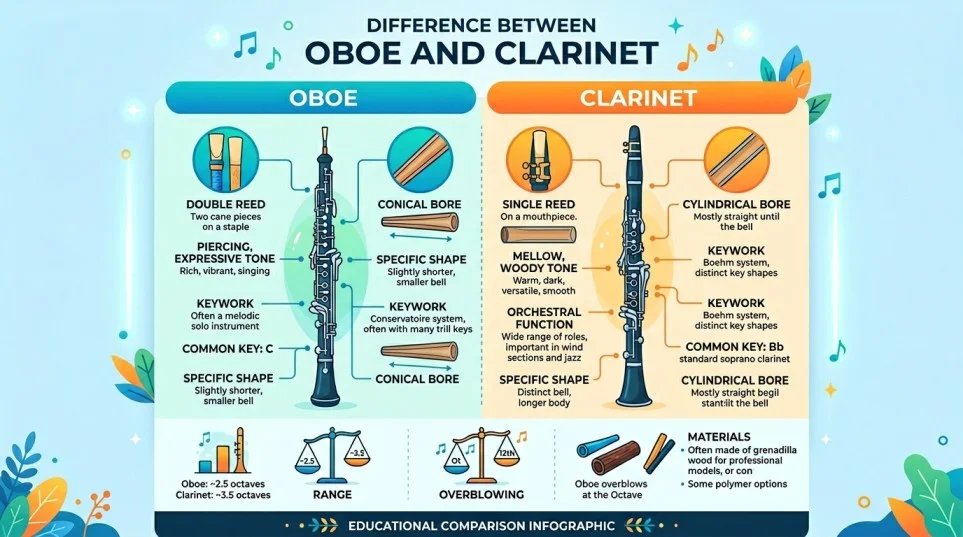
The difference between oboe and clarinet is important for music students, beginners, and instrument lovers. The difference between oboe and clarinet helps people choose the right instrument for school bands, orchestras, and music learning.
Both are woodwind instruments. However, they use different reeds, make different sounds, and feel different while playing. In this guide, you will learn their meanings, history, uses, and main differences in very simple words.
What is “Oboe”?
An Oboe is a woodwind instrument with a double reed. It makes a clear, sharp, and sweet sound. Players blow air through two thin reeds tied together.
The oboe is often used in orchestras and classical music. It usually plays soft and emotional melodies.
History of the Oboe
The oboe started in France during the 1600s. It came from an older instrument called the shawm. French musicians improved its shape and sound. Soon, it became popular in royal courts and orchestras across Europe. During the 1700s and 1800s, makers added more keys to help players perform complex music. Famous composers like Johann Sebastian Bach and Wolfgang Amadeus Mozart used the oboe in their works. Today, the oboe is still important in orchestras, bands, and music schools around the world because of its rich and expressive tone.
What is “Clarinet”?
A Clarinet is a woodwind instrument with a single reed. It creates a smooth, warm, and flexible sound.
The clarinet is used in jazz, bands, orchestras, and folk music. It can play both low and high notes very well.
History of the Clarinet
The clarinet was developed in Germany around the late 1600s. A maker named Johann Christoph Denner improved an older instrument called the chalumeau. He added keys and changed its design. This created the modern clarinet. During the 1700s, the clarinet became popular in orchestras because it had a wide range of sounds. Many composers, including Ludwig van Beethoven, wrote music for it. Later, jazz musicians also loved the clarinet because it could play soft, fast, and emotional music. Today, it is common in schools, bands, and concerts worldwide.
Oboe vs Clarinet
- Oboe: A double-reed woodwind instrument with a bright sound.
- Clarinet: A single-reed woodwind instrument with a warm sound.
Now, let us explore how each instrument works and where people use them.
How “Oboe” Works
The oboe works when a player blows air through two small reeds. The reeds vibrate and create sound.
Key Features
- Uses a double reed
- Bright and sharp tone
- Slim and straight shape
- Common in orchestras
- Needs strong breath control
Example Sentences
🔵 The oboe played a soft tune during the concert.
🔵 My sister practices the oboe every evening.
Uses
- Classical music
- School orchestras
- Music education
- Film music
- Live concerts
How “Clarinet” Works
The clarinet works when air passes through one reed attached to the mouthpiece. This makes the reed vibrate and produce sound.
Key Features
- Uses a single reed
- Warm and smooth tone
- Wide range of notes
- Popular in jazz and bands
- Easier for many beginners
Example Sentences
🟢 The clarinet sounded smooth in the jazz band.
🟢 He learned clarinet in middle school.
Uses
- Jazz music
- School bands
- Classical orchestras
- Folk music
- Solo performances
Which One Should You Use?
Choose the oboe if you like bright and emotional sounds. It is great for orchestras and classical music.
Choose the clarinet if you want a flexible instrument with many music styles. It is often easier for beginners.
10 Differences Between Oboe and Clarinet
1. Reed Type
Oboe: Uses two reeds together.
🔴 The oboe reed looked very small.
🔴 She adjusted both reeds before playing.
Clarinet: Uses one reed attached to the mouthpiece.
🔴 The clarinet player changed his single reed.
🔴 One reed made the clarinet easier to manage.
2. Sound
Oboe: Produces a bright and piercing sound.
🔴 The oboe stood out in the orchestra.
🔴 Its sharp tone filled the hall.
Clarinet: Produces a warm and smooth sound.
🔴 The clarinet sounded soft and rich.
🔴 Its tone blended well with the band.
3. Difficulty
Oboe: Harder to learn because of breath control.
🔴 My friend found the oboe challenging.
🔴 The reeds needed careful control.
Clarinet: Often easier for beginners.
🔴 Many students start with clarinet.
🔴 It felt simpler to play basic notes.
4. Music Style
Oboe: Mostly used in classical music.
🔴 The oboe played in the symphony.
🔴 Classical pieces often include oboe solos.
Clarinet: Used in many music styles.
🔴 Jazz bands love the clarinet.
🔴 Folk musicians also use clarinets.
5. Mouthpiece
Oboe: Does not use a separate mouthpiece.
🔴 The reeds connected directly to the oboe.
🔴 She carefully placed the double reed.
Clarinet: Uses a mouthpiece with a reed.
🔴 The clarinet mouthpiece was black.
🔴 He cleaned the mouthpiece after practice.
6. Shape
Oboe: Slim with a narrow opening.
🔴 The oboe looked thin and elegant.
🔴 Its bell was small.
Clarinet: Slightly wider and more cylindrical.
🔴 The clarinet had a larger bell.
🔴 Its body looked rounder.
7. Breath Pressure
Oboe: Needs strong air pressure.
🔴 Oboe players use focused breathing.
🔴 She became tired after long practice.
Clarinet: Needs less air pressure.
🔴 The clarinet felt easier on the lungs.
🔴 He played longer without stress.
8. Cost
Oboe: Usually more expensive.
🔴 Professional oboes cost a lot.
🔴 Oboe reeds also need replacement.
Clarinet: Often cheaper than oboes.
🔴 Student clarinets are affordable.
🔴 Many schools provide clarinets.
9. Role in Orchestra
Oboe: Often gives tuning notes.
🔴 The orchestra tuned to the oboe.
🔴 Everyone listened to the oboe pitch.
Clarinet: Plays harmony and melody.
🔴 The clarinet joined the melody.
🔴 It blended with other instruments.
10. Popularity
Oboe: Less common among beginners.
🔴 Few students chose oboe class.
🔴 Oboe sections are usually small.
Clarinet: Very popular in schools.
🔴 Many children learn clarinet first.
🔴 School bands often have many clarinets.
Why People Get Confused About Their Use
People get confused because both instruments are black, long, and part of the woodwind family. They also use reeds and appear in orchestras. From far away, they may look similar. However, their sound, reed type, and playing style are very different.
Table: Difference and Similarity
| Feature | Oboe | Clarinet | Similarity |
| Reed | Double reed | Single reed | Both use reeds |
| Sound | Bright | Warm | Both make musical tones |
| Difficulty | Harder | Easier | Both need practice |
| Music Style | Classical | Jazz and classical | Both appear in bands |
| Shape | Narrow | Cylindrical | Both are long instruments |
| Breath Control | Strong | Moderate | Both use airflow |
| Cost | Higher | Lower | Both can be professional instruments |
| Family | Woodwind | Woodwind | Same music family |
Which is Better in What Situation?
The oboe is better for classical music lovers and orchestra players. It gives emotional and clear sounds. People who enjoy detailed music often choose it.
The clarinet is better for beginners and players who like many music styles. It works well in jazz, school bands, and folk music. It is flexible and easier for many students.
How Are “Oboe” and “Clarinet” Used in Metaphors and Similes?
🟣 “Her voice was sharp like an oboe.”
🟣 “His speech flowed like a clarinet melody.”
🟣 “The music room sounded like an orchestra of oboes and clarinets.”
Connotative Meaning
- Oboe: Often gives a serious or elegant feeling.
- Clarinet: Often gives a warm and friendly feeling.
🟣 “The oboe solo created a deep mood.”
🟣 “The clarinet brought joyful energy to the song.”
Idioms or Proverbs
There are no famous English idioms directly about oboes or clarinets. Still, musicians use simple expressions.
🟣 “Face the music” — accept the truth.
Example: He forgot practice time, so he had to face the music.
🟣 “Blow your own horn” — talk proudly about yourself.
Example: She kept blowing her own horn after the concert.
Works in Literature
🟣 The Magic Flute by Wolfgang Amadeus Mozart (1791) includes beautiful woodwind music.
🟣 Peter and the Wolf by Sergei Prokofiev (1936) uses woodwind instruments for characters.
🟣 Boléro by Maurice Ravel (1928) includes famous clarinet passages.
Movies Related to the Keywords
🟣 The Red Violin — 1998, Canada
🟣 Whiplash — 2014, USA
🟣 Fantasia — 1940, USA
Frequently Asked Questions
1. Is an oboe harder than a clarinet?
Yes. Many beginners find the oboe harder because of the double reed.
2. Which instrument is louder?
The oboe often sounds sharper and more noticeable.
3. Can clarinets play jazz music?
Yes. Clarinets are very common in jazz bands.
4. Are both woodwind instruments?
Yes. Both belong to the woodwind family.
5. Which is better for beginners?
Many teachers suggest the clarinet for beginners.
Final Words
Music becomes more fun when you understand instruments clearly. The oboe and clarinet may look alike, but they create very different sounds and feelings. Keep learning, listening, and practicing music every day.
Conclusion
The difference between oboe and clarinet mainly comes from their reeds, sound, and playing style. The oboe uses a double reed and creates a bright tone. The clarinet uses a single reed and gives a warm sound. Both instruments are important in music and have rich histories. The oboe fits classical orchestras very well, while the clarinet works in many styles like jazz and folk music. Beginners often choose the clarinet because it feels easier to play. However, both instruments can create beautiful music with practice and skill. Learning these differences helps students, music lovers, and English learners understand musical vocabulary in a simple and clear way.

Hi! I am Arshad Ullah presently working as linguist in Punjab Education Department. I have done MA in English Literature while M.Phil in Applied Linguistics. I have taught creative writing to the post graduation classes for 15 years. Presently I am working as content writer, and offering classes for blog writing.