Imagine you own a small bakery. Every day, you count how many cakes you sell. You also check if your monthly sales goal is growing. These numbers help you understand your business. But are they all the same? Not really.
Many people get confused about the difference between metrics and KPIs. They both use numbers, but they have different jobs. Understanding the difference between metrics and KPIs can help students, workers, and business owners make better decisions.
This topic is useful in school, offices, marketing, sports, and even daily life. When you know what to measure, you can improve faster. In this guide, you will learn everything in very simple words with easy examples.
What is “Metrics”?
Metrics are numbers that measure activity or performance. They show what is happening in a process or task.
For example, website visitors, daily sales, and student attendance are metrics. They give information and help people track progress.
History of Metrics
The idea of metrics started many centuries ago. Ancient traders used numbers to measure goods, money, and work. Later, factories used metrics during the Industrial Revolution to improve production. In the 20th century, companies began using business metrics to study profit, customer service, and employee work. Today, metrics are everywhere. Schools use grades and attendance metrics. Social media apps use likes and views as metrics. Businesses use many kinds of metrics to understand performance and make better plans for the future.
What is “KPIs”?
KPIs stand for Key Performance Indicators. They are special metrics that measure important goals.
A KPI helps people know if they are reaching success. For example, increasing sales by 20% is a KPI. It focuses on a major target.
History of KPIs
KPIs became popular in business management during the 1980s and 1990s. Companies wanted better ways to measure success and long-term goals. Business experts created KPI systems to focus on the most important results instead of too many numbers. Over time, schools, hospitals, sports teams, and online businesses also started using KPIs. Today, KPIs help organizations track growth, customer happiness, profit, and performance. They are now an important part of planning and decision-making in many industries around the world.
Metrics vs KPIs
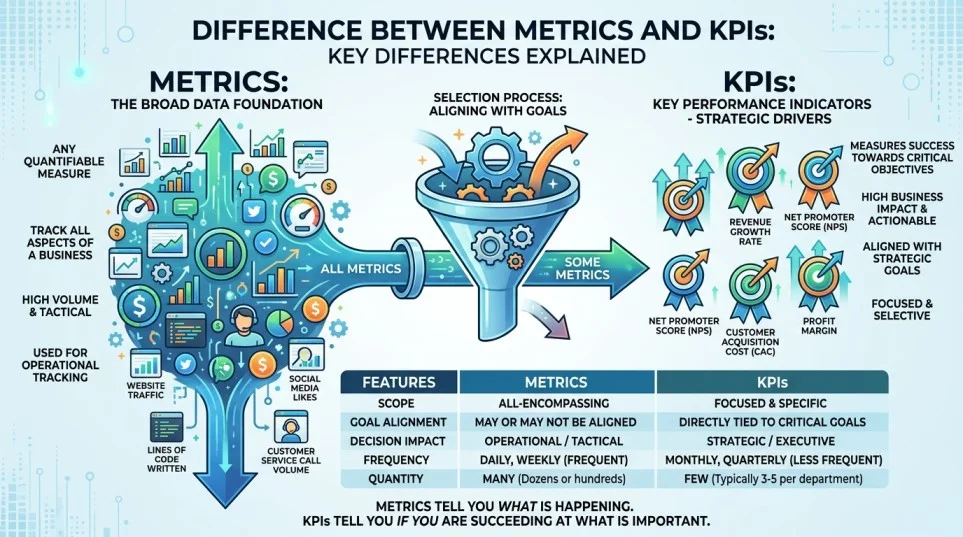
Metrics measure general performance. KPIs measure important success goals.
Both use numbers, but they answer different questions. Now, let us explore them in detail.
How “Metrics” Works
Metrics collect data and show performance over time.
Key Features
- Measure activities and processes
- Can track many things
- Give detailed information
- Help analyze performance
- Used in reports and studies
Example Sentences
🔵 The company tracks website traffic as a metric.
🔵 My teacher uses attendance metrics every month.
Uses
- Education
- Business reports
- Fitness tracking
- Website analysis
- Daily budgeting
- Sports performance
How “KPIs” Works
KPIs focus on the most important goals. They help people see if success is happening.
Key Features
- Goal-focused
- Measure success
- Easy to understand
- Linked with targets
- Help decision-making
Example Sentences
🟢 The store’s KPI is to increase sales this year.
🟢 Customer satisfaction is an important KPI for the hotel.
Uses
- Business planning
- Marketing campaigns
- Employee performance
- School improvement goals
- Project management
Which One Should You Use?
Use metrics when you want detailed information about activities and performance. Use KPIs when you want to measure important goals and success. Most businesses use both together because they support each other.
10 Differences Between Metrics and KPIs
1. Purpose
Metrics: Measure general activities.
🔴 Website visits increased this week.
🔴 The school tracked attendance numbers.
KPIs: Measure key success goals.
🔴 The company reached its sales target.
🔴 The team improved customer satisfaction.
2. Importance
Metrics: Not always critical.
🔴 Social media likes are metrics.
🔴 Daily clicks are metrics.
KPIs: Very important for success.
🔴 Monthly profit growth is a KPI.
🔴 Customer retention is a KPI.
3. Focus
Metrics: Focus on details.
🔴 Email open rates are metrics.
🔴 Number of calls is a metric.
KPIs: Focus on main goals.
🔴 Revenue growth is a KPI.
🔴 Student pass rate is a KPI.
4. Quantity
Metrics: Businesses can have many metrics.
🔴 A website tracks many numbers.
🔴 A school measures many activities.
KPIs: Usually fewer in number.
🔴 A company may have five KPIs.
🔴 A team may focus on one KPI.
5. Decision-Making
Metrics: Help with analysis.
🔴 Managers study traffic metrics.
🔴 Teachers study grade metrics.
KPIs: Help with major decisions.
🔴 Leaders use KPIs for planning.
🔴 Owners use KPIs for growth goals.
6. Goal Connection
Metrics: May not connect directly to goals.
🔴 Number of followers is a metric.
🔴 Total emails sent is a metric.
KPIs: Directly linked with goals.
🔴 Sales target achievement is a KPI.
🔴 Employee retention is a KPI.
7. Complexity
Metrics: Can be simple or detailed.
🔴 Daily visitors are metrics.
🔴 Traffic reports are metrics.
KPIs: Usually simple and clear.
🔴 Profit increase is a KPI.
🔴 Customer happiness score is a KPI.
8. Time Frame
Metrics: Often measured daily or weekly.
🔴 Daily steps are metrics.
🔴 Weekly website visits are metrics.
KPIs: Often measured monthly or yearly.
🔴 Annual growth is a KPI.
🔴 Quarterly revenue target is a KPI.
9. Examples
Metrics: Attendance, clicks, views.
🔴 The app tracks user clicks.
🔴 The gym tracks daily visits.
KPIs: Sales goals, customer loyalty.
🔴 The store tracks yearly profit.
🔴 The hospital tracks patient recovery rates.
10. Relationship
Metrics: Can support KPIs.
🔴 Website traffic supports sales analysis.
🔴 Study hours support exam preparation.
KPIs: Use metrics for success measurement.
🔴 Revenue KPI uses sales metrics.
🔴 School success KPI uses grade metrics.
Why People Get Confused About Their Use
People get confused because KPIs are also metrics. The difference is that KPIs are the most important metrics. Both use numbers and reports, so they look similar. Many companies also use the words together, which creates confusion for beginners.
Table: Difference and Similarity
| Feature | Metrics | KPIs | Similarity |
| Meaning | General measurements | Important success measurements | Both use numbers |
| Purpose | Track activities | Track goals | Both measure performance |
| Importance | Less critical | Highly important | Both help improvement |
| Quantity | Many | Few | Both can be tracked regularly |
| Goal Link | Not always linked | Directly linked | Both support decisions |
| Usage | Detailed analysis | Strategic planning | Both used in business |
Which is Better in What Situation?
Metrics are better when you need detailed information. For example, a website owner may track clicks, views, and visitors to understand user behavior. Metrics help people study performance deeply.
KPIs are better when you want to measure success. A business may use profit growth or customer satisfaction as KPIs. They help leaders focus on the most important goals and results.
How Are “Metrics” and “KPIs” Used in Metaphors and Similes?
🟣 Metrics are like a car dashboard showing every detail.
🟣 KPIs are like the fuel warning light showing what matters most.
🟣 Metrics are like puzzle pieces. KPIs are the final picture.
🟣 KPIs shine like a lighthouse guiding a ship.
Connotative Meaning
Metrics: Mostly neutral and professional.
🟣 “The manager checked the metrics carefully.”
KPIs: Positive because they connect with success.
🟣 “The company celebrated reaching its KPIs.”
Idioms or Proverbs
🟣 “Numbers do not lie.”
Meaning: Data shows the truth.
Example: The sales numbers proved the new plan worked.
🟣 “Keep your eye on the prize.”
Meaning: Stay focused on the goal.
Example: The team followed KPIs to reach success.
Works in Literature
🟣 The Balanced Scorecard by Robert Kaplan and David Norton (1996) discusses KPIs and performance management.
🟣 Measure What Matters by John Doerr (2017) explains goals, KPIs, and business growth.
Movies Related to the Keywords
🟣 Moneyball (2011, USA) shows how data and metrics improve baseball performance.
🟣 The Founder (2016, USA) shows business growth using performance tracking and goals.
Frequently Asked Questions
1. Are KPIs and metrics the same?
No. KPIs are important metrics linked to goals.
2. Can a metric become a KPI?
Yes. A metric becomes a KPI when it measures a key goal.
3. Why do businesses use KPIs?
Businesses use KPIs to track success and growth.
4. What is a simple example of a metric?
Website visitors are a common metric.
5. What is a simple example of a KPI?
Monthly sales growth is a KPI.
Final Words
Metrics and KPIs help people understand progress and success. They may look similar, but they serve different purposes. When you learn how to use them correctly, decision-making becomes easier and smarter. Keep learning and practicing with real-life examples.
Conclusion
Understanding the difference between metrics and KPIs is very important in today’s world. Metrics give detailed information about activities, while KPIs focus on the most important goals. Both work together to improve performance and support better decisions. Students, businesses, teachers, and workers all use them in different ways. Once you know their roles, it becomes easier to measure success clearly. Start using metrics for tracking and KPIs for goal-setting, and you will understand progress much better.

Hi! I am Arshad Ullah presently working as linguist in Punjab Education Department. I have done MA in English Literature while M.Phil in Applied Linguistics. I have taught creative writing to the post graduation classes for 15 years. Presently I am working as content writer, and offering classes for blog writing.