Ali bought a new mobile phone. Then he visited a mobile shop to get a SIM card. The shopkeeper asked, “Do you want prepaid or postpaid?” Ali felt confused because he did not know the difference between postpaid and prepaid.
Many people face this same problem every day. The difference between postpaid and prepaid is important because it affects your phone bills, internet use, and monthly budget. Students, workers, and families all use these mobile plans in different ways.
Understanding the difference between postpaid and prepaid helps people choose the right option for daily life. Some users want control over spending, while others want convenience and extra services. This guide explains both terms in simple English with clear examples, easy comparisons, and practical situations.
What is “Postpaid”?
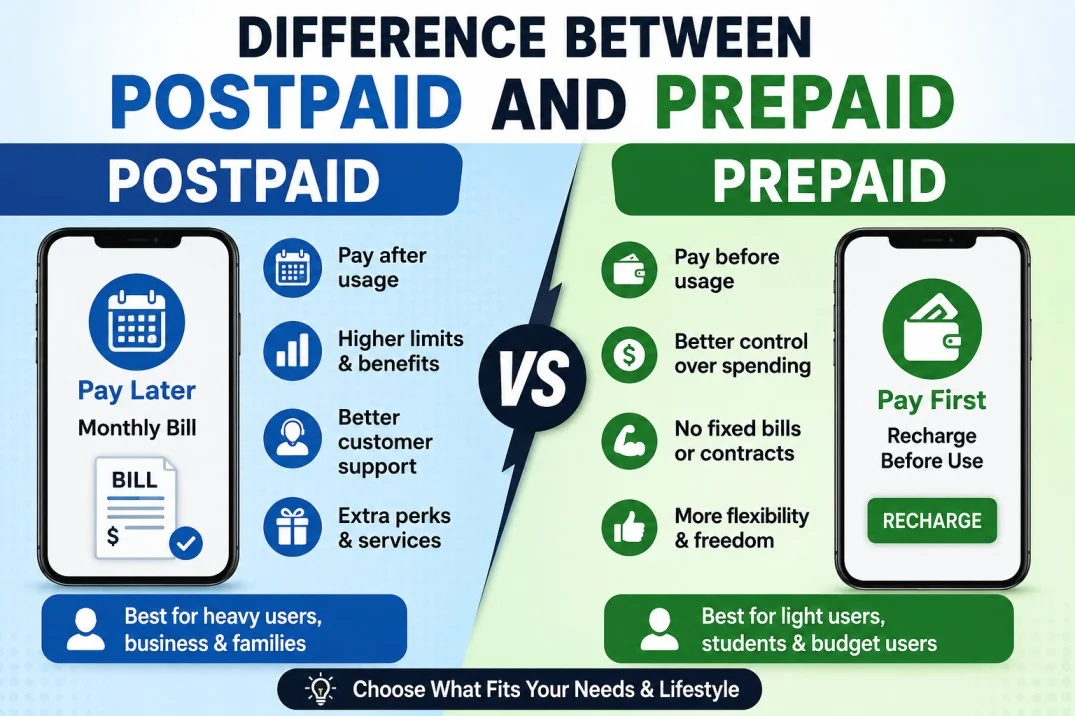
Postpaid is a mobile plan where you use services first and pay later. At the end of the month, the company sends a bill for calls, messages, and internet use.
What is “Prepaid”?
Prepaid is a mobile plan where you pay first before using mobile services. You recharge your balance in advance.
History of Postpaid
Postpaid mobile service became popular in the 1980s and 1990s when mobile phones first spread around the world. At that time, most companies used billing systems because mobile services were expensive. Customers received monthly bills after using calls and messages. Business users mainly used postpaid plans because they needed reliable service and larger call packages. Over time, telecom companies added internet data, family bundles, and international services. Today, postpaid plans are common for people who want unlimited services, fixed monthly packages, and extra customer support.
History of Prepaid
Prepaid mobile service started becoming popular in the 1990s. It helped people use mobile phones without monthly contracts or large bills. Users could recharge small amounts whenever needed. This system became very popular among students and low-income users because it gave better spending control. Prepaid plans spread quickly in many countries because they were simple and flexible. As mobile technology improved, prepaid users also got internet packages, social media bundles, and online recharge options. Today, millions of people around the world use prepaid SIM cards for easy and budget-friendly communication.
Postpaid vs Prepaid
Postpaid means “use first, pay later.”
Prepaid means “pay first, use later.”
Now let us look deeper into how both systems work in daily life.
How Postpaid Works
In a postpaid plan, the company gives you services for one month. After the month ends, you receive a bill.
Key Features
- Monthly billing system
- Better for heavy users
- Often includes extra benefits
- May require a contract
- Easy automatic payments
🔵 She used unlimited internet with her postpaid plan.
🔵 My father pays his phone bill at the end of every month.
Uses
- Business communication
- Office work
- Online meetings
- Heavy internet use
- Family packages
How Prepaid Works
In a prepaid plan, you recharge money before using calls, texts, or internet data.
Key Features
- Pay before use
- Better spending control
- No monthly bill
- Easy recharge options
- No long contract
🟢 I recharged my prepaid SIM yesterday.
🟢 Students often use prepaid internet packages.
Uses
- Student budgets
- Temporary phone use
- Travel communication
- Emergency balance use
- Daily internet packages
Which One Should You Use?
If you use a lot of internet and calls every day, postpaid may be better. It gives convenience and larger packages.
If you want to control spending and avoid surprise bills, prepaid is a smarter choice.
10 Differences Between Postpaid and Prepaid
1. Payment Time
Postpaid
You pay after using services.
🔴 He received his bill at month’s end.
🔴 They used data first and paid later.
Prepaid
You pay before using services.
🔴 She bought recharge credit first.
🔴 I added balance before calling.
2. Monthly Bills
Postpaid
Monthly bills are included.
🔴 My postpaid bill arrived yesterday.
🔴 He checks his monthly usage online.
Prepaid
No monthly bill exists.
🔴 I recharge only when needed.
🔴 She has no fixed phone bill.
3. Spending Control
Postpaid
Spending can increase easily.
🔴 He used extra internet accidentally.
🔴 Her bill became very high.
Prepaid
Users control spending better.
🔴 I stopped using data after balance ended.
🔴 Students like prepaid for budgeting.
4. Contracts
Postpaid
Often needs contracts.
🔴 He signed a one-year mobile contract.
🔴 The company offered a long-term package.
Prepaid
Usually no contract exists.
🔴 I can stop anytime.
🔴 Travelers prefer prepaid SIMs.
5. Internet Packages
Postpaid
Large internet bundles are common.
🔴 She streams movies daily.
🔴 My office uses postpaid data plans.
Prepaid
Smaller packages are common.
🔴 I buy daily internet bundles.
🔴 He uses weekly recharge offers.
6. Customer Support
Postpaid
Better support services are common.
🔴 The company solved his issue quickly.
🔴 VIP support came with the plan.
Prepaid
Basic support is more common.
🔴 She contacted normal customer care.
🔴 Recharge problems took time.
7. Credit Check
Postpaid
Some companies check financial records.
🔴 He showed identity documents.
🔴 The company checked payment history.
Prepaid
Usually no credit check happens.
🔴 I bought a SIM easily.
🔴 Students quickly activate prepaid cards.
8. Flexibility
Postpaid
Less flexible because of contracts.
🔴 He could not change the plan early.
🔴 Cancellation fees were expensive.
Prepaid
More flexible and easy to change.
🔴 She changed packages anytime.
🔴 I switched networks easily.
9. Best Users
Postpaid
Good for heavy users.
🔴 Office workers prefer postpaid.
🔴 Families often share postpaid plans.
Prepaid
Good for light users.
🔴 Teenagers often use prepaid.
🔴 Travelers buy temporary prepaid SIMs.
10. Surprise Costs
Postpaid
Extra charges may happen.
🔴 His international calls increased the bill.
🔴 Roaming charges surprised her.
Prepaid
Costs stay limited to balance amount.
🔴 My balance ended before extra use.
🔴 She avoided surprise charges.
Why People Get Confused About Their Use
Many people confuse postpaid and prepaid because both provide the same mobile services like calls, texts, and internet. The main difference is the payment method. Some users also think postpaid always costs more, but that depends on usage. Marketing offers from telecom companies can also confuse beginners.
Table: Difference and Similarity
| Feature | Postpaid | Prepaid | Similarity |
| Payment | Pay later | Pay first | Both need payment |
| Bills | Monthly bill | No bill | Both offer mobile service |
| Contracts | Often included | Usually none | Both use SIM cards |
| Spending Control | Lower | Higher | Both offer data packages |
| Flexibility | Less flexible | More flexible | Both support calls and texts |
| Users | Heavy users | Budget users | Both work on mobile networks |
Which is Better in What Situation?
Postpaid is better for people who use large amounts of internet, business calls, and family packages. It is also useful for users who want convenience and do not want frequent recharges.
Prepaid is better for students, travelers, and people with limited budgets. It helps control spending and avoids large monthly bills. Many users choose prepaid for flexibility and simple recharge options.
How Are “Postpaid” and “Prepaid” Used in Metaphors and Similes?
🟣 “Postpaid life” can describe enjoying now and paying later.
🟣 “Prepaid thinking” can describe careful planning before action.
🟣 “His spending style is like a postpaid plan” means he spends freely first.
🟣 “Her budget works like prepaid credit” means she plans money carefully.
Connotative Meaning
- Positive
🟣 Postpaid suggests comfort and convenience.
🟣 Prepaid suggests control and smart budgeting. - Negative
🟣 Postpaid may suggest debt or overspending.
🟣 Prepaid may suggest limited resources. - Neutral
🟣 Both simply describe payment systems for mobile services.
Idioms or Proverbs
🟣 “Pay as you go”
Meaning: Pay little by little when needed.
Example: Prepaid users often follow a “pay as you go” style.
🟣 “Cut your coat according to your cloth”
Meaning: Spend according to your budget.
Example: Many prepaid users follow this idea.
Works in Literature
🟣 The Mobile Society by Manuel Castells (2004) discusses mobile communication systems.
🟣 Digital Disconnect by Robert McChesney (2013) explains technology and telecom culture.
Movies Related to the Keywords
🟣 Her (2013, USA) shows modern mobile communication and technology use.
🟣 The Social Network (2010, USA) connects with digital communication culture.
🟣 Disconnect (2012, USA) explores technology and communication in modern life.
Frequently Asked Questions
1. What is the main difference between postpaid and prepaid?
Postpaid means pay later. Prepaid means pay first.
2. Which is cheaper?
Prepaid is often cheaper for light users.
3. Is postpaid better for internet use?
Yes, many heavy internet users prefer postpaid plans.
4. Can students use postpaid?
Yes, but many students choose prepaid because it controls spending.
5. Can I switch from prepaid to postpaid?
Yes, most telecom companies allow switching.
Final Words
Choosing between postpaid and prepaid depends on your lifestyle, budget, and phone usage. Both systems have benefits. Learn your needs first, then choose the option that makes daily life easier and smarter.
Conclusion
Understanding the difference between postpaid and prepaid helps people make better mobile service choices. Postpaid gives convenience, larger packages, and monthly billing. Prepaid gives flexibility, spending control, and easy recharge options. Both systems are useful in different situations. Students may prefer prepaid for budgeting, while office workers may choose postpaid for heavy usage. Learning the difference between postpaid and prepaid also improves technology vocabulary and daily communication knowledge. When users understand both systems clearly, they can save money and choose the best mobile plan with confidence.

Hi! I am Arshad Ullah presently working as linguist in Punjab Education Department. I have done MA in English Literature while M.Phil in Applied Linguistics. I have taught creative writing to the post graduation classes for 15 years. Presently I am working as content writer, and offering classes for blog writing. On this site, I research each topic from authoritative sources and edit every comparison for accuracy and clear, simple language.








1 thought on “30 Differences Between Postpaid and Prepaid — Simple Guide”