The terms Scandinavian and Nordic are often used in daily talk, travel, and news. Imagine a traveler visiting Northern Europe. They go to Sweden, then Finland, and say, “I love Scandinavian countries.” But this is not fully correct. This simple mix-up shows the difference between Scandinavian and Nordic.
The word Scandinavian refers to a smaller group of countries, while Nordic includes a wider region. Many people use these words in the same way, but they are not the same.
In this article, we will explain the difference between Scandinavian and Nordic in simple language with examples, pronunciation, and real-life use.
Scandinavian vs Nordic
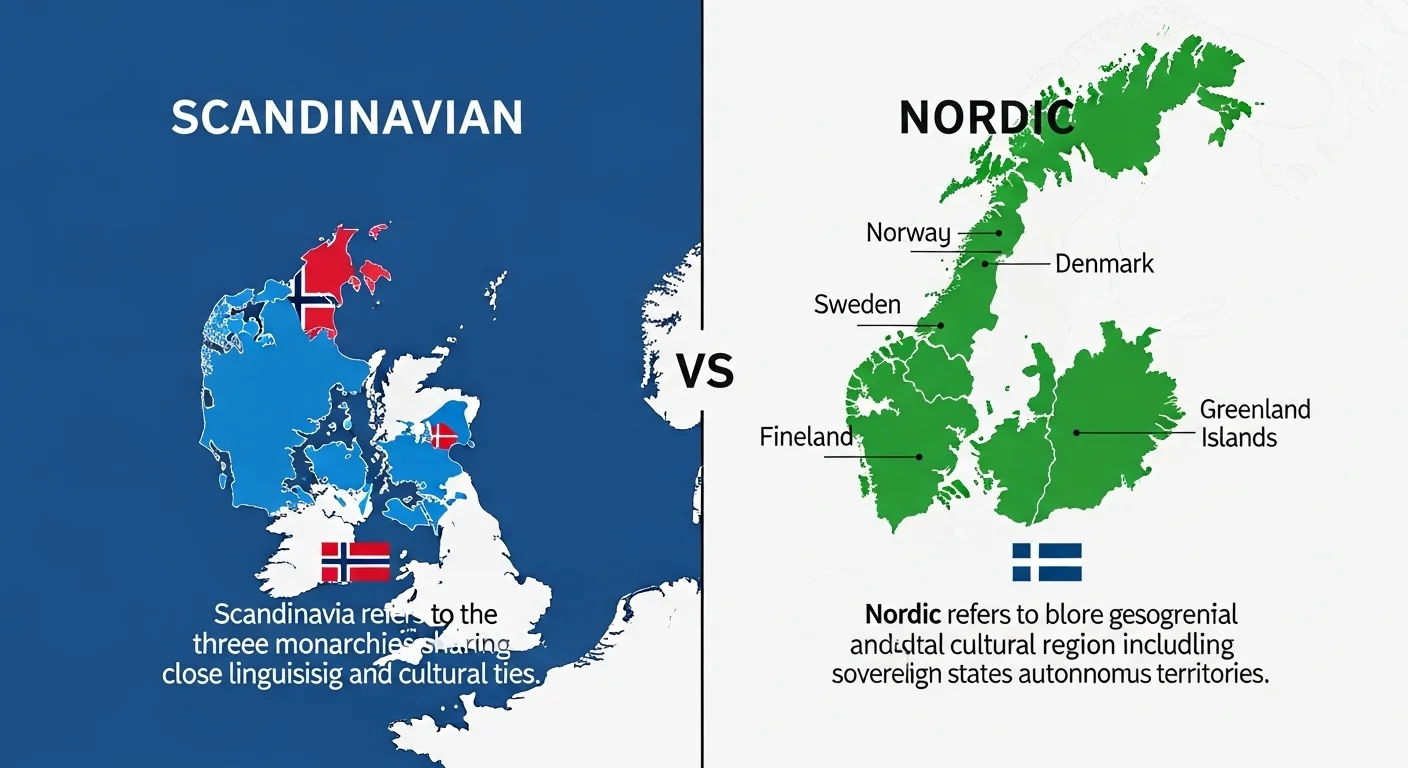
The main difference between Scandinavian and Nordic is about size and inclusion. Scandinavian countries are part of the Nordic region, but Nordic countries include more areas than Scandinavia.
Why Is Their Difference Necessary to Know?
Knowing the difference between Scandinavian and Nordic is important in education, travel, and global communication. It helps people speak correctly about regions, culture, and identity. For learners, it improves vocabulary and accuracy. For experts, it supports clear research and writing. In society, using correct terms shows respect for people’s identity and geography.
Pronunciation (US & UK)
- Scandinavian
US: /ˌskændɪˈneɪviən/
UK: /ˌskændɪˈneɪviən/ - Nordic
US: /ˈnɔːrdɪk/
UK: /ˈnɔːdɪk/
Now, let’s explore the main differences in detail.
A List of 10 Differences Between Scandinavian & Nordic
1. Definition
- Scandinavian: Refers to Denmark, Norway, and Sweden
🔴 She traveled across Scandinavian countries.
🟣 Scandinavian culture is rich and old. - Nordic: Includes Denmark, Norway, Sweden, Finland, and Iceland
🔴 Nordic countries have strong economies.
🟣 Finland is part of the Nordic group.
2. Number of Countries
- Scandinavian: 3 countries
🔴 There are three Scandinavian nations.
🟣 Sweden is one of them. - Nordic: 5 countries
🔴 Nordic region has five countries.
🟣 Iceland is also included.
3. Geography
- Scandinavian: Mainly mainland Europe
🔴 Norway is in Scandinavia.
🟣 Sweden shares land borders. - Nordic: Includes islands too
🔴 Iceland is an island nation.
🟣 Nordic region spreads wide.
4. Language
- Scandinavian: Similar languages (Danish, Swedish, Norwegian)
🔴 These languages are close.
🟣 People understand each other. - Nordic: Different languages (Finnish, Icelandic added)
🔴 Finnish is very different.
🟣 Icelandic is unique.
5. Culture
- Scandinavian: Shared traditions
🔴 Food and dress are similar.
🟣 Festivals are alike. - Nordic: More diverse culture
🔴 Finland has different customs.
🟣 Iceland has unique traditions.
6. History
- Scandinavian: Viking history
🔴 Vikings came from Scandinavia.
🟣 Their stories are famous. - Nordic: Broader history
🔴 Nordic history includes more groups.
🟣 It is more diverse.
7. Political Cooperation
- Scandinavian: Informal ties
🔴 They share values.
🟣 Cooperation is natural. - Nordic: Formal group (Nordic Council)
🔴 Nordic countries work together.
🟣 They have official meetings.
8. Climate
- Scandinavian: Cold but moderate
🔴 Sweden has cold winters.
🟣 Denmark is milder. - Nordic: Wider climate range
🔴 Iceland is very cold.
🟣 Finland has snowy winters.
9. Identity
- Scandinavian: Narrow identity
🔴 People identify as Scandinavian.
🟣 It is a smaller group. - Nordic: Wider identity
🔴 People say Nordic region.
🟣 It includes more nations.
10. Usage in English
- Scandinavian: More specific
🔴 Use it for three countries.
🟣 It is more exact. - Nordic: More general
🔴 Use it for all five.
🟣 It is broader.
Nature and Behaviour of Both
Scandinavian countries are closely connected in language and culture. They often act in similar ways. Nordic countries show more diversity but still share values like equality, peace, and cooperation.
Why People Get Confused About Their Use
People often mix these terms because they are close in location and share history. Media and travel guides also use them loosely, which increases confusion.
Table: Difference and Similarity
| Feature | Scandinavian | Nordic |
| Countries | 3 | 5 |
| Region Size | Smaller | Larger |
| Languages | Similar | Diverse |
| Culture | Shared | Mixed |
| Geography | Mainland | Mainland + Islands |
| Similarity | Both are in Northern Europe and share values |
Which Is Better in What Situation?
Use Scandinavian when you talk about Denmark, Norway, and Sweden only. It is best for specific cultural or language topics. This word is useful in history and language studies.
Use Nordic when you include Finland and Iceland. It is better for general discussions, politics, and regional cooperation. This term is common in global reports and education.
How Are the Keywords Used in Metaphors and Similes?
🟣 “Cold as a Nordic winter” (very cold)
🟣 “Calm like Scandinavian lakes” (peaceful nature)
Connotative Meaning
- Scandinavian:
Positive: modern, peaceful
Neutral: regional term
Negative: sometimes seen as limited - Nordic:
Positive: inclusive, strong
Neutral: geographic term
Negative: may feel too broad
Idioms or Proverbs
🟣 “As cool as a Nordic breeze” – calm person
🟣 “Strong like a Scandinavian spirit” – brave person
Works in Literature
🟣 Nordic Mythology — Fantasy, Neil Gaiman, 2017
🟣 Scandinavian Folk Tales — Folklore, Various authors
Movies
🟣 The Hunt (2012, Denmark)
🟣 Rams (2015, Iceland)
Frequently Asked Questions
- What is the main difference?
Scandinavian is smaller; Nordic is larger. - Is Finland Scandinavian?
No, it is Nordic only. - Is Iceland Scandinavian?
No, it is Nordic. - Can we use them the same way?
No, they have different meanings. - Which is more correct?
It depends on the context.
How Are Both Useful for Surroundings?
Both regions show strong systems in education, environment care, and equality. They inspire the world with clean cities, green energy, and peaceful societies.
Final Words for Both
Scandinavian is precise and focused. Nordic is broad and inclusive. Both words are useful when used correctly.
Conclusion
Understanding the difference between Scandinavian and Nordic helps improve clear communication. These words are not the same, even though they are related. Scandinavian refers to three countries, while Nordic includes five. Learning this difference helps in studies, travel, and writing. It also builds confidence in English and avoids common mistakes. With simple practice, you can use both words correctly in daily life.

Hi! I am Arshad Ullah presently working as linguist in Punjab Education Department. I have done MA in English Literature while M.Phil in Applied Linguistics. I have taught creative writing to the post graduation classes for 15 years. Presently I am working as content writer, and offering classes for blog writing.