Imagine you eat rice, chicken, and vegetables for lunch. After eating, you feel full and active. But have you ever thought about what gives your body energy and keeps you healthy? This is where nutrients become important.
Many people want to understand the difference between macro and micronutrients because both help the body in different ways. The difference between macro and micronutrients is simple once you learn what each one does.
Macronutrients give your body energy and strength. Micronutrients help your body grow, heal, and stay healthy. Both are important for daily life, fitness, study, and work.
Learning this topic can help you make better food choices. It can also improve your health and energy levels in a simple way.
What is “Macronutrients”?
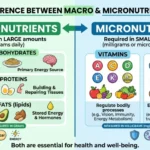
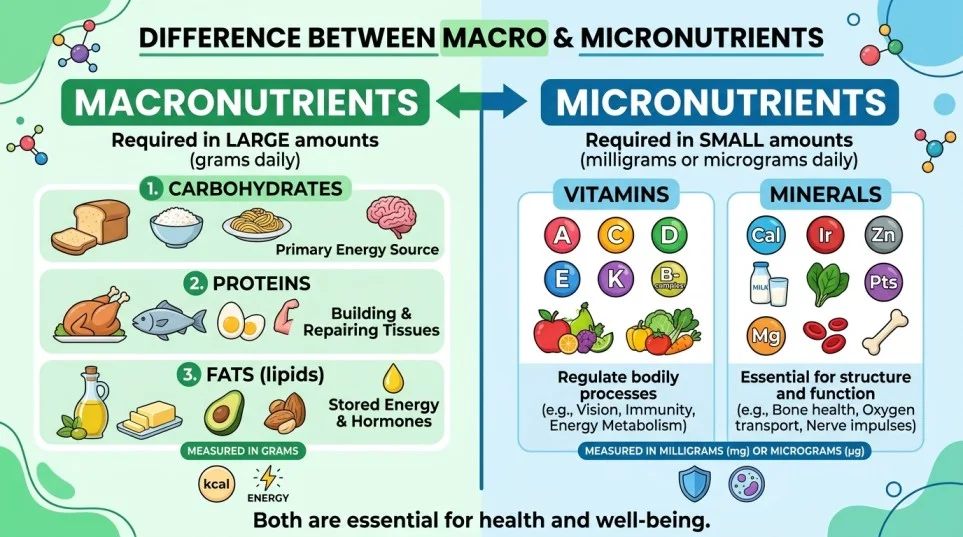
Macronutrients are nutrients the body needs in large amounts. They give energy and support body growth. The three main macronutrients are carbohydrates, proteins, and fats.
Carbohydrates give quick energy. Proteins help build muscles. Fats support the brain and protect organs.
History of Macronutrients
The idea of macronutrients became popular in the 1800s when scientists started studying food and energy. Researchers learned that carbohydrates, proteins, and fats give calories to the body. Later, fitness experts and doctors used this knowledge to create healthy diets. Today, athletes, students, and workers all learn about macronutrients to improve health and performance. Modern food labels also show macronutrients clearly so people can track what they eat every day.
What is “Micronutrients”?
Micronutrients are nutrients the body needs in small amounts. These include vitamins and minerals. They help the body stay healthy and work properly.
Examples include vitamin C, iron, calcium, and vitamin D.
History of Micronutrients
Scientists discovered micronutrients later than macronutrients. In the early 1900s, researchers found that some diseases happened because people lacked certain vitamins or minerals. For example, lack of vitamin C caused scurvy. Lack of vitamin D caused weak bones. These discoveries changed nutrition science forever. Governments later added vitamins and minerals to foods to improve public health. Today, doctors teach people about micronutrients because they support immunity, bones, blood, skin, and overall wellness.
Macronutrients vs Micronutrients
Macronutrients are nutrients needed in large amounts for energy. Micronutrients are nutrients needed in small amounts for health and body functions.
Now, let’s explore how both work in daily life.
How “Macronutrients” Works
Macronutrients fuel the body and support body functions.
Key Features
- Needed in large amounts
- Give calories and energy
- Include carbs, proteins, and fats
- Help muscle growth and repair
- Support daily body activities
Example Sentences
🔵 I eat protein after exercise to build muscle.
🔵 Rice and bread give the body quick energy.
Uses
- Sports and fitness
- Bodybuilding
- Daily energy
- Weight management
- Healthy meal planning
How “Micronutrients” Works
Micronutrients protect the body and help important body systems.
Key Features
- Needed in small amounts
- Include vitamins and minerals
- Support immunity and health
- Help bones, blood, and skin
- Prevent nutrient deficiency diseases
Example Sentences
🟢 Oranges give vitamin C for better immunity.
🟢 Milk contains calcium for strong bones.
Uses
- Better immunity
- Healthy skin and hair
- Strong bones and teeth
- Brain function
- Disease prevention
Which One Should You Use?
You need both macronutrients and micronutrients. Macronutrients give energy for work and movement. Micronutrients keep the body balanced and healthy. A healthy diet includes both every day.
10 Differences Between Macro and Micronutrients
1. Amount Needed
Macronutrients: Needed in large amounts.
🔴 The body needs protein daily.
🔴 Carbohydrates are eaten in bigger portions.
Micronutrients: Needed in small amounts.
🔴 Iron is needed in tiny amounts.
🔴 Vitamin A is important but small in quantity.
2. Main Function
Macronutrients: Give energy and strength.
🔴 Bread gives energy quickly.
🔴 Protein repairs muscles after exercise.
Micronutrients: Support body health.
🔴 Calcium strengthens bones.
🔴 Zinc supports immunity.
3. Types
Macronutrients: Include carbs, fats, and proteins.
🔴 Rice is a carbohydrate.
🔴 Fish contains healthy fats.
Micronutrients: Include vitamins and minerals.
🔴 Spinach has iron.
🔴 Citrus fruits contain vitamin C.
4. Calories
Macronutrients: Provide calories.
🔴 Fat gives high calories.
🔴 Protein also gives energy.
Micronutrients: Do not provide calories.
🔴 Vitamin D gives no calories.
🔴 Calcium has no energy value.
5. Quantity in Food
Macronutrients: Found in larger amounts in meals.
🔴 A plate of rice has many carbs.
🔴 Chicken contains lots of protein.
Micronutrients: Found in tiny amounts.
🔴 Fruits contain small amounts of vitamins.
🔴 Nuts have minerals in smaller levels.
6. Deficiency Effects
Macronutrients: Lack causes weakness and low energy.
🔴 Low protein may weaken muscles.
🔴 Low carbs can cause tiredness.
Micronutrients: Lack causes diseases.
🔴 Low iron may cause anemia.
🔴 Low vitamin D may weaken bones.
7. Digestion
Macronutrients: Need longer digestion.
🔴 Fat takes more time to digest.
🔴 Protein digestion is slower than sugar.
Micronutrients: Absorbed in small amounts.
🔴 Vitamins enter the blood quickly.
🔴 Minerals support body processes silently.
8. Sources
Macronutrients: Found in grains, meat, and oils.
🔴 Bread contains carbohydrates.
🔴 Eggs provide protein.
Micronutrients: Found in fruits and vegetables.
🔴 Carrots contain vitamin A.
🔴 Bananas contain potassium.
9. Storage in Body
Macronutrients: Stored for energy use.
🔴 Fat is stored in body tissues.
🔴 Carbs are stored as glycogen.
Micronutrients: Stored in smaller amounts.
🔴 Vitamin B is not stored much.
🔴 Iron is stored carefully in the body.
10. Importance in Diet
Macronutrients: Important for daily energy.
🔴 Athletes need more protein.
🔴 Workers need carbs for energy.
Micronutrients: Important for protection and balance.
🔴 Children need calcium for growth.
🔴 Vitamin C helps fight illness.
Why People Get Confused About Their Use
People often get confused because both macronutrients and micronutrients are nutrients. Both are found in food and help the body. However, macronutrients mainly give energy, while micronutrients mainly protect health. The names also sound similar, which makes learning harder for beginners.
Table: Difference and Similarity
| Feature | Macronutrients | Micronutrients | Similarity |
| Amount Needed | Large amounts | Small amounts | Both are important |
| Main Job | Give energy | Support health | Both help the body |
| Types | Carbs, proteins, fats | Vitamins, minerals | Both come from food |
| Calories | Yes | No | Both support life |
| Examples | Rice, meat, oil | Fruits, vegetables | Both improve health |
Which is Better in What Situation?
Macronutrients are better when the body needs energy, muscle growth, or physical strength. Athletes, workers, and active people need enough carbohydrates, proteins, and fats every day.
Micronutrients are better for immunity, healthy skin, strong bones, and disease prevention. Fruits and vegetables help the body stay balanced and healthy over time.
How Are “Macronutrients” and “Micronutrients” Used in Metaphors and Similes?
🟣 “Protein is the building block of the body.”
🟣 “Vitamins work like tiny body guards.”
🟣 “Carbohydrates are fuel for the human engine.”
🟣 “Minerals are silent helpers inside the body.”
Connotative Meaning
Macronutrients usually have a positive and neutral meaning because they relate to energy and strength.
🟣 “Protein-rich food helps athletes stay strong.”
🟣 “Healthy fats support brain function.”
Micronutrients usually have a positive meaning because they connect with health and wellness.
🟣 “Vitamin C keeps the body healthy.”
🟣 “Iron supports healthy blood.”
Idioms or Proverbs
🟣 “You are what you eat.”
Meaning: Food affects your health and life.
Example: Eating healthy meals proves that you are what you eat.
🟣 “An apple a day keeps the doctor away.”
Meaning: Healthy food helps prevent illness.
Example: My mother says an apple a day keeps the doctor away.
Works in Literature
🟣 Food Rules — Food Rules by Michael Pollan (2009)
🟣 In Defense of Food — In Defense of Food by Michael Pollan (2008)
🟣 How Not to Die — How Not to Die by Michael Greger (2015)
Movies Related to the Keywords
🟣 Super Size Me (2004, USA)
🟣 Fed Up (2014, USA)
🟣 The Game Changers (2018, USA)
Frequently Asked Questions
1. What are macronutrients?
Macronutrients are nutrients needed in large amounts for energy and growth.
2. What are micronutrients?
Micronutrients are vitamins and minerals needed in small amounts for health.
3. Do macronutrients give energy?
Yes. Carbs, proteins, and fats give calories and energy.
4. Are vitamins micronutrients?
Yes. Vitamins are a type of micronutrient.
5. Which foods contain both?
Foods like milk, eggs, vegetables, nuts, and fish contain both types.
Final Words
Understanding nutrition does not need to be hard. Small knowledge can help you choose better foods every day. When you balance macronutrients and micronutrients, your body feels stronger, healthier, and more active.
Conclusion
The difference between macro and micronutrients is mainly about quantity and function. Macronutrients give energy and support growth, while micronutrients protect health and help the body work properly. Both are necessary for a healthy life. A balanced diet with proteins, fats, carbohydrates, vitamins, and minerals can improve your energy, mood, and overall wellness. Once you understand the difference, healthy eating becomes much easier and smarter.

Hi! I am Arshad Ullah presently working as linguist in Punjab Education Department. I have done MA in English Literature while M.Phil in Applied Linguistics. I have taught creative writing to the post graduation classes for 15 years. Presently I am working as content writer, and offering classes for blog writing.