Ali was very active in school. He talked fast, forgot homework, and could not sit still. His teacher thought he had ADHD. Later, doctors found he also had mood swings. Some days he felt very happy. Other days he felt very sad. This is why knowing the difference between bipolar and ADHD is important.
Many people mix these two conditions. Both can affect focus, mood, and daily life. Still, they are not the same. The difference between bipolar and ADHD helps students, parents, and teachers understand behavior better.
This guide uses simple words and real-life examples. So, you can learn quickly and clearly.
What is “Bipolar”?
Bipolar Disorder is a mental health condition. It causes big mood changes. A person may feel very happy and energetic at one time. Later, the same person may feel very sad and tired.
These mood changes can affect sleep, work, school, and relationships.
History of Bipolar
Doctors have known about bipolar disorder for many years. In ancient times, people noticed extreme mood changes in some patients. Greek doctors used words like “mania” and “melancholy.” Later, in the 1900s, scientists studied the illness more deeply. They learned it affects brain chemistry and emotions. Today, doctors use therapy and medicine to help people manage bipolar disorder. Many people with bipolar live healthy and successful lives with proper care and support.
What is “ADHD”?
Attention-Deficit/Hyperactivity Disorder, or ADHD, is a condition that affects attention and self-control. People with ADHD may find it hard to focus, stay organized, or sit still.
It often starts in childhood, but adults can have it too.
History of ADHD
Doctors started studying ADHD more closely in the 1900s. At first, people thought children were only “too active.” Later, researchers learned ADHD is linked to brain development and attention control. In the 1980s, the name ADHD became common in medicine. Today, teachers and doctors better understand how ADHD affects learning, focus, and behavior. Many people with ADHD succeed in school, sports, and work with the right support and habits.
Bipolar vs ADHD
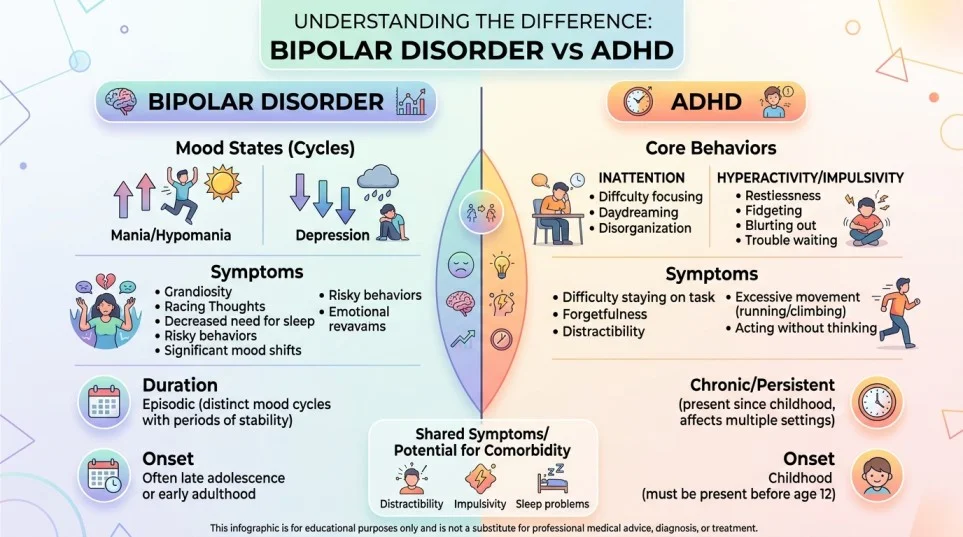
Bipolar is mainly about mood changes. ADHD is mainly about attention and hyperactivity.
Both can affect behavior and emotions. So, many people confuse them. Let’s look deeper.
How “Bipolar” Works
Mood changes in bipolar can last for days or weeks.
Key Features
- Extreme mood swings
- High energy during mania
- Sadness during depression
- Changes in sleep
- Fast talking or risky actions
Examples
🔵 Sara stayed awake all night and started many projects at once.
🔵 Ahmed felt very sad for two weeks and stopped meeting friends.
Uses in Daily Life
- Mental health treatment
- School counseling
- Workplace support
- Family understanding
How “ADHD” Works
ADHD affects attention and activity levels.
Key Features
- Trouble focusing
- Forgetting tasks
- Restlessness
- Impulsive actions
- Easy distraction
Examples
🟢 Bilal forgot his books again because he rushed out quickly.
🟢 Ayesha kept moving during class and interrupted others often.
Uses
- Classroom learning support
- Time management
- Work organization
- Behavior improvement
Which One Should You Use?
You do not “use” bipolar or ADHD like tools. Doctors diagnose them. Bipolar needs mood treatment. ADHD needs focus and behavior support. A mental health expert can guide the best care.
10 Differences Between Bipolar and ADHD
1. Main Problem
Bipolar
It mainly affects mood.
🔴 A person feels overly excited for days.
🔴 A person later feels deeply sad.
ADHD
It mainly affects attention and behavior.
🔴 A child cannot focus on homework.
🔴 An adult keeps losing keys.
2. Mood Changes
Bipolar
Mood swings are strong and long.
🔴 He laughed loudly all day.
🔴 Next week, he stayed silent and tired.
ADHD
Mood changes are usually short.
🔴 She got angry quickly.
🔴 Ten minutes later, she felt normal again.
3. Energy Levels
Bipolar
Energy can become extremely high.
🔴 He cleaned the whole house at midnight.
🔴 She talked nonstop for hours.
ADHD
Energy is often restless but steady.
🔴 The child kept running around.
🔴 He tapped his feet during class.
4. Sleep Patterns
Bipolar
Sleep changes a lot during mania.
🔴 She slept only two hours.
🔴 He stayed awake all night.
ADHD
Sleep problems happen from restlessness.
🔴 The child could not relax at bedtime.
🔴 He kept thinking about many things.
5. Focus
Bipolar
Focus changes with mood episodes.
🔴 During mania, she jumped between ideas.
🔴 During depression, he could not study.
ADHD
Focus problems happen often.
🔴 He forgot instructions daily.
🔴 She lost focus during reading.
6. Age of Start
Bipolar
It often appears in late teens or adulthood.
🔴 Symptoms started at age 20.
🔴 Mood swings began in college.
ADHD
It usually starts in childhood.
🔴 Teachers noticed behavior at age 7.
🔴 Parents saw focus problems early.
7. Impulsive Actions
Bipolar
Impulsiveness increases during mania.
🔴 He spent too much money suddenly.
🔴 She quit her job quickly.
ADHD
Impulsiveness happens regularly.
🔴 The child shouted answers early.
🔴 He interrupted conversations often.
8. Emotional State
Bipolar
Emotions become extreme.
🔴 She felt unstoppable one day.
🔴 He felt hopeless the next week.
ADHD
Emotions change fast but less deeply.
🔴 He became frustrated quickly.
🔴 She calmed down after a short time.
9. Treatment
Bipolar
Doctors often use mood-stabilizing medicine.
🔴 Therapy helps manage emotions.
🔴 Medicine reduces mood swings.
ADHD
Treatment focuses on attention and habits.
🔴 Teachers use focus plans.
🔴 Medicine may improve concentration.
10. Daily Life Impact
Bipolar
Mood episodes can stop normal routines.
🔴 He missed work during depression.
🔴 She made risky choices during mania.
ADHD
Organization problems affect routines.
🔴 He forgot appointments often.
🔴 She struggled to finish tasks.
Why People Get Confused About Their Use
Both conditions can cause restlessness, impulsive actions, and emotional problems. A person with bipolar may seem hyper during mania. A person with ADHD may also look overly active. Because of this, many people think they are the same. But doctors study mood patterns, attention problems, and behavior over time to find the correct condition.
Table: Difference and Similarity
| Feature | Bipolar | ADHD | Similarity |
| Main issue | Mood swings | Attention problems | Both affect daily life |
| Energy | Extreme highs and lows | Constant restlessness | Both may seem hyper |
| Focus | Changes with mood | Ongoing issue | Both affect learning |
| Sleep | Changes during episodes | Trouble relaxing | Both may disturb sleep |
| Age | Often later | Usually childhood | Both can continue into adulthood |
| Treatment | Mood medicine | Focus support | Both may need therapy |
Which is Better in What Situation?
Bipolar treatment is better for people with strong mood swings. It helps manage emotional highs and lows. Therapy, support, and healthy habits also help daily life.
ADHD support is better for focus and organization problems. Time planning, school help, and behavior tools can improve learning and work performance.
How Are “Bipolar” and “ADHD” Used in Metaphors and Similes?
🟣 “His mood was like a roller coaster.” — used for bipolar mood swings.
🟣 “She moved like a racing car.” — used for ADHD hyperactivity.
🟣 “His thoughts jumped like monkeys.” — used for attention problems.
Connotative Meaning
Bipolar
🟣 Positive: “creative energy”
🟣 Negative: “unstable moods”
🟣 Neutral: “mental health condition”
ADHD
🟣 Positive: “full of energy”
🟣 Negative: “easily distracted”
🟣 Neutral: “attention disorder”
Idioms or Proverbs
🟣 “Up and down like a yo-yo” — changing moods often.
Example: “His emotions were up and down like a yo-yo.”
🟣 “All over the place” — unable to focus.
Example: “Her attention was all over the place today.”
Works in Literature
🟣 An Unquiet Mind — Kay Redfield Jamison, 1995
🟣 Driven to Distraction — Edward M. Hallowell and John J. Ratey, 1994
Movies Related to the Keywords
🟣 Silver Linings Playbook — USA, 2012
🟣 The Disruptors — USA, 2022
Frequently Asked Questions
1. Is bipolar the same as ADHD?
No. Bipolar affects mood. ADHD affects attention and activity.
2. Can a person have both?
Yes. Some people have both conditions together.
3. Does ADHD cause mood swings?
ADHD may cause frustration, but bipolar mood swings are stronger and longer.
4. Can children have bipolar disorder?
Yes, but ADHD is more common in children.
5. Should I see a doctor for symptoms?
Yes. A mental health expert can give proper advice and treatment.
Final Words
Learning about mental health helps us understand people better. Bipolar and ADHD may look similar, but they are different conditions. With support and care, people with both conditions can live happy and successful lives.
Conclusion
The difference between bipolar and ADHD becomes easier when you look at mood versus attention. Bipolar mainly causes strong emotional highs and lows. ADHD mainly affects focus, activity, and self-control. Both conditions can affect school, work, and relationships. Still, the right diagnosis helps people get proper support. Simple knowledge can reduce confusion and improve understanding for families, students, and teachers.

Hi! I am Arshad Ullah presently working as linguist in Punjab Education Department. I have done MA in English Literature while M.Phil in Applied Linguistics. I have taught creative writing to the post graduation classes for 15 years. Presently I am working as content writer, and offering classes for blog writing. On this site, I research each topic from authoritative sources and edit every comparison for accuracy and clear, simple language.