A few months ago, a family in my neighborhood lost a loved one. The next day, a short note appeared in the newspaper. It shared facts about the person’s life. Later, at the funeral, a close friend stood up and spoke with emotion. He shared memories, love, and respect. That day, I saw the real difference between eulogy and obituary.
A eulogy is a speech given to honor someone who has passed away. An obituary is a written notice about the person’s death and life. Many people mix them up. So, learning the difference between eulogy and obituary helps us use the right word at the right time.
It also shows respect. In this article, you will clearly understand the difference between eulogy and obituary in a simple way.
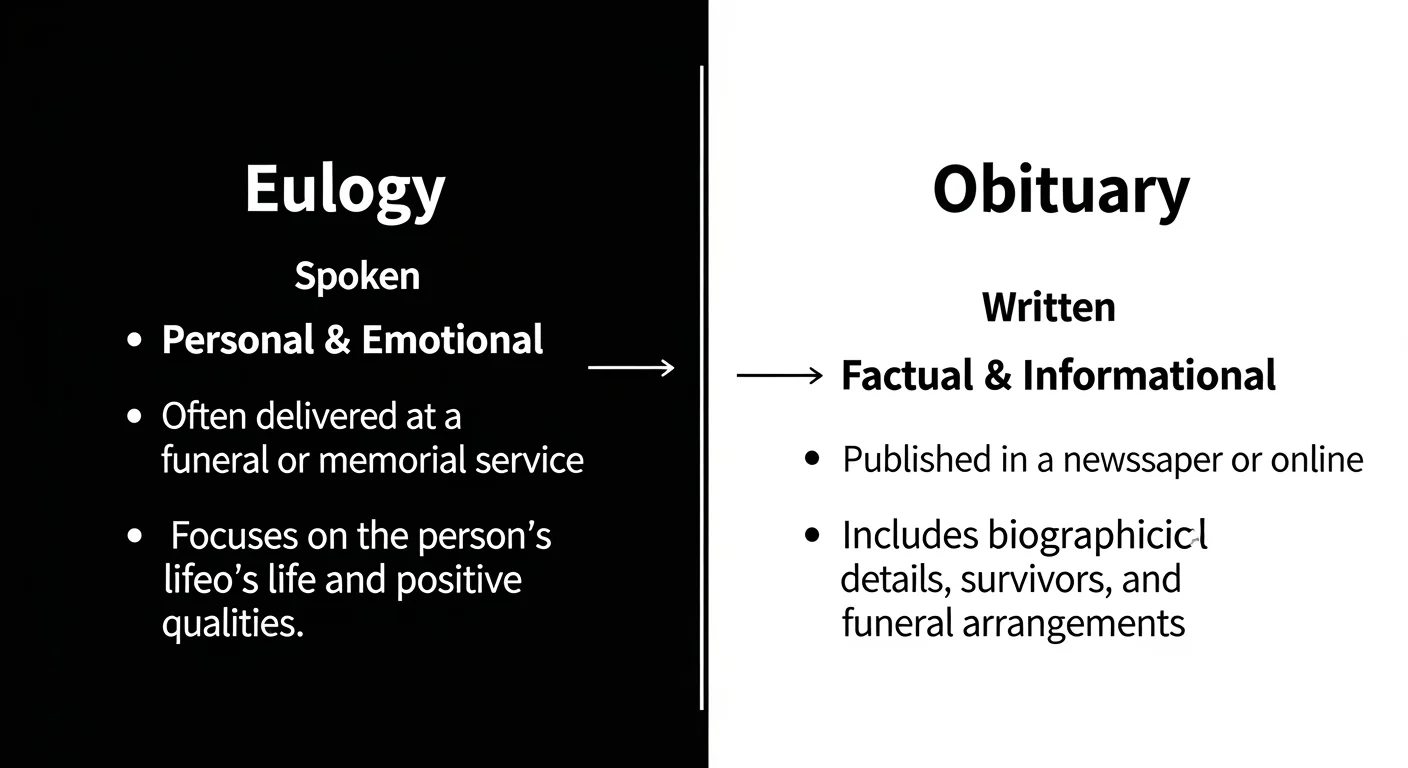
Eulogy vs Obituary
A eulogy is spoken and emotional.
An obituary is written and factual.
Why Is Their Difference Important in Society?
Knowing the difference between eulogy and obituary helps people communicate with care. In society, we often share news of loss. Using the right term shows respect to families. It also helps writers, students, and professionals express ideas clearly. Clear language builds trust and avoids confusion.
Pronunciation of Both
- Eulogy
- US: /ˈjuː.lə.dʒi/
- UK: /ˈjuː.lə.dʒi/
- Obituary
- US: /əˈbɪtʃ.u.er.i/
- UK: /əˈbɪtʃ.u.ri/
Now that you know the basics, let’s explore the difference between eulogy and obituary in detail with clear points and examples.
Difference Between Eulogy and Obituary
1. Form
- Eulogy: Spoken speech
- 🔴 Example: She gave a eulogy at the funeral.
- 🟣 Example: His speech made everyone cry.
- Obituary: Written notice
- 🔴 Example: The obituary was in the newspaper.
- 🟣 Example: I read his life story online.
2. Purpose
- Eulogy: To honor and remember
- 🔴 Example: He praised her kindness.
- 🟣 Example: She shared loving memories.
- Obituary: To inform people
- 🔴 Example: It told the date of death.
- 🟣 Example: It listed family members.
3. Tone
- Eulogy: Emotional and personal
- 🔴 Example: His words were full of love.
- 🟣 Example: She spoke with deep feeling.
- Obituary: Formal and neutral
- 🔴 Example: The tone was simple.
- 🟣 Example: It shared facts only.
4. Place
- Eulogy: At funerals or memorials
- 🔴 Example: It was given in a church.
- 🟣 Example: People listened quietly.
- Obituary: In newspapers or websites
- 🔴 Example: It appeared in print.
- 🟣 Example: It was posted online.
5. Length
- Eulogy: Can be longer
- 🔴 Example: The speech lasted ten minutes.
- 🟣 Example: He told many stories.
- Obituary: Usually short
- 🔴 Example: It was one page.
- 🟣 Example: It had brief details.
6. Content
- Eulogy: Stories and feelings
- 🔴 Example: She told funny moments.
- 🟣 Example: He shared personal memories.
- Obituary: Facts and dates
- 🔴 Example: It listed birth and death.
- 🟣 Example: It included career details.
7. Writer/Speaker
- Eulogy: Family or friends
- 🔴 Example: His son gave the speech.
- 🟣 Example: A close friend spoke.
- Obituary: Journalists or family
- 🔴 Example: A paper wrote it.
- 🟣 Example: Family shared details.
8. Style
- Eulogy: Creative and expressive
- 🔴 Example: He used kind words.
- 🟣 Example: She added humor.
- Obituary: Straight and clear
- 🔴 Example: It was direct.
- 🟣 Example: No extra emotion.
9. Audience
- Eulogy: People at the event
- 🔴 Example: Guests listened.
- 🟣 Example: Family felt comfort.
- Obituary: Public readers
- 🔴 Example: Many people read it.
- 🟣 Example: It reached a wide audience.
10. Timing
- Eulogy: During or after funeral
- 🔴 Example: It was given that day.
- 🟣 Example: It followed the ceremony.
- Obituary: Before or soon after death
- 🔴 Example: It was published quickly.
- 🟣 Example: It informed the public early.
Nature and Behaviour
- Eulogy: Warm, emotional, personal
- Obituary: Informative, formal, structured
Why People Get Confused About Their Use
Both words relate to death. Both talk about a person’s life. So, people often mix them up. But one is spoken, and one is written.
Table: Difference and Similarity
| Feature | Eulogy | Obituary | Similarity |
| Form | Speech | Written text | Both about a person |
| Tone | Emotional | Formal | Show respect |
| Purpose | Honor | Inform | Share life story |
| Place | Funeral | Media | After death |
| Content | Stories | Facts | About the same person |
Which Is Better in What Situation?
A eulogy is better during a funeral or memorial. It helps people feel comfort. It shares love and memories. It connects people emotionally.
An obituary is better when you need to inform others. It gives clear facts. It helps people know about the death and funeral details. Both are important, but they serve different needs.
Use in Metaphors and Similes
🟣 His speech was like a eulogy for lost dreams.
🟣 The article read like an obituary of a fallen empire.
Connotative Meaning
- Eulogy: Positive (honor, respect)
- Example: Her words were a true eulogy of love.
- Obituary: Neutral (information)
- Example: The obituary shared his life story.
Idioms or Proverbs
🟣 “Speak well of the dead”
Example: At the funeral, they spoke well of him.
🟣 “Write one’s own obituary”
Example: His actions almost wrote his own obituary.
Works in Literature
🟣 “Eulogy for a Dog” – Essay, Mark Twain, 1901
🟣 “The Obituary Writer” – Fiction, Ann Hood, 2013
Movies Related to the Keywords
🟣 “Obit” (2016, USA)
🟣 “The Eulogy” (2004, USA)
Frequently Asked Questions
1. What is a eulogy?
A speech to honor someone who has died.
2. What is an obituary?
A written notice about a person’s death.
3. Can a eulogy be written?
Yes, but it is mainly spoken.
4. Who writes an obituary?
Family or media writers.
5. Are both used together?
Yes, often in death events.
How Are Both Useful for Society?
Both help people deal with loss. A eulogy brings comfort and connection. An obituary spreads information. Together, they help society remember and respect people.
Final Words
A eulogy touches the heart. An obituary informs the mind. Both are important in different ways.
Conclusion
Understanding the difference between eulogy and obituary is simple but very useful. A eulogy is a heartfelt speech. An obituary is a factual written notice. Both honor a person’s life, but they do it in different ways. Knowing this difference helps you communicate clearly and respectfully. Whether you are writing, speaking, or learning English, this knowledge will guide you. In daily life and in society, using the right word at the right time always matters.

Hi! I am Arshad Ullah presently working as linguist in Punjab Education Department. I have done MA in English Literature while M.Phil in Applied Linguistics. I have taught creative writing to the post graduation classes for 15 years. Presently I am working as content writer, and offering classes for blog writing. On this site, I research each topic from authoritative sources and edit every comparison for accuracy and clear, simple language.