A few years ago, I helped a friend start a small shop. We needed products at a good price, so we started looking for suppliers. During that process, we kept hearing two terms: wholesaler and retailer.
At first, they sounded almost the same.
Many people first assume that both simply sell products. While that is true, their roles in the supply chain are very different. Understanding the difference can save money, improve business decisions, and help you avoid costly mistakes.
The comparison is especially important for business owners, students, entrepreneurs, and anyone curious about how products move from manufacturers to customers.
Choosing the wrong option can lead to higher costs, lower profits, and unnecessary confusion.
This guide explains everything in simple English with practical examples so you can clearly understand the real difference.
What Is a Wholesaler?
A wholesaler is a business or person who buys products in large quantities from manufacturers and sells them to retailers or other businesses.
The main goal of a wholesaler is to distribute products efficiently.
Instead of selling one item at a time, wholesalers usually sell hundreds or thousands of units in bulk.
How a Wholesaler Works
The process is simple:
- Manufacturer produces goods.
- Wholesaler buys large quantities.
- Retailers purchase stock from the wholesaler.
- Customers buy products from retailers.
Who Uses Wholesalers?
Wholesalers are commonly used by:
- Retail stores
- Supermarkets
- Online sellers
- Restaurants
- Small businesses
- Commercial buyers
Real-World Example
A smartphone manufacturer produces 50,000 phones.
A wholesaler purchases 10,000 units and stores them in a warehouse.
Retail stores then buy smaller quantities from the wholesaler and sell them to customers.
Why Wholesalers Matter
Wholesalers help:
- Reduce distribution costs
- Move products quickly
- Supply retailers regularly
- Simplify logistics
Without wholesalers, many retailers would struggle to maintain inventory.
What Is a Retailer?
A retailer is a business that sells products directly to the final customer.
Retailers are the last step in the supply chain before a product reaches consumers.
Unlike wholesalers, retailers usually sell products in small quantities.
How a Retailer Works
Retailers purchase goods from:
- Wholesalers
- Manufacturers
- Distributors
They then sell those products individually to customers.
Who Uses Retailers?
Almost everyone uses retailers, including:
- Families
- Students
- Professionals
- Businesses making small purchases
Real-World Example
When you buy a phone from a local electronics store or an online shop, you are buying from a retailer.
The retailer purchased that phone earlier through a wholesaler or manufacturer.
Why Retailers Matter
Retailers provide:
- Easy access to products
- Customer support
- Product displays
- Shopping convenience
- Flexible purchase quantities
For everyday use, retailers are where most people make purchases.
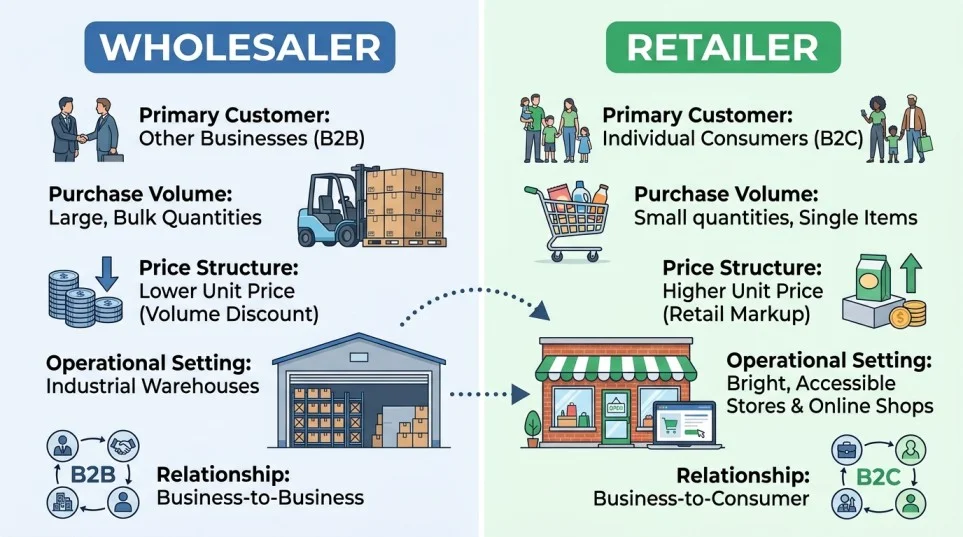
Quick Comparison Table
| Feature | Wholesaler | Retailer |
| Meaning | Sells products in bulk | Sells directly to consumers |
| Main Customers | Businesses and retailers | End users and consumers |
| Purchase Quantity | Large quantities | Small quantities |
| Product Price | Lower per unit | Higher per unit |
| Profit Source | Volume sales | Retail markup |
| Inventory Size | Very large | Moderate or small |
| Storage Needs | Warehouses | Shops or stores |
| Customer Interaction | Limited | High |
| Convenience | Lower for consumers | Higher for consumers |
| Business Focus | Distribution | Customer service |
| Best Use Case | Bulk purchasing | Individual buying |
| Main Advantage | Lower costs | Easy access |
| Main Drawback | Large order requirements | Higher prices |
Biggest Difference
The biggest difference between a wholesaler and a retailer is who they sell to.
A wholesaler sells products to businesses.
A retailer sells products directly to consumers.
This matters more than many beginners realize.
A wholesaler focuses on volume and lower prices. A retailer focuses on convenience and customer experience.
In real-world use, wholesalers help products move through the supply chain, while retailers help products reach the final buyer.
Key Differences Explained
1. Target Customers
Wholesaler
- Sells to retailers and businesses
- Rarely serves individual consumers
- Focuses on bulk buyers
Retailer
- Sells directly to customers
- Serves individual buyers daily
- Focuses on consumer needs
Example: A grocery chain buys from a wholesaler, while families buy from the grocery store.
2. Quantity Sold
Wholesaler
- Large bulk orders
- Cases, pallets, or truckloads
Retailer
- Single products
- Small quantities
Example: A wholesaler may sell 500 bottles of water at once. A retailer may sell one bottle.
3. Pricing Structure
Wholesaler
- Lower prices per unit
- Small profit margins
- High-volume sales
Retailer
- Higher prices per unit
- Larger markup
- Lower sales volume
Example: A wholesaler sells a product for $8. A retailer sells the same item for $12.
4. Customer Service
Wholesaler
- Limited interaction
- Business-focused support
Retailer
- Extensive customer support
- Returns and exchanges
- Product recommendations
One small difference most people overlook is how much customer service retailers provide.
5. Inventory Management
Wholesaler
- Maintains huge inventories
- Uses warehouses
Retailer
- Holds smaller stock levels
- Uses stores or fulfillment centers
Example: A wholesaler may stock 100,000 units, while a retailer stocks 1,000.
6. Marketing Approach
Wholesaler
- Markets to businesses
- Focuses on pricing and supply
Retailer
- Markets to consumers
- Uses advertising and promotions
Retailers spend far more effort attracting everyday shoppers.
7. Business Relationship
Wholesaler
- Long-term B2B relationships
- Repeat bulk orders
Retailer
- Consumer-focused relationships
- Individual transactions
8. Profit Model
Wholesaler
- Makes money through volume
- Lower margins
Retailer
- Makes money through markups
- Higher margins
Over the long term, wholesalers depend on large sales quantities.
9. Location and Facilities
Wholesaler
- Warehouses
- Distribution centers
Retailer
- Shopping centers
- Physical stores
- Online storefronts
10. Risk Level
Wholesaler
- Inventory risk from large stock volumes
- Supply chain challenges
Retailer
- Demand fluctuations
- Consumer trends
Both face risks, but those risks are different.
11. Licensing and Operations
Wholesaler
- Often requires business licenses
- Business buyer verification
Retailer
- Easier consumer transactions
- Less restrictive purchasing process
Many first-time entrepreneurs discover this difference only after launching a business.
Similarities Between Them
Despite their differences, wholesalers and retailers share several similarities.
- Both sell products.
- Both earn profits from sales.
- Both play important roles in supply chains.
- Both manage inventory.
- Both rely on manufacturers.
- Both contribute to product distribution.
These similarities are one reason people often confuse them.
Pros and Cons
Pros of Wholesaler
- Lower product costs
- Better bulk discounts
- Consistent supply
- Higher volume opportunities
- Strong business relationships
Cons of Wholesaler
- Large minimum orders
- High storage needs
- Requires larger investment
- Not ideal for individual buyers
Pros of Retailer
- Convenient purchasing
- Small quantity buying
- Better customer support
- Product variety
- Easy returns and exchanges
Cons of Retailer
- Higher prices
- Limited bulk discounts
- Lower negotiating power
- Markups increase costs
Which Is Better for Different Situations?
For Beginners
Retailers are usually better because they allow small purchases and less risk.
For Small Business Owners
Wholesalers often provide better profit potential through lower product costs.
For Families
Retailers are usually the most practical choice.
For Online Sellers
Many online businesses start with wholesalers to improve profit margins.
For Budget-Conscious Buyers
Retailers are better for small purchases.
Wholesalers become more economical when buying large quantities.
For Long-Term Business Growth
Wholesalers often provide greater cost savings and scalability.
Common Mistakes People Make
Thinking They Are the Same
This is the most common misunderstanding.
Buying Wholesale Without Storage Space
Some users later regret purchasing too much inventory.
Ignoring Minimum Order Requirements
Many wholesalers require large purchases.
Choosing Based Only on Price
Lower prices are attractive, but storage and inventory costs matter too.
Confusing Convenience With Value
Retailers offer convenience, while wholesalers offer cost savings.
Not Calculating Total Costs
Transportation, storage, and inventory management can significantly affect profitability.
Expert Recommendation
Choose Wholesaler If:
- You run a business
- You buy products regularly
- You need bulk quantities
- You have storage capacity
- You want lower per-unit costs
Choose Retailer If:
- You are an individual buyer
- You need small quantities
- You want convenience
- You value customer service
- You need products immediately
Avoid Wholesaler If:
- You lack storage space
- You only need a few items
- You have limited capital
- You are not buying regularly
Avoid Retailer If:
- You purchase in large volumes
- You want the lowest possible cost
- You operate a growing resale business
FAQ Section
Which is better, a wholesaler or a retailer?
Neither is universally better. A wholesaler is better for businesses purchasing in bulk, while a retailer is better for consumers who need small quantities and convenience. The best choice depends on your buying goals and budget.
Is buying from a wholesaler worth it?
Yes, buying from a wholesaler can be worth it if you need large quantities. Lower per-unit costs can significantly improve profit margins. However, storage and inventory management should also be considered.
Which offers lower prices?
Wholesalers generally offer lower prices because they sell in bulk. Retailers charge more because they provide convenience, customer service, and smaller purchase options.
Can a wholesaler sell directly to consumers?
Some wholesalers do sell directly to consumers. However, most focus on business customers and larger orders. Policies vary depending on the company and industry.
Which is easier for beginners?
Retailers are easier for beginners because there are no bulk purchase requirements. Customers can buy exactly what they need without making a large investment.
Are wholesaler and retailer interchangeable terms?
No. A wholesaler sells primarily to businesses, while a retailer sells directly to end consumers. Their roles within the supply chain are different.
What do most businesses prefer?
Most businesses prefer wholesalers because they offer lower prices and reliable inventory access. This helps improve profitability and maintain stock levels.
What mistakes should beginners avoid?
Beginners should avoid focusing only on product price. They should also consider storage costs, minimum order requirements, shipping expenses, and actual product demand.
Conclusion
Understanding the difference between wholesaler and retailer becomes much easier when you look at their role in the supply chain. A wholesaler focuses on selling large quantities to businesses, while a retailer focuses on selling smaller quantities directly to consumers. Both are essential, and neither is inherently better than the other.
The right choice depends on your needs. If you run a business, need inventory, and want lower per-unit costs, a wholesaler may be the smarter option. If you value convenience, flexibility, and customer support, a retailer is usually the better fit.
Many people make decisions based only on price, but long-term practicality matters just as much. Consider your budget, storage capacity, purchasing volume, and goals. Once you understand how wholesalers and retailers operate, choosing between them becomes a straightforward and confident decision.

Hi! I am Arshad Ullah presently working as linguist in Punjab Education Department. I have done MA in English Literature while M.Phil in Applied Linguistics. I have taught creative writing to the post graduation classes for 15 years. Presently I am working as content writer, and offering classes for blog writing. On this site, I research each topic from authoritative sources and edit every comparison for accuracy and clear, simple language.