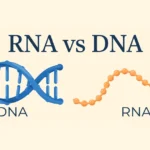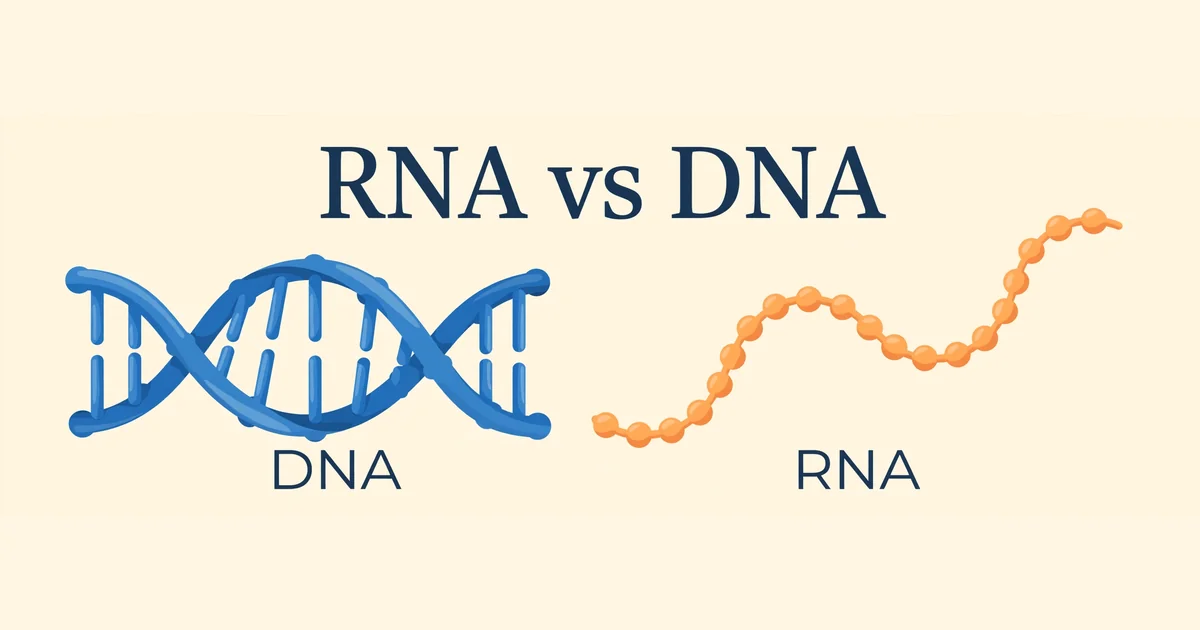
The difference between RNA and DNA starts with their jobs. DNA is the cell’s master instruction book. It stores all the genetic information for life and keeps it safe for years. RNA is a working copy of one small part of that book. It carries instructions out of the nucleus so the cell can build proteins.
| Attribute | RNA | DNA |
|---|---|---|
| Full name | Ribonucleic acid | Deoxyribonucleic acid |
| Main job | Carries instructions to build proteins | Stores genetic information |
| Structure | Usually one strand | Two strands (double helix) |
| Sugar | Ribose | Deoxyribose |
| Bases | A, U, C, G | A, T, C, G |
| Where it works | Nucleus and cytoplasm | Mostly inside the nucleus |
| Stability | Breaks down fast | Very stable, lasts long |
| Types | Many types (mRNA, tRNA, rRNA) | Only one type |
Introduction
DNA and RNA are the two molecules that carry the instructions of life. Scientists call them nucleic acids. Both are built from small blocks called nucleotides.
Each nucleotide has three parts: a sugar, a base, and a phosphate group. A close word is nucleoside. A nucleoside is the sugar and base only, with no phosphate. Our guide on the difference between a nucleoside and a nucleotide explains that pair in more detail.
Textbooks describe both molecules in the same way. They are chains of nucleotides, and they direct key cell work such as growth and protein building (Lumen Learning, Biology for Non-Majors I). The two chains look alike, yet they do very different jobs. This guide shows what each one is and how they differ.
What Is RNA?
RNA is short for ribonucleic acid. Think of it as the cell’s messenger and helper. The cell copies one small part of DNA into RNA. The RNA then leaves the nucleus and moves into the cytoplasm. The cytoplasm is the jelly-like fluid inside the cell. There, RNA helps the cell build proteins. Proteins are the work molecules of the body. They build tissues, fight germs, and carry out daily jobs.
Main Characteristics of RNA
- Usually a single strand, and the strand can fold into shapes
- Its sugar is ribose
- Its bases are adenine (A), uracil (U), cytosine (C), and guanine (G)
- Made in the nucleus, but it works in the cytoplasm too
- Short-lived: the cell breaks it down soon after use
- Comes in several types, each with its own job
What Is DNA?
DNA is short for deoxyribonucleic acid. It is the master instruction book of the cell. It holds all the information needed to build and run a living body. Parents pass DNA to their children, so traits pass down too.
DNA is shaped like a twisted ladder. Scientists call this shape a double helix. OpenStax textbooks describe DNA as the cell’s blueprint, with two strands that match each other (OpenStax, Biology for AP Courses). In cells like ours, DNA stays inside the nucleus, the control center of the cell. In bacteria, which have no nucleus, DNA rests in the main body of the cell.
A small amount of DNA also sits in the cell’s power parts and, in plants, in the green parts that catch sunlight. Those green parts hold chlorophyll, the pigment that makes leaves and algae green — see the difference between chlorella and chlorophyll for more on that green pair.
Main Characteristics of DNA
- Two strands joined like a twisted ladder (a double helix)
- Its sugar is deoxyribose
- Its bases are adenine (A), thymine (T), cytosine (C), and guanine (G)
- Stores the full set of instructions for life
- Stays protected inside the nucleus
- Very stable, and there is only one type
Core Difference Between RNA and DNA
Five clear points separate the two molecules.
Difference 1: The Sugar
Each block of DNA uses a sugar called deoxyribose. Each block of RNA uses ribose. The names sound close, but ribose has one extra oxygen atom. The word “deoxy” means “missing an oxygen.” That one small change matters a lot. It makes DNA tough and long-lasting. It makes RNA easier to break down, which suits a short-term message.
Difference 2: One Strand or Two
DNA has two strands that run side by side. The pair protects the information. If one strand is hurt, the cell can use the other strand to fix it. RNA has just one strand in most cases. With no partner strand, it folds back on itself and forms shapes. Those shapes help it do its many jobs.
Difference 3: Thymine in DNA, Uracil in RNA
The two molecules share three bases: adenine, cytosine, and guanine. The fourth base is where they split. DNA uses thymine. RNA uses uracil in its place. In DNA, adenine pairs with thymine, and guanine pairs with cytosine. In RNA, adenine pairs with uracil instead. Thymine is found only in DNA, and uracil is found only in RNA (Lodish et al., Molecular Cell Biology, NCBI Bookshelf).
Difference 4: Storage vs Daily Work
DNA does one big job: storage. It keeps the full instruction set safe for the life of the cell. RNA does the daily work. It carries one instruction at a time to the protein builders. A simple way to see it: DNA is the master book in a locked room. RNA is a small note copied from one page and taken to the workshop.
Difference 5: How Long They Last
DNA is built to last for years, and the cell guards it well. RNA is built for short use. Most RNA strands break down within minutes or hours. The cell then makes fresh copies when it needs them. This short life is useful. It lets the cell start and stop protein jobs quickly.
Similarities Between RNA and DNA
The two molecules are close cousins, and they share a lot.
- Both are nucleic acids built from nucleotides
- Both have a backbone (a chain) made of sugar and phosphate
- Both use the bases adenine, cytosine, and guanine
- Both carry information in the order of their bases
- Both team up to build proteins
And both live and work inside cells — in bacteria, in fungi, in plants, and in animals. If those simple life forms blur together, our guide on the difference between fungi and bacteria can help.
Types of RNA
DNA comes in just one type. RNA comes in many. Three types do most of the protein-building work:
- Messenger RNA (mRNA) carries one instruction from the DNA to the protein-building site.
- Transfer RNA (tRNA) brings amino acids — the small blocks that make proteins — to the right spot.
- Ribosomal RNA (rRNA) is part of the ribosome, the cell machine that joins the blocks into a protein.
Other RNA types help the cell control which genes are on or off. A gene is one section of DNA with instructions for one job.
Common Misconceptions
Misconception 1: RNA Is Just a Copy of DNA
Only one type of RNA, the messenger, is a copy of a DNA section. The other types are not messages at all. Transfer RNA ferries building blocks. Ribosomal RNA forms part of a machine. Some RNA can even speed up chemical jobs in the cell. So RNA is a whole team of workers, not just a copy.
Misconception 2: Only DNA Can Store Genetic Information
In our cells, DNA is the storehouse. But some viruses keep all of their genetic information in RNA. The flu virus and the coronaviruses are two known examples. Nature Scitable points out that some viruses, such as poliovirus, have RNA genomes (Nature Scitable, Origin of Viruses). For these viruses, RNA does the storing job that DNA does in us.
Misconception 3: One of Them Must Be Better
Neither one is better. They do different jobs. DNA is made for safe, long storage. RNA is made for fast, short work. A cell needs both, just as a kitchen needs both a recipe book and a cook. Asking which is better misses the point.
Frequently Asked Questions
What are the three main differences between DNA and RNA?
First, the strands: DNA has two, and RNA usually has one. Second, the sugar: DNA uses deoxyribose, and RNA uses ribose. Third, one base: DNA uses thymine, while RNA uses uracil in its place. These three small changes explain almost all the bigger gaps — why DNA stores information for years and RNA works in short bursts.
Why does RNA have uracil instead of thymine?
Uracil is cheaper and faster for the cell to make. RNA strands live for a short time, so cheap parts are fine. Thymine costs more to build, but it has an extra chemical tag. That tag helps the cell spot damage and repair DNA. For a molecule that must last a lifetime, the safer base is worth the extra cost.
Can RNA store genetic information?
Yes, in some cases. A few viruses store their full instruction set in RNA. The flu virus and coronaviruses work this way. In plants, animals, and people, though, DNA does the long-term storing. There, RNA only holds a short working copy of one instruction at a time, and the copy is thrown away after use.
Can RNA be double-stranded?
Yes, though it is not the norm. A single RNA strand often folds back and pairs with itself in short patches. That folding gives it a useful shape. Some viruses go further and carry true double-stranded RNA. In our own cells, RNA mostly stays single-stranded, unlike DNA, which is almost always a pair.
Which is more stable, DNA or RNA?
DNA is far more stable. Its two strands protect each other, its sugar is tougher, and the cell keeps repair teams on guard. RNA is built to fall apart. A short life sounds like a flaw, but it is a feature. It lets the cell change which proteins it makes within hours when needs change.
What happens when there is a mistake in DNA or RNA?
A mistake in DNA is called a mutation. If the cell does not fix it, the error can pass to new cells and even to children. That is why cells check and repair DNA with care. A mistake in RNA is minor. It affects only that one short-lived copy. The copy soon breaks down, and the cell makes a fresh, correct one.
Conclusion
The difference between RNA and DNA is a story of two partners. DNA is the safe master copy. It uses two strands, a strong sugar, and thymine to guard life’s instructions for years. RNA is the busy worker. It uses one strand, ribose sugar, and uracil to carry one instruction at a time and help build proteins. One stores the plan. The other does the daily work. Once you see their sugars, strands, and bases side by side, you will never mix them up again.

Hi! I am Arshad Ullah presently working as linguist in Punjab Education Department. I have done MA in English Literature while M.Phil in Applied Linguistics. I have taught creative writing to the post graduation classes for 15 years. Presently I am working as content writer, and offering classes for blog writing. On this site, I research each topic from authoritative sources and edit every comparison for accuracy and clear, simple language.