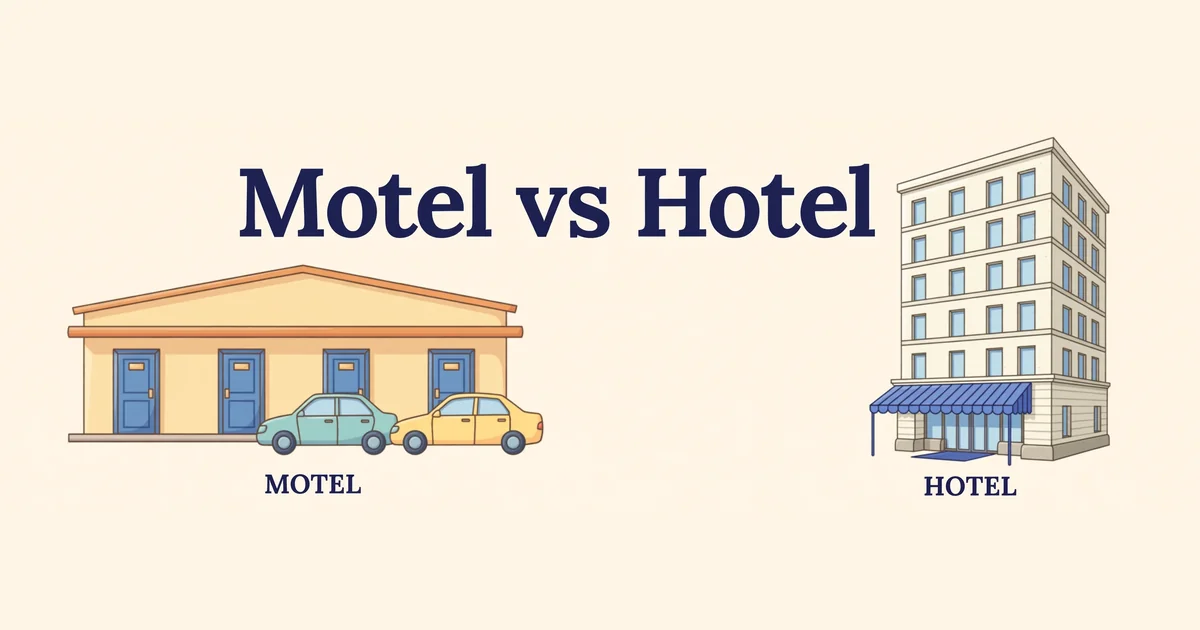
The difference between a motel and a hotel is in the design. A motel is a low building made for drivers. Its room doors open outside, right by the parking area, so you park at your door. A hotel is a bigger building. Its rooms open onto indoor halls, and it offers more staff and services.
| Attribute | Motel | Hotel |
|---|---|---|
| Main guest | Drivers on a road trip | All travelers |
| Building | Low, one or two floors | Often tall, many floors |
| Room doors | Open outside, to the parking area | Open onto an indoor hallway |
| Parking | Right in front of your room | Shared lot or garage, away from the room |
| Staff and services | Few staff, basic services | Front desk, restaurant, room service |
| Location | Beside highways and main roads | City centers, airports, holiday areas |
| Price | Usually cheaper | Wide range, often higher |
Introduction
A motel and a hotel both sell you the same basic thing: a private room with a bed and a bathroom for the night. Their signs can look alike, and many travelers use the two words as if they mean the same thing.
They do not. The split between them is about one hundred years old, and it started with the car. Hotels grew up around train stations and city centers. Motels grew up on the highway, built for people who drive. Once you see who each building was made for, the other differences fall into place.
This guide explains both, point by point, so you can pick the right stay for your trip and your budget.
What Is a Motel?
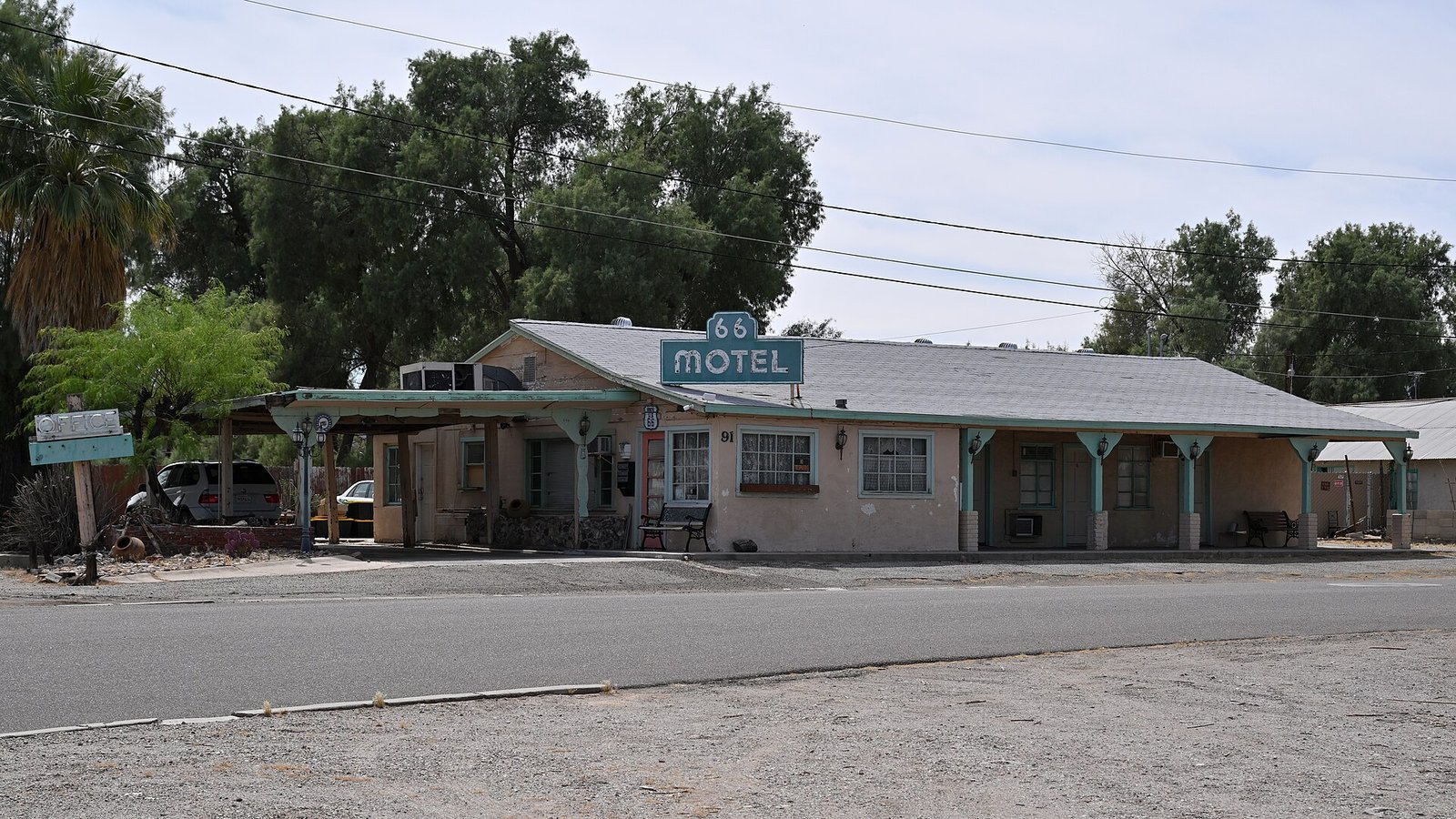
A motel is a small lodging built for people traveling by car. Merriam-Webster defines a motel as a place providing lodging and parking, with rooms that are “usually accessible from an outdoor parking area,” and the name is a blend of motor and hotel (Merriam-Webster, “Motel”). The word was first used in 1925. That year, the Milestone Mo-Tel opened in San Luis Obispo, California, halfway between Los Angeles and San Francisco. Britannica calls it the world’s first motel (Encyclopaedia Britannica, “Motel”).
Motels were built as close to the highway as possible, so a tired driver could stop, park, and sleep with no fuss. You carry your own bags, walk a few steps, and you are at your door.
The motel rose with the car, and it still serves road trips best. Planning the drive itself? Our guide on the difference between a crossover and an SUV can help you pick the right vehicle.
Main Characteristics of a Motel
- Low building, usually one or two floors
- Room doors open outside, onto the parking area or an open walkway
- You park right in front of your room
- Small office instead of a grand lobby, and few staff
- Basic rooms: a bed, a bathroom, a TV, and often a small fridge
- Usually cheaper than a hotel
What Is a Hotel?
A hotel is a building that offers lodging, meals, and other services to travelers. Britannica describes it as a building that provides “lodging, meals, and other services to the traveling public” (Encyclopaedia Britannica, “Hotel”). A hotel is built around staff and services: a front desk, people to carry bags and clean rooms, and often a restaurant, room service, laundry, and a concierge.
You reach your room from inside. You cross a lobby and walk an indoor hallway to your door. That indoor layout lets hotels grow tall, which is why they fit city centers, airports, and holiday areas where land is costly.
Hotels come in many sizes, from small city stops to large holiday properties. The biggest leisure type is the resort, built around rest and fun. Our guide on the difference between a resort and a hotel explains how those two differ.
Main Characteristics of a Hotel
- Often a tall building with many floors
- Room doors open onto indoor hallways
- Lobby and front desk, staffed day and night in larger hotels
- Restaurant, room service, laundry, and other services
- Extras like a pool, a gym, meeting rooms, or a spa
- Prices range from budget to luxury
Core Difference Between Motel and Hotel
Five clear points separate a motel from a hotel.
Difference 1: Where the Room Door Opens
This is the surest test. In a motel, your room door opens to the open air. You step out of your room and you are outside, next to your car. In a hotel, your door opens onto a hallway inside the building. You are never outdoors until you leave through the lobby.
Difference 2: The Shape of the Building
Motels spread out; hotels grow up. A motel is a long, low block of rooms, most often one or two floors, because every room needs ground-level access to the cars. A hotel stacks its rooms on many floors around elevators and stairs. That is why a motel needs a wide plot of roadside land, while a hotel can stand on a small, costly city plot.
Difference 3: Parking
At a motel, parking is part of the design. You park in front of your own door, so unloading takes seconds and you can watch your car. At a hotel, you park in a shared lot, a basement garage, or a car park nearby, then walk or ride an elevator to your room. Hotel parking may also cost extra, while motel parking is almost always free.
Difference 4: Staff and Services
A motel runs with a small team. One person may run the office and hand you the key. There is rarely a restaurant, and there is no room service. A hotel employs many more people: desk staff, cleaners, cooks, waiters, and porters. That team is why hotels can offer meals, laundry, and help at any hour — and why they cost more.
Difference 5: Price and Place
Motels are usually the cheaper stay. The building is simple, the staff is small, and land beside a highway costs less than land in a city center. Hotels cover a wide range, from plain budget hotels to luxury towers. Place follows the guest: look for motels along the road, and hotels where people gather.
Similarities Between Motel and Hotel
A motel and a hotel are cousins, and they share the basics.
- Both give you a private room with a bed and a private bathroom
- Both charge by the night, with set check-in and check-out times
- Both add local taxes and fees to the bill
- Both can be booked ahead, by phone or online
- Both range in quality, from rough to excellent
In both cases, you rent a room for a short time; you do not own any part of the building. Our guide on the difference between a condo and a co-op shows how owned homes work. In a motel or a hotel, the room is yours only until check-out.
Common Misconceptions
Misconception 1: All Motels Are Dirty or Unsafe
Quality varies in both worlds. Some old, independent motels are poorly kept, but many motels belong to large chains that follow strict cleaning rules, and some small hotels are worse than the motel down the road. Judge the place, not the word: read recent reviews, look at guest photos, and check the area before you book.
Misconception 2: A Motel Is Just a Cheap Hotel
Price is not the line between them; design is. A motel is defined by its layout for drivers — a low building, doors that open outside, and parking at the room. A luxury hotel can drop its price below a motel’s on a quiet night, and a motel in a busy holiday town can charge hotel prices. The label tells you how the place is built, not what it costs.
Misconception 3: Star Ratings Work the Same Way for Both
There is no single world system for stars. Hotel ratings come from many different organizations around the world, and the schemes do not match: some groups award stars, others award diamonds, and countries set their own rules (Wikipedia, “Hotel rating”). Many motels are not star-rated at all. So the same stars can mean different things in different places.
Frequently Asked Questions
Which is cheaper, a motel or a hotel?
A motel is usually cheaper. Its building is simple, it needs only a few staff, and roadside land costs less than city land. But prices move with demand. A motel in a busy holiday town can cost more than a plain city hotel on a quiet night. Compare the total price — taxes, parking, and breakfast included — before you decide.
Why do motel rooms open to the outside?
Because the motel was built for drivers. When your door opens straight onto the parking area, you can unload the car in seconds, keep an eye on it through the window, and leave early without crossing a lobby. Merriam-Webster builds this into the definition itself: motel rooms are “usually accessible from an outdoor parking area.”
Are motels safe?
Most motels are as safe as any other lodging, but safety depends on the place, not the label. Well-run motels have bright parking areas, strong locks, and staff on site. Before booking, read recent guest reviews, check the area on a map, and avoid places with broken lights or no office staff. The same checks work for hotels.
Motel or hotel: which is better for a long stay?
For a stay of a few weeks, compare both. Hotels give you daily cleaning, meals, and laundry, but the bill grows fast. Some motels offer weekly rates and a small kitchen area, which suits workers on long jobs. For a month or more, renting may beat both. Our guide on the difference between a lessor and a lessee explains the two sides of a lease.
Where did the word “motel” come from?
The word is a blend of motor and hotel. It was coined in 1925 for the Milestone Mo-Tel in San Luis Obispo, California, a stop built for drivers halfway between Los Angeles and San Francisco. The name “Mo-Tel” told travelers exactly what the place was: a hotel for people with motors. The short name caught on, and “motel” entered the language for good.
Conclusion
A motel and a hotel both give you a bed for the night, but they were built for different kinds of trips. The motel is the child of the highway: low, simple, and open to the road, with your car waiting at your door. The hotel is the child of the city and the station: tall, staffed, and full of services under one roof. Pick the motel for a cheap, easy stop on a drive. Pick the hotel when you want comfort, food, and help on hand. Match the stay to the trip, and you will rarely choose wrong.

Hi! I am Arshad Ullah presently working as linguist in Punjab Education Department. I have done MA in English Literature while M.Phil in Applied Linguistics. I have taught creative writing to the post graduation classes for 15 years. Presently I am working as content writer, and offering classes for blog writing. On this site, I research each topic from authoritative sources and edit every comparison for accuracy and clear, simple language.