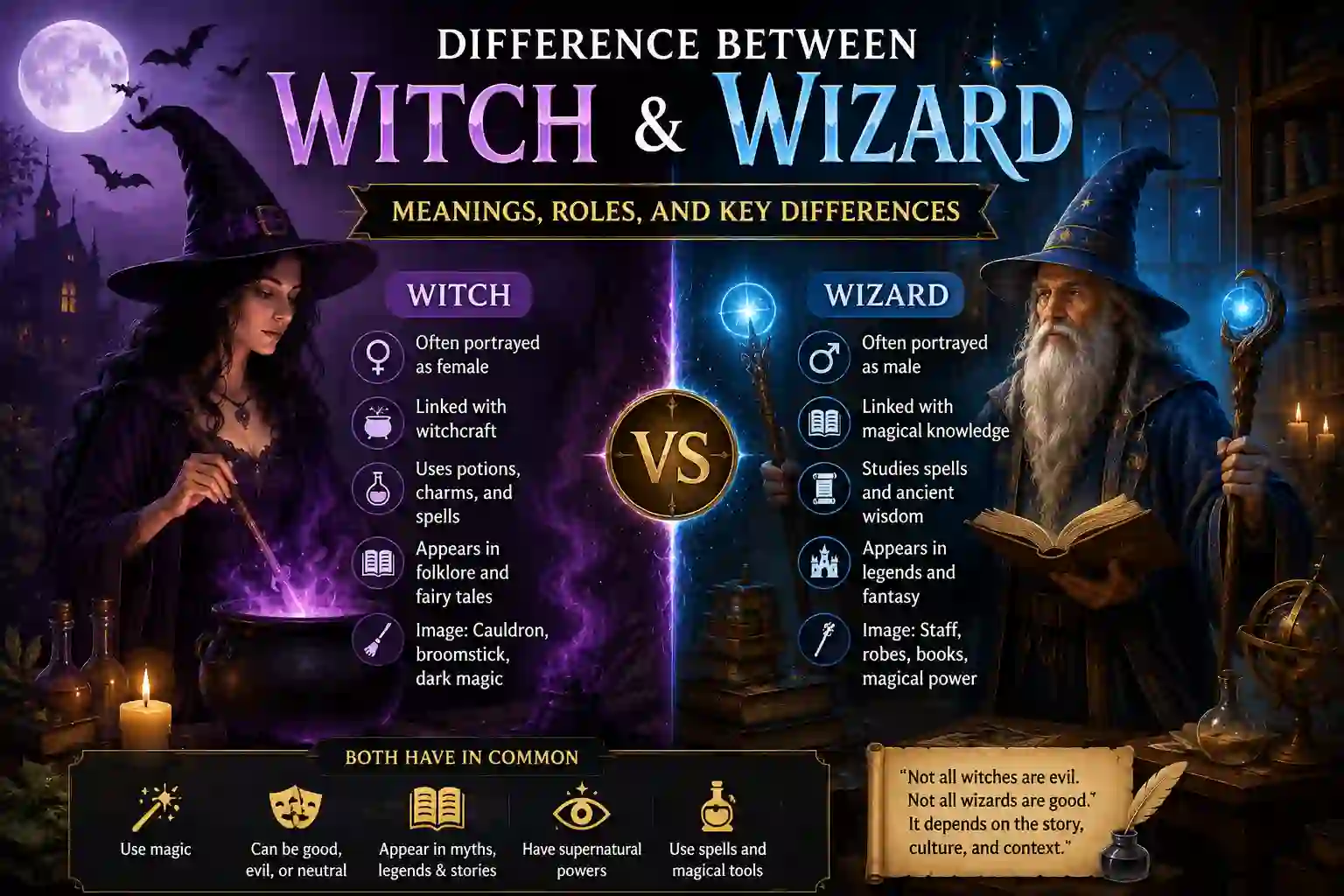
A witch and a wizard are both figures linked to magic, but the terms are not exact opposites. In modern English, witch often means a person, especially a woman, believed to use supernatural powers. Wizard usually means a person who practices magic, often portrayed as a learned or skilled magic user. The difference also changes across myths, cultures, and stories.
| Feature | Witch | Wizard |
| Common image | Often a woman | Often a man |
| Main role | Magic or witchcraft | Magic and magical knowledge |
| Gender | Usually female in modern usage, but not always | Usually male in fantasy and folklore |
| Moral role | Can be good, evil, or neutral | Can be good, evil, or neutral |
| Common setting | Folklore, fairy tales, witchcraft traditions | Folklore, legends, fantasy |
| Typical image | Cauldron, broomstick, spells | Staff, robes, books, spells |
| Meaning | Often linked to witchcraft | Often linked to learned magic |
| Gender is required? | No in every tradition | No in every tradition |
Introduction
The difference between witch and wizard can be confusing because both words describe people associated with magic.
The biggest difference is how the words are normally used. In many English-language stories, a witch is usually female, while a wizard is usually male.
But this is not a universal rule. Older traditions used different terms, and some modern traditions use witch for people of any gender.
Another important point is that witch does not always mean evil, and wizard does not always mean good. Their roles depend on the culture, story, or tradition.
What Is a Witch?
A witch is a person who is believed to use magic or supernatural powers.
In folklore, witches have often been connected with spells, charms, curses, healing, divination, and other forms of magic. The word has also been strongly linked with female characters in European folklore and later popular culture.
Common Characteristics of a Witch
A witch may be shown as someone who:
- Uses spells or magical rituals.
- Makes potions or charms.
- Uses supernatural powers.
- Practices witchcraft.
- Helps or harms other people.
- Has a familiar animal in some stories.
- Lives alone or outside normal society in some folktales.
These features are common in stories, but they do not describe every historical or modern use of the word witch.
What Is a Wizard?
A wizard is a person who practices magic and is often portrayed as having special magical knowledge or skill.
In fantasy stories, wizards are commonly shown as learned magic users. They may study ancient books, learn spells, use magical objects, and advise heroes or rulers.
The word wizard has an interesting history. It originally referred to a wise person before its meaning developed into its modern association with magic.
Common Characteristics of a Wizard
A wizard may be shown as someone who:
- Studies magic.
- Learns spells.
- Uses magical tools.
- Has deep knowledge.
- Teaches other magic users.
- Helps heroes or kingdoms.
- Uses magic for good or evil.
The familiar image of a wizard with a long robe, staff, and magical books is mainly a product of folklore, literature, and popular culture.
Difference Between Witch and Wizard
1. Gender
Gender is the most common difference between the two terms in modern English-language fiction.
A witch is often portrayed as a woman. A wizard is often portrayed as a man. This pattern appears in many fairy tales, fantasy books, films, and games.
However, it is not a strict rule.
Historical and cultural traditions have used these words in different ways. Even the word witch has older masculine and feminine forms in Old English.
Simple example:
- A woman who uses magic may be called a witch.
- A man who uses magic may be called a wizard.
But a male witch or female wizard can also appear in modern fiction.
2. Type of Magic
There is no universal magical system that separates witches from wizards.
A story may give witches one kind of magic and wizards another. Another story may treat them as almost identical.
For example, a story might show:
- Witches using potions, herbs, charms, or curses.
- Wizards studying spells, magical books, or ancient knowledge.
These are story conventions, not fixed rules.
Historical beliefs about witchcraft were also much more complex than modern fantasy often suggests. English Heritage notes that older ideas included many different forms of magic and supernatural belief.
3. Image and Appearance
Popular culture often gives witches and wizards different looks.
A traditional fictional witch may appear with:
- A pointed hat
- A broomstick
- A cauldron
- Dark clothing
- A magical wand or staff
A fictional wizard may appear with:
- Long robes
- A staff
- A long beard
- Magical books
- A pointed hat
These images are familiar, but they are not definitions of the words.
For example, a witch does not need a broomstick to be a witch, and a wizard does not need a beard to be a wizard.
4. Social Role
Wizards are often shown as learned figures.
They may live in towers, study magical texts, teach students, or advise important people.
Witches are more often shown as people who live outside ordinary society. In European folklore, accusations of witchcraft were often directed at women, although men were also accused.
This difference is especially strong in traditional stories, but it is not a universal rule.
5. Moral Character
Neither word automatically means good or evil.
A witch can be:
- Good
- Evil
- Helpful
- Harmful
- Neutral
A wizard can also be:
- Good
- Evil
- Helpful
- Harmful
- Neutral
For example, The Wonderful Wizard of Oz includes both good and wicked magical characters. This shows why the words themselves do not tell us whether a magic user is good or bad.
Witch vs Wizard: An Important Exception
One of the biggest mistakes is thinking that witch always means female and wizard always means male.
That is common in modern fantasy, but language and folklore are more complex.
The word witch can refer to a person of any gender in some modern religious or cultural contexts. The Museum of Witchcraft and Magic also notes that modern witchcraft is varied and continues to develop.
So, gender can help explain the usual difference, but it should not be treated as an absolute rule.
Are Witches and Wizards the Same?
Not exactly.
Both terms can describe people believed to use magic, but they carry different associations.
Witch is strongly connected with witchcraft, folklore, and supernatural practices.
Wizard is more strongly connected with magical skill, learning, and fantasy characters.
There is also a large overlap between the two. In some stories, a witch and wizard may have almost the same powers.
Similarities Between Witches and Wizards
Witches and wizards have several things in common.
What They Have in Common
- Both can be magical characters.
- Both may use spells.
- Both may possess supernatural powers.
- Both appear in myths and legends.
- Both appear in fantasy literature and films.
- Both can be heroes or villains.
- Both may use magical objects.
- Both can have special knowledge.
The exact powers depend on the tradition or fictional world.
Witch and Wizard in Folklore
The ideas behind witches and magic are much older than modern fantasy.
Stories about magical people appear in many cultures. For example, English Heritage points to Circe in Homer’s Odyssey as an ancient example of a magical woman later described as a witch.
European beliefs about witchcraft also changed over time. During the medieval and early modern periods, ideas about magic, religion, spirits, and harmful supernatural practices became closely connected.
Later, literature and popular entertainment created the familiar images of witches and wizards that many people recognize today.
Common Misconceptions
Misconception 1: Every Witch Is Evil
This is false.
Some stories portray witches as dangerous villains. Others portray them as helpful or neutral characters.
Modern uses of witch can also refer to people who practice witchcraft without the old fictional image of an evil spellcaster.
Misconception 2: Every Wizard Is Good
This is also false.
Wizards can be villains. Many fantasy stories include evil wizards who use magic to gain power or harm others.
The word wizard describes a type of magic user, not a person’s moral character.
Misconception 3: A Witch Must Be a Woman
Not always.
In modern English, witch is often associated with women, but historical and cultural uses are more varied. Even the history of the word shows masculine and feminine forms.
Misconception 4: A Wizard Must Be a Man
Not always.
Fantasy often uses wizard for male characters, but fictional worlds can use the term more broadly. Some stories use terms such as witch, sorceress, mage, or wizard in their own ways.
Witch vs Wizard: Which Word Should You Use?
Use witch when you mean a person associated with witchcraft, especially when the person is traditionally portrayed as female.
Use wizard when you mean a person who practices magic and is commonly portrayed as a learned or skilled magic user, especially a male character in fantasy.
But always check the context.
A particular book, film, game, or culture may define these terms differently.
FAQs
Is a witch female and a wizard male?
Usually, that is how the terms are used in modern English-language fantasy. A witch is commonly portrayed as female, while a wizard is commonly portrayed as male. However, this is not a universal language rule. Some traditions and fictional worlds use the terms differently, and witch can refer to people of any gender in some modern contexts.
Can a man be a witch?
Yes. Although witch is often associated with women, male witches have existed in folklore and historical accounts. The word’s history is also more complex than the modern female-only image suggests. In some modern traditions, witch is a gender-neutral term.
Can a woman be a wizard?
Yes. Fiction can use wizard for a woman, although terms such as witch, sorceress, or mage may be more common. There is no universal rule that prevents a female character from being called a wizard.
Are witches stronger than wizards?
There is no general answer. Witches and wizards do not have fixed powers across all myths and stories. One fictional world may make witches more powerful, while another may make wizards more powerful. Their abilities depend on the rules of the particular story or tradition.
What is the main difference between a witch and a wizard?
The main difference is their usual cultural and fictional association. Witch is commonly linked with witchcraft and female magic users, while wizard is commonly linked with learned or skilled magic users, especially men. The distinction is not universal, so context matters.
Are witches and wizards real?
The words describe cultural, religious, folkloric, and fictional ideas about people who use or possess magical powers. Historical records show that people have genuinely believed in witchcraft and magic, and some people practice modern forms of witchcraft. That does not establish that supernatural powers exist.
Conclusion
The difference between witch and wizard is mainly a matter of language, tradition, and storytelling. A witch is commonly portrayed as a person who practices witchcraft, often a woman. A wizard is commonly portrayed as a person who uses magic, often a man and sometimes a learned magic user. But these are common patterns, not strict rules. Both can be good, evil, or neutral. Both can use spells and supernatural powers. The safest way to understand the difference is to look at the specific culture, tradition, book, film, or game where the terms are used.

Hi! I am Arshad Ullah presently working as linguist in Punjab Education Department. I have done MA in English Literature while M.Phil in Applied Linguistics. I have taught creative writing to the post graduation classes for 15 years. Presently I am working as content writer, and offering classes for blog writing. On this site, I research each topic from authoritative sources and edit every comparison for accuracy and clear, simple language.