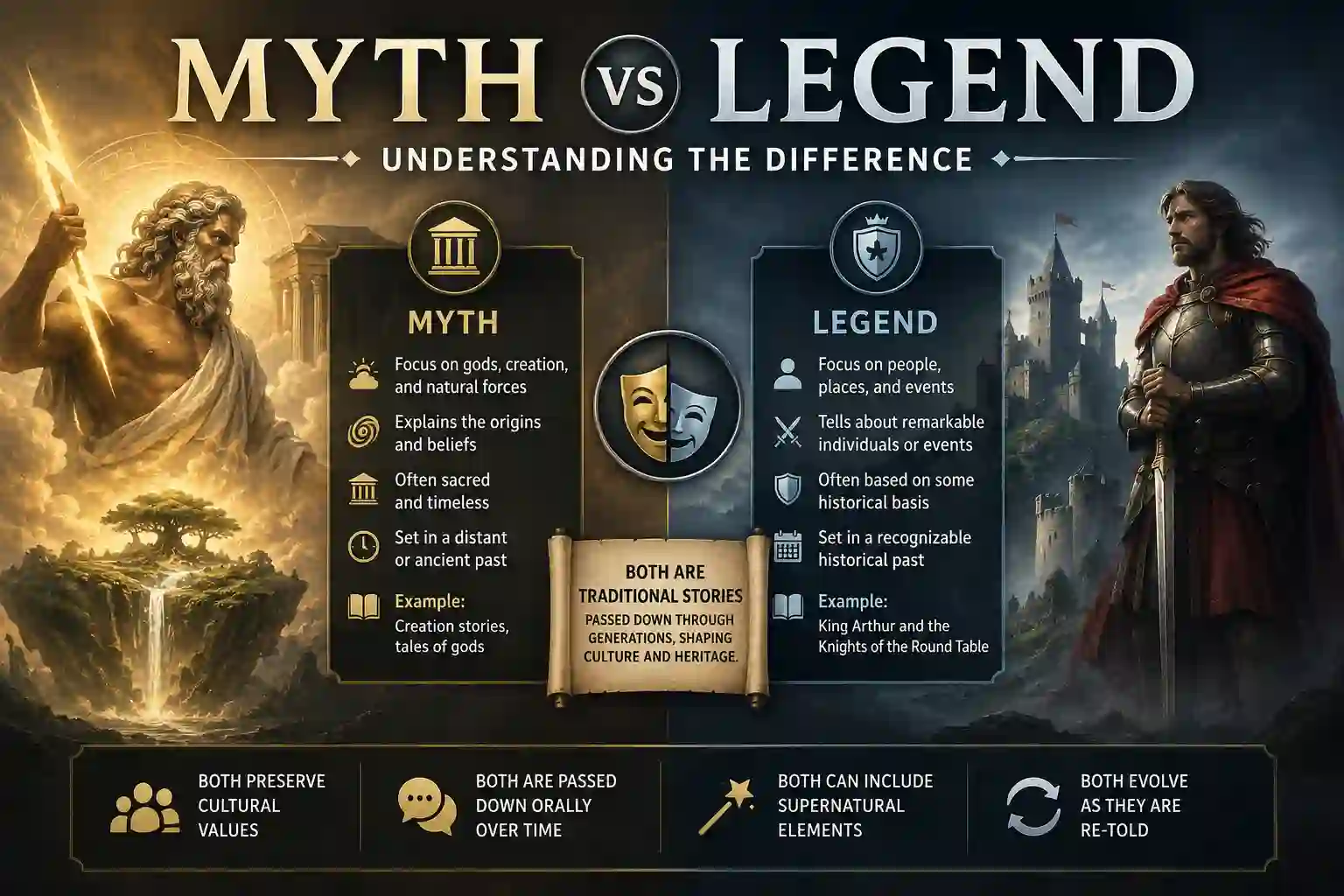
The main difference between myth and legend is their purpose and subject. A myth usually explains gods, creation, nature, or sacred beliefs. A legend usually tells a story about a person, place, or event that may have some historical basis. However, the line between myth and legend is not always clear.
Quick Comparison Table
| Feature | Myth | Legend |
| Main focus | Gods, creation, nature, or sacred ideas | People, places, and events |
| Main characters | Gods, divine beings, heroes, or supernatural figures | Usually humans or human heroes |
| Purpose | Explains origins, beliefs, or the world | Tells about remarkable events or people |
| Historical basis | Usually not tied to a known historical person | Often has some link to history |
| Religious role | Often has a sacred or religious role | Usually less sacred |
| Setting | Often a distant or ancient past | Often a recognizable historical past |
| Truth status | Traditionally meaningful to the culture, not simply “false” | Often told as possibly true or historically based |
| Example | Creation stories about gods | Stories about King Arthur |
People often use myth and legend as if they mean the same thing. They are closely related, but they are not always the same.
Both are traditional stories. Both can include supernatural events. Both may be passed from one generation to another.
The key difference is their role and focus. Myths often deal with sacred questions, gods, creation, and the nature of the world. Legends are more often connected to people, places, or events that are believed to have some connection with history.
But there is no single rule that works for every culture. Scholars also note that the boundary between myth and legend can be difficult to draw.
What Is a Myth?
A myth is a traditional story that often deals with gods, divine beings, creation, nature, or major questions about human existence.
Myths are important because they can express the beliefs of a culture. They may explain why the world exists, how humans came into being, or why a religious practice exists.
For example, many cultures have stories about:
- The creation of the world
- The origin of humans
- Gods and divine beings
- The beginning of death
- The origin of fire
- Natural forces
- The relationship between humans and gods
The word myth does not simply mean “a false story.” In academic and cultural studies, a myth can be a meaningful traditional narrative that expresses important beliefs.
Main Characteristics of Myths
Myths often have these features:
- They deal with sacred or supernatural subjects.
- Gods or divine beings may play major roles.
- They may explain origins or natural phenomena.
- They can express religious or cultural beliefs.
- They often take place in a distant or ancient past.
- They can form part of a larger mythology.
The exact features vary from culture to culture.
What Is a Legend?
A legend is a traditional story about a person, place, or event that is presented as having some connection to the real world.
A legend may contain extraordinary or supernatural events. However, the story often has a recognizable human or historical setting.
The Library of Congress describes legends as stories about extraordinary events in which listeners are invited to believe, question, or debate whether the events really happened.
Examples can include stories about:
- Famous warriors
- Kings and queens
- Historical heroes
- Famous places
- Unusual events
- Local people
- Legendary battles
A legend does not have to be completely true. In fact, it may contain a mixture of historical material, tradition, and imagination.
Main Characteristics of Legends
Legends often have these features:
- They usually focus on people, places, or events.
- They may have a historical setting.
- They are often presented as possible or believable.
- Supernatural elements may appear.
- They can grow and change as people retell them.
- They may be connected to a particular community or region.
The University of California, San Diego notes that some scholars use legend for stories with at least some historical basis, while also stressing that truth or falsity alone does not determine whether a story is a myth or legend.
Difference Between Myth and Legend
1. Difference in Subject
The biggest difference is often the subject of the story.
A myth commonly deals with gods, creation, sacred beliefs, or the nature of existence.
A legend more often deals with human beings, heroes, places, or events.
For example:
- A story about how a god created the world is generally a myth.
- A story about a famous king who may have really lived is more likely to be a legend.
This is a useful rule, but it is not absolute.
2. Difference in Purpose
Myths often answer large questions about the world and human life.
They may explain:
- Where the world came from
- Where humans came from
- Why a natural event happens
- How a religious custom began
- How gods interact with humans
Legends often preserve stories about people, places, or important events.
Their purpose may be to entertain, preserve cultural memory, explain a local tradition, or celebrate a hero.
3. Difference in Historical Connection
Legends are often linked to a possible historical person, place, or event.
For example, a legend may describe a king who may have existed but whose story has been changed over many generations.
Myths are more commonly connected with sacred or cosmic events rather than ordinary human history.
Still, this distinction is not perfect. Some myths include human heroes, and some legends contain supernatural beings.
4. Difference in Religious Role
Myths often have a stronger connection to religion.
They can explain beliefs about:
- Gods
- Creation
- Death
- The universe
- Rituals
- The relationship between humans and divine beings
Legends usually have a weaker religious role. They can be cultural or historical stories rather than sacred narratives.
This does not mean every myth is religious or every legend is non-religious. The categories can overlap.
5. Difference in Main Characters
Myths commonly feature:
- Gods
- Goddesses
- Divine beings
- Demigods
- Supernatural creatures
- Mythic heroes
Legends commonly feature:
- Kings
- Warriors
- Leaders
- Heroes
- Travelers
- Local people
The difference is not based only on the character. A human can appear in a myth, and supernatural figures can appear in a legend.
6. Difference in Truth and Belief
This is one of the most misunderstood differences.
Many people think:
Myth = false story
Legend = partly true story
That is too simple.
In everyday English, myth can mean a widely believed but false idea. But this is a different meaning from the traditional and academic meaning of myth.
In folklore studies, a myth is not defined simply by whether it is factually true. Its cultural meaning and function matter.
Legends are often told in a way that invites questions about whether the events really happened. The Library of Congress notes that belief and debate about the story’s truth are important features of legends.
Myth vs. Legend: Simple Examples
Here is an easy way to understand the difference.
Example of a Myth
Imagine a traditional story about a god who creates the sun and moon.
The story explains something about the universe. It involves a divine being and may have religious meaning.
That is a good example of a myth.
Example of a Legend
Imagine a traditional story about a brave king who defended his kingdom.
The king may have been based on a real person. Over time, storytellers may have added extraordinary events to the story.
That is a typical legend.
King Arthur as an Example
The stories of King Arthur are often described as legends because they are connected to a possible historical figure and a recognizable historical setting.
However, the stories also contain magical and supernatural elements. This shows why the boundary between myth and legend is not always clear. Oxford notes that stories about King Arthur are part of the complex mixture of history, myth, and legend surrounding the British past.
Similarities Between Myth and Legend
Myths and legends have several things in common.
What They Have in Common
- Both are traditional narratives.
- Both can be passed from one generation to another.
- Both can contain supernatural events.
- Both can change through retelling.
- Both can preserve cultural beliefs and values.
- Both can explain or reinforce traditions.
- Both can include heroes and extraordinary events.
- Both are important parts of folklore and cultural heritage.
The Library of Congress includes legends and other traditional narratives within the wider study of folklore and oral tradition.
Are Myths and Legends Always Easy to Separate?
No.
This is an important point that many simple definitions leave out.
Different cultures and scholars may use the terms in different ways. A story that one source calls a myth may be called a legend by another.
The distinction can become especially difficult when a story contains both supernatural elements and possible historical material. Encyclopaedia Iranica specifically notes that the distinction between myth and legend can be difficult to identify in practice.
So, the definitions are useful guides, not rigid rules.
Myth, Legend, and Folklore
Folklore is the broader category.
It can include traditional:
- Stories
- Myths
- Legends
- Beliefs
- Customs
- Songs
- Proverbs
- Rituals
- Superstitions
The Library of Congress describes folklore as including traditional narratives, beliefs, and other forms of cultural expression passed through oral, imitative, or observational traditions.
So you can think of the relationship this way:
Folklore → traditional cultural material
Myths → traditional stories often involving sacred or cosmic ideas
Legends → traditional stories often connected to people, places, or possible historical events
Common Misconceptions
Misconception 1: A Myth Is Always False
Not in the academic sense.
The word myth has a common modern meaning: a false belief or idea. But when discussing mythology and traditional cultures, myth has a different meaning.
A myth is a traditional narrative. Its importance can come from what it explains or represents for a culture, rather than from modern standards of historical proof.
Misconception 2: Every Legend Is Based on a Real Event
Not necessarily.
A legend may have a historical basis, but it can also contain invented, exaggerated, or supernatural elements. The important point is that legends are often presented as stories connected to real people, places, or events.
Misconception 3: Myths Always Have Gods
Gods and divine beings are common in myths, but this is not an absolute rule.
Different cultures use the term myth in different ways. Some mythic traditions include heroes, humans, animals, spirits, and other supernatural beings.
Misconception 4: Myth and Legend Are Completely Separate
They are not.
The two categories can overlap. A traditional story may contain religious ideas, historical characters, supernatural events, and cultural traditions at the same time.
That is why scholars sometimes disagree about the best label for a particular story.
FAQs
What is the main difference between myth and legend?
A myth usually focuses on sacred, supernatural, or cosmic subjects, such as gods, creation, and the origin of the world. A legend usually focuses on people, places, or events that may have some historical connection. However, the categories overlap, so this distinction is a general guide rather than a strict rule.
Is a myth always fictional?
No. In folklore and religious studies, calling something a myth does not simply mean calling it false. Myths can be sacred or culturally important stories that explain beliefs, origins, or the nature of existence. Their cultural meaning is more important than simply asking whether modern historians can prove every event.
Is a legend based on a true story?
A legend may have some connection to a real person, place, or event, but that does not mean the whole story is historically accurate. Legends can gain supernatural or exaggerated details as they are passed from one generation to another.
Can a story be both a myth and a legend?
Yes, depending on the culture and the way the terms are being used. Some traditional stories contain features of both categories. Scholars have noted that the boundary between myth and legend can be difficult to define.
What is an example of a legend?
The stories of King Arthur are commonly treated as legends. They are connected to a possible historical figure and a recognizable historical setting, but the stories also include magical and supernatural elements.
What is the difference between myth and folklore?
Folklore is the broader term. It can include myths, legends, folktales, beliefs, customs, songs, and other traditional cultural expressions. A myth or legend is therefore a type of traditional narrative within the wider world of folklore.
Why are myths and legends important?
They help preserve cultural ideas, values, beliefs, memories, and traditions. Myths can express ideas about creation and the universe, while legends can preserve stories about heroes, places, and events. Both can help communities pass cultural knowledge from one generation to another.
Conclusion
The difference between myth and legend is mainly found in their focus and cultural function. A myth often deals with gods, creation, sacred beliefs, or major questions about existence. A legend more often tells about people, places, or events that may have some historical basis. Both can contain supernatural elements, and both can change through oral tradition. The most important point is that the categories are not rigid. Different cultures and scholars may classify the same story differently. Think of myth as a traditional story often tied to sacred or cosmic ideas, while legend is often a traditional story linked to people, places, or possible history.

Hi! I am Arshad Ullah presently working as linguist in Punjab Education Department. I have done MA in English Literature while M.Phil in Applied Linguistics. I have taught creative writing to the post graduation classes for 15 years. Presently I am working as content writer, and offering classes for blog writing. On this site, I research each topic from authoritative sources and edit every comparison for accuracy and clear, simple language.