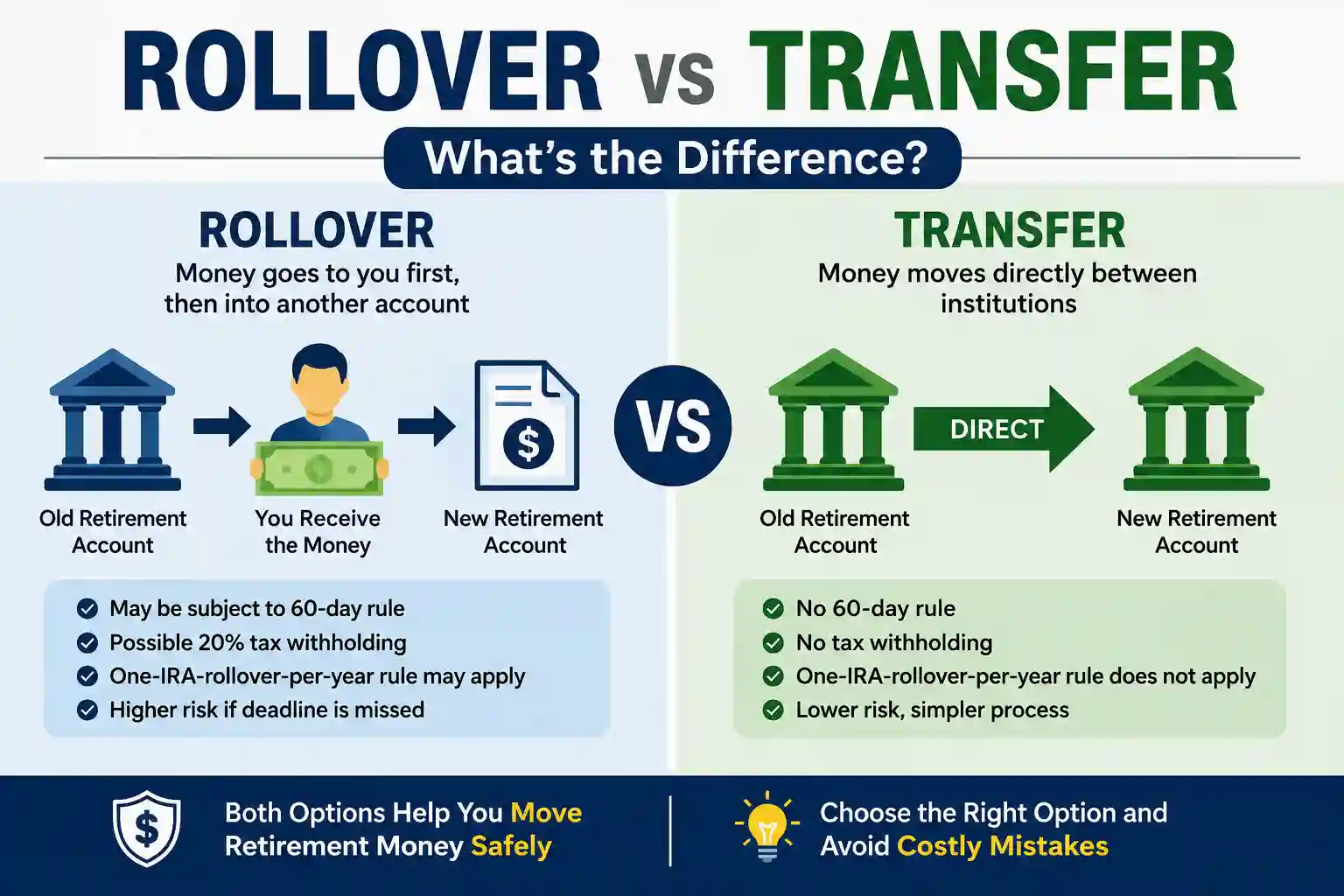
The difference between a rollover and a transfer is mainly how retirement money moves between accounts. A rollover usually involves a distribution from one retirement account that is deposited into another account, often within 60 days. A transfer moves money directly from one trustee or financial institution to another without treating it as a distribution to you.
| Attribute | Rollover | Transfer |
| Basic meaning | Moves retirement money to another eligible retirement account | Moves money directly between trustees or institutions |
| Who receives the money? | You may receive it first, depending on the type | The receiving trustee generally receives it directly |
| 60-day rule | Usually applies to an indirect rollover | Does not apply to a trustee-to-trustee transfer |
| Tax withholding | May apply when a retirement-plan distribution is paid to you | Generally no withholding |
| IRS one-rollover-per-year rule | Can apply to IRA-to-IRA rollovers | Does not apply to direct IRA transfers |
| Main risk | Missing the rollover deadline or failing to replace withheld taxes | Usually simpler because the money moves directly |
| Common use | Moving an old 401(k) into an IRA | Moving an IRA from one financial institution to another |
Introduction
The words rollover and transfer are often used as if they mean the same thing. They both describe moving retirement money from one account to another.
But the IRS treats them differently.
The key question is how the money moves. A rollover can involve a distribution to you before the money enters the new account. A trustee-to-trustee transfer moves the money directly between financial institutions.
Understanding this difference can help you avoid taxes, withholding problems, and missed deadlines.
What Is a Rollover?
A rollover is a way to move money or assets from one eligible retirement plan or IRA to another retirement account.
In a common 60-day rollover, you receive the money and then deposit it into another eligible retirement account within 60 days.
How a Rollover Works
A simple example:
- You take a distribution from a retirement account.
- You receive the money.
- You deposit the money into another eligible retirement account.
- You complete the rollover within the required time.
If the rollover meets the IRS rules, the amount can generally continue to receive tax-deferred treatment.
Direct Rollover vs. 60-Day Rollover
Not every rollover means you personally receive the money.
The IRS also recognizes a direct rollover, where the retirement plan sends the money directly to another eligible retirement plan or IRA.
This is different from a 60-day rollover because the money does not first come to you.
What Is a Transfer?
A transfer generally means moving money directly from one retirement account trustee or financial institution to another.
For example, you can ask the institution holding your IRA to send the funds directly to another IRA trustee.
The IRS says a trustee-to-trustee transfer is not a rollover. Because the money is transferred directly, it is not subject to the IRA one-rollover-per-year rule.
How a Transfer Works
A simple example:
- You have an IRA at Bank A.
- You open an IRA at Bank B.
- You ask Bank A to transfer the money directly to Bank B.
- Bank B receives the money.
You do not take the distribution for your personal use.
Core Difference Between Rollover and Transfer
1. How the Money Moves
This is the most important difference.
With a 60-day rollover, the money can be paid to you first. You then put it into another eligible retirement account within 60 days.
With a trustee-to-trustee transfer, the money moves directly from one trustee to another.
Simple rule:
- Rollover: Account → You → New retirement account
- Transfer: Account → New retirement account
2. The 60-Day Rule
The 60-day rule is important for an indirect rollover.
If you receive a retirement distribution and want it treated as a rollover, you generally must deposit it into the new retirement account within 60 days.
A direct trustee-to-trustee transfer does not use this 60-day process.
3. Tax Withholding
A rollover can create a withholding issue when money from an employer retirement plan is paid to you.
For example, eligible retirement-plan distributions paid to you generally have 20% federal income tax withholding. If you want to roll over the full amount, you generally need to replace the withheld amount with other money.
A direct rollover avoids this mandatory withholding on the amount sent directly to the new plan.
4. One-Rollover-Per-Year Rule
The IRS limits you to one IRA-to-IRA rollover in a one-year period, regardless of how many IRAs you have.
A trustee-to-trustee transfer is different. It is not considered a rollover and is not affected by this one-rollover-per-year rule.
This is an important distinction that beginners often miss.
5. Risk of Making a Mistake
A 60-day rollover requires more attention.
You must follow the applicable rules and meet the deadline. If you do not complete a required rollover on time, the amount may become taxable. In some cases, an additional 10% tax may also apply to an early taxable distribution.
A direct transfer is often simpler because the financial institutions handle the movement of the money directly.
Similarities Between Rollover and Transfer
Both can be used to move retirement assets without simply cashing out the retirement account.
Both can help you move retirement savings to another eligible account while preserving the intended retirement-account treatment when the transaction follows the applicable IRS rules.
However, the exact tax treatment depends on the account types and the transaction.
Practical Examples
Example 1: 401(k) to IRA
Suppose you leave a job and have money in a 401(k).
You may be able to move the money to an IRA through a direct rollover. The plan sends the money directly to the IRA provider.
Example 2: IRA to Another IRA
Suppose you have an IRA at one financial institution and want to move it to another.
A trustee-to-trustee transfer can move the money directly between the institutions. This is not treated as an IRA rollover.
Example 3: Money Paid to You
Suppose a retirement plan pays an eligible distribution directly to you.
If you want to use a 60-day rollover, you generally must deposit the eligible amount into another retirement plan or IRA within 60 days. Employer-plan distributions paid to you generally have mandatory 20% withholding.
When to Use a Rollover or Transfer
Consider a Rollover When:
- You are moving money from an employer retirement plan to another eligible retirement account.
- You need to use a rollover method allowed for the accounts involved.
- You understand the applicable rollover deadline and tax rules.
Consider a Transfer When:
- You are moving an IRA from one financial institution to another.
- You want the institutions to move the money directly.
- You want to avoid the IRA one-rollover-per-year limitation that applies to rollovers.
Common Misconceptions
Is a Transfer the Same as a Rollover?
No. In everyday conversation, people may use the words interchangeably. But the IRS makes an important distinction.
A trustee-to-trustee IRA transfer is not a rollover. It has different rules, including no 60-day rollover process and no one-rollover-per-year limitation.
Does Every Rollover Give You 60 Days?
No.
The 60-day rule applies to certain rollovers where you receive the distribution. A direct rollover sends the money directly to the receiving retirement plan or IRA instead.
Is a Rollover Always Taxable?
No.
A properly completed rollover can generally avoid current taxation on the amount rolled over. However, the tax result depends on the type of accounts and the specific transaction. For example, moving pre-tax money into a Roth IRA can create taxable income.
FAQs
What is the main difference between a rollover and a transfer?
A rollover generally involves moving a retirement distribution into another eligible retirement account. A transfer moves IRA money directly from one trustee or financial institution to another. The IRS does not treat a trustee-to-trustee transfer as a rollover.
Is a rollover better than a transfer?
Neither is automatically better. They serve different situations. A direct transfer is often simpler when moving an IRA between financial institutions. A rollover may be appropriate when moving eligible money between different types of retirement plans. The correct choice depends on the accounts involved.
Is a transfer taxable?
A properly completed trustee-to-trustee transfer is generally not treated as a taxable distribution. The IRS specifically states that a direct transfer between IRA trustees is tax free because there is no distribution to you.
Can I transfer an IRA more than once a year?
Yes. The IRA one-rollover-per-year rule does not apply to trustee-to-trustee transfers. You can therefore make direct IRA transfers without using up the one-rollover-per-year limit.
What happens if I miss the 60-day rollover deadline?
Generally, a rollover completed after 60 days may not qualify for tax-free rollover treatment. The IRS can waive the deadline in certain situations, including some circumstances beyond your control.
Can a 401(k) be transferred to an IRA?
An eligible distribution from a qualified employer retirement plan can generally be rolled over to an IRA when the applicable requirements are met. The IRS specifically lists plan-to-IRA rollovers among permitted rollover transactions.
Conclusion
The key difference between a rollover and a transfer is how the retirement money moves. A rollover can involve receiving a distribution and putting it into another eligible account, while a trustee-to-trustee transfer moves IRA funds directly between trustees. A rollover may involve a 60-day deadline and, in some cases, tax withholding. A direct IRA transfer avoids the one-rollover-per-year rule. Understanding these differences can help you choose the correct method and avoid costly mistakes.

Hi! I am Arshad Ullah presently working as linguist in Punjab Education Department. I have done MA in English Literature while M.Phil in Applied Linguistics. I have taught creative writing to the post graduation classes for 15 years. Presently I am working as content writer, and offering classes for blog writing. On this site, I research each topic from authoritative sources and edit every comparison for accuracy and clear, simple language.