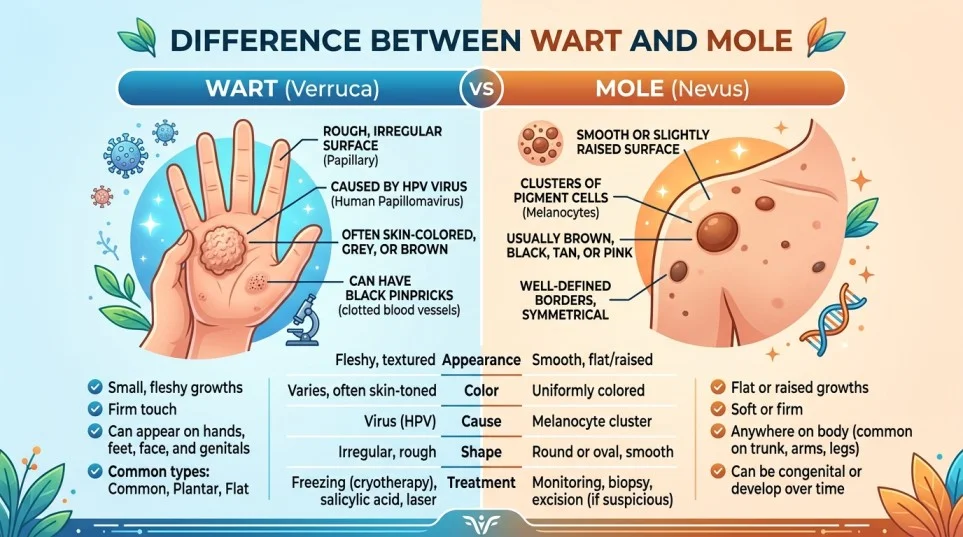
A few years ago, I noticed a small growth on my hand. At first, I thought it was just a mole. A friend told me it looked more like a wart. That simple confusion led me to discover that many people struggle to tell the difference between a wart and a mole.
Since both appear on the skin, they can look similar at first glance. Many people first assume they are the same thing. Others ignore them completely until they become larger or more noticeable.
Knowing the difference matters because the cause, treatment, and health risks can be very different. A wart is usually caused by a virus, while a mole is a growth of skin pigment cells.
Choosing the wrong treatment can lead to irritation, unnecessary worry, or delayed medical attention.
This guide explains everything in simple English with practical examples so you can clearly understand the real difference.
What Is a Wart?
A wart is a small skin growth caused by the human papillomavirus (HPV).
The virus enters the skin through tiny cuts or scratches. Once inside, it causes skin cells to grow faster than normal, creating a raised bump.
Warts can appear almost anywhere on the body, but they are most common on:
- Hands
- Fingers
- Feet
- Knees
- Face
Warts are usually rough to the touch and may have a grainy surface.
Common Types of Warts
- Common warts
- Plantar warts
- Flat warts
- Filiform warts
- Genital warts
Real-World Example
A child who frequently shares sports equipment or walks barefoot around public pools may develop a wart on the foot or hand.
One small difference most people overlook is that warts are contagious and can spread from one person to another.
What Is a Mole?
A mole is a collection of pigment-producing cells called melanocytes.
Most moles develop naturally during childhood and early adulthood. Some people are born with them.
Moles are usually:
- Brown
- Black
- Tan
- Flesh-colored
Unlike warts, moles are not caused by a virus.
They can appear anywhere on the body and often remain unchanged for years.
Types of Moles
- Common moles
- Congenital moles
- Atypical moles
- Dysplastic nevi
Real-World Example
Someone may have a small brown mole on the shoulder since childhood that never changes in size or shape.
For everyday use, most moles are harmless and require no treatment.
Quick Comparison Table
| Feature | Wart | Mole |
| Meaning | Skin growth caused by HPV | Pigmented skin growth |
| Cause | Viral infection | Melanocyte cell growth |
| Contagious | Yes | No |
| Color | Skin-colored, gray, white | Brown, black, tan, pink |
| Texture | Rough | Smooth or slightly raised |
| Shape | Irregular | Usually round or oval |
| Growth Speed | Can appear quickly | Usually develops slowly |
| Pain | Sometimes painful | Usually painless |
| Treatment | Often removable | Usually no treatment needed |
| Health Risk | Usually low | Some may become cancerous |
| Maintenance | Prevent spreading | Monitor changes |
| Popularity | Very common | Extremely common |
| Best Use Case | Requires treatment if bothersome | Monitor for skin health |
| Pros | Often removable | Usually harmless |
| Cons | Contagious | Can occasionally become dangerous |
Biggest Difference Between Wart and Mole
The biggest difference is the cause.
A wart develops because of a viral infection. A mole develops because pigment cells gather together in one area of the skin.
This matters more than many beginners realize.
Because warts are contagious, they can spread to other parts of the body or other people. Moles do not spread.
Another important point is that some moles can occasionally develop into skin cancer, while ordinary warts generally do not.
Understanding this difference helps people decide when to seek medical advice.
Key Differences Explained
1. Cause
Wart
- Caused by HPV infection
- Develops after virus enters skin
Mole
- Caused by clustered pigment cells
- Not related to infection
Example
A wart may appear after using a public locker room. A mole develops naturally over time.
2. Contagious Nature
Wart
- Can spread through direct contact
- Can spread through shared surfaces
Mole
- Cannot spread
- Not infectious
Example
Family members may accidentally spread warts through shared towels.
3. Appearance
Wart
- Rough texture
- Uneven surface
- Often raised
Mole
- Smooth surface
- More uniform appearance
- Often symmetrical
Example
A wart often feels like a tiny cauliflower. A mole usually feels smoother.
4. Color
Wart
- Gray
- White
- Flesh-colored
Mole
- Brown
- Black
- Tan
- Pink
Example
Most moles contain more pigment than warts.
5. Growth Pattern
Wart
- Can develop rapidly
- May multiply
Mole
- Usually grows slowly
- Often remains stable
Example
A wart can appear within weeks, while a mole may take years to change noticeably.
6. Pain and Discomfort
Wart
- Can become painful
- Especially on feet
Mole
- Usually painless
- May become irritated by clothing
Example
Plantar warts often hurt while walking.
7. Location
Wart
- Hands
- Feet
- Fingers
- Knees
Mole
- Anywhere on the body
Example
A mole may appear on areas that rarely experience friction.
8. Cancer Risk
Wart
- Rarely linked to skin cancer
Mole
- Some atypical moles may increase cancer risk
Example
Doctors often monitor unusual moles for warning signs.
9. Treatment Approach
Wart
- Freezing
- Salicylic acid
- Medical removal
Mole
- Usually monitored
- Removed if suspicious
Example
Many people remove warts because they spread.
10. Long-Term Behavior
Wart
- May disappear naturally
- Can return
Mole
- Often permanent
Example
After using wart treatments, some people later regret stopping treatment too early because the wart returns.
11. Age Group
Wart
- Common in children and teens
Mole
- Common in all age groups
Example
Children often develop warts more frequently due to close contact activities.
Similarities Between Them
Despite their differences, warts and moles share several similarities.
- Both appear on the skin
- Both can be raised
- Both vary in size
- Both may concern people cosmetically
- Both may require medical evaluation
- Both can appear almost anywhere on the body
These similarities explain why many people confuse them.
Pros and Cons
Pros of Wart
- Often treatable
- May disappear naturally
- Usually non-cancerous
Cons of Wart
- Contagious
- Can spread
- Sometimes painful
- May recur
Pros of Mole
- Usually harmless
- Non-contagious
- Often stable for years
Cons of Mole
- Some may become cancerous
- Can cause cosmetic concerns
- May require monitoring
Which Is Better for Different Situations?
This question is slightly different because neither a wart nor a mole is “better.” They are different skin conditions.
For General Skin Health
- A stable mole is usually less troublesome than a wart.
For Cosmetic Appearance
- Many people prefer a flat mole over a rough wart.
For Low Maintenance
- Stable moles often require less attention.
For Medical Monitoring
- Moles deserve more long-term observation because of potential cancer risk.
For Families With Children
- Preventing wart transmission is often a priority.
Common Mistakes People Make
Assuming Every Skin Bump Is a Wart
Many harmless moles are mistaken for warts.
Ignoring Changing Moles
Changes in color, size, or shape should not be ignored.
Self-Diagnosing Online
Pictures can be misleading.
Using Wart Treatments on Moles
This can damage healthy skin.
Waiting Too Long
Unusual growths should be checked by a healthcare professional.
Expert Recommendation
Choose Wart Treatment If:
- The growth is confirmed as a wart
- It spreads easily
- It causes discomfort
- It affects daily activities
Choose Mole Monitoring If:
- The mole remains stable
- There are no warning signs
- A healthcare provider confirms it is harmless
Avoid Wart Treatment If:
- You are unsure whether it is a wart
- The growth has unusual colors
- The area bleeds easily
Avoid Ignoring a Mole If:
- It changes size
- It changes color
- It develops irregular borders
- It starts itching or bleeding
Final Verdict
The difference between wart and mole comes down to cause, appearance, and health implications. Warts are caused by a viral infection and can spread from person to person. Moles are collections of pigment cells and are usually harmless, though some require monitoring.
In real-world use, most people worry more about warts because they are contagious and sometimes uncomfortable. However, moles often deserve closer long-term attention because unusual changes can signal more serious skin conditions.
If you are unsure whether a skin growth is a wart or a mole, avoid self-treatment and seek professional advice. A proper diagnosis can save time, prevent unnecessary treatments, and provide peace of mind. Understanding these differences helps you make smarter decisions about your skin health and know when medical attention may be needed.
FAQ Section
What is the main difference between a wart and a mole?
A wart is caused by HPV infection and is contagious. A mole is a collection of pigment cells and is not contagious. Their causes, appearance, and treatment methods are different.
Can a wart turn into a mole?
No. A wart cannot become a mole. They develop from completely different biological processes.
Which is more dangerous, a wart or a mole?
Most warts are harmless. Certain atypical moles may carry a higher risk because some can develop into skin cancer.
How can I tell if a bump is a wart or a mole?
Warts are usually rough and irregular. Moles tend to be smoother and more evenly colored. A healthcare provider can give the most accurate diagnosis.
Are warts and moles treated the same way?
No. Wart treatments target viral growths. Moles are usually monitored and only removed when medically necessary or for cosmetic reasons.
Which lasts longer, a wart or a mole?
Moles often last for many years or a lifetime. Warts may disappear naturally or after treatment.
Are warts and moles interchangeable terms?
No. They are different skin conditions with different causes, risks, and treatments.
What mistake should beginners avoid?
The biggest mistake is treating an unknown skin growth without knowing whether it is a wart, mole, skin tag, or another condition.
Conclusion
Warts and moles may look similar at first, but they are very different skin conditions. Warts are caused by a viral infection and can spread through contact, while moles develop from pigment-producing cells and are generally not contagious. Understanding this distinction helps prevent unnecessary worry and reduces the risk of using the wrong treatment.
Many people focus only on appearance, but the real difference lies in how these growths develop and what they may mean for your health. Warts often need treatment because they can spread or cause discomfort. Moles usually require observation, especially if they begin to change in size, color, or shape.
When in doubt, getting a professional skin evaluation is the safest choice. Knowing the difference between a wart and a mole allows you to make informed decisions, protect your skin health, and respond appropriately if changes occur.

Hi! I am Arshad Ullah presently working as linguist in Punjab Education Department. I have done MA in English Literature while M.Phil in Applied Linguistics. I have taught creative writing to the post graduation classes for 15 years. Presently I am working as content writer, and offering classes for blog writing. On this site, I research each topic from authoritative sources and edit every comparison for accuracy and clear, simple language.