A few years ago, I worked with a small business owner who believed buying and procurement were exactly the same thing. Whenever the company needed office supplies, software, or equipment, he simply searched for the product and purchased it.
At first, everything seemed fine.
But over time, costs increased, suppliers became unreliable, and the business started facing delays. That was when he realized something important: buying is only one part of procurement.
Many people compare buying and procurement because the terms often appear together in business, supply chain management, purchasing departments, and vendor management discussions. They seem similar, but they serve different purposes.
Understanding the difference between buying and procurement can help businesses save money, reduce risks, improve supplier relationships, and make smarter purchasing decisions.
This guide explains everything in simple English with practical examples so you can clearly understand the real difference.
What Is Buying?
Buying is the process of purchasing goods or services from a seller.
It is usually a simple transaction where a buyer identifies a need, chooses a product, pays for it, and receives it.
In most cases, buying focuses on the immediate purchase itself.
How Buying Works
A typical buying process includes:
- Identifying a need
- Finding a supplier
- Comparing prices
- Making the purchase
- Receiving the product or service
Who Uses Buying?
Buying is used by:
- Individuals
- Small businesses
- Retail stores
- Schools
- Government offices
- Large companies
Practical Example
Suppose a company needs ten computer keyboards.
The employee searches online, compares prices, chooses a seller, and places an order.
That is buying.
The Main Goal of Buying
The primary goal is to obtain a product or service quickly and at a reasonable price.
Buying focuses on the transaction.
What Is Procurement?
Procurement is the complete strategic process of acquiring goods and services for an organization.
It includes buying, but it goes much further.
Procurement focuses on planning, supplier selection, negotiations, contracts, risk management, quality control, compliance, and long-term value.
How Procurement Works
A procurement process may include:
- Identifying business needs
- Budget planning
- Market research
- Supplier evaluation
- Contract negotiation
- Purchase approval
- Buying goods or services
- Monitoring supplier performance
- Managing relationships
Who Uses Procurement?
Procurement is commonly used by:
- Large organizations
- Government agencies
- Manufacturers
- Healthcare institutions
- Universities
- Multinational corporations
Practical Example
A hospital needs medical equipment.
Instead of simply buying from the cheapest supplier, the procurement team:
- Reviews multiple vendors
- Checks certifications
- Evaluates quality standards
- Negotiates pricing
- Signs service agreements
- Ensures regulatory compliance
This entire process is procurement.
The Main Goal of Procurement
The goal is to maximize value while reducing cost, risk, and operational problems.
Procurement focuses on long-term business success.
Quick Comparison Table
| Feature | Buying | Procurement |
| Meaning | Purchasing goods or services | Complete acquisition strategy |
| Purpose | Obtain products quickly | Achieve long-term value |
| Focus | Transaction | Process and strategy |
| Scope | Narrow | Broad |
| Supplier Selection | Basic | Detailed evaluation |
| Negotiation | Limited | Extensive |
| Contracts | Often unnecessary | Usually important |
| Cost Focus | Purchase price | Total cost of ownership |
| Risk Management | Minimal | Significant |
| Relationship Management | Short-term | Long-term |
| Complexity | Simple | More complex |
| Time Required | Fast | Longer |
| Popularity | Common in everyday purchases | Common in organizations |
| Best Use Case | Immediate needs | Strategic business purchasing |
| Pros | Quick and easy | Cost-effective and strategic |
| Cons | May overlook risks | Requires more planning |
Biggest Difference
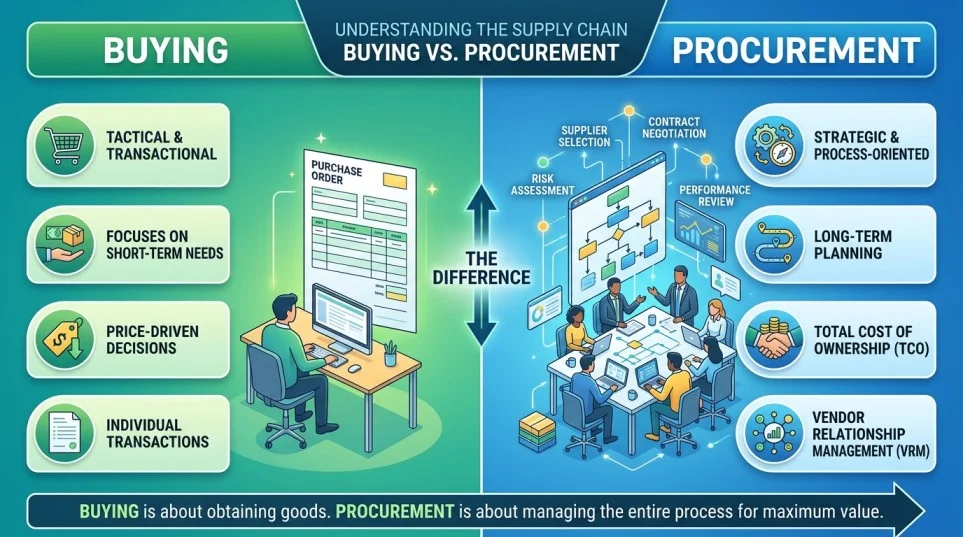
The biggest difference between buying and procurement is that buying focuses on making a purchase, while procurement focuses on managing the entire purchasing strategy.
Many people first assume procurement is simply another word for buying.
It is not.
Buying answers:
“How do we get this item?”
Procurement answers:
“What should we buy, from whom, at what price, under what terms, and how will it benefit the organization over time?”
This matters more than many beginners realize.
A company can be excellent at buying products but still struggle financially if it lacks a proper procurement strategy.
Over the long term, procurement often creates greater savings, better supplier relationships, and lower risks.
Key Differences Explained
1. Scope of Activities
Buying
Buying mainly focuses on the purchase transaction.
- Select product
- Pay supplier
- Receive item
Procurement
Procurement covers the entire lifecycle.
- Planning
- Supplier research
- Contract management
- Purchasing
- Performance evaluation
Example
Buying a laptop is one task.
Managing a company’s entire laptop purchasing strategy is procurement.
2. Strategic vs Operational Focus
Buying
Buying is mostly operational.
It solves immediate needs.
Procurement
Procurement is strategic.
It supports long-term business goals.
Real-World Impact
A procurement strategy can reduce costs for years, while a buying decision affects only a single purchase.
3. Supplier Relationship Management
Buying
The buyer may interact with suppliers only when a purchase is needed.
Procurement
Procurement teams build long-term supplier partnerships.
Example
A manufacturer may work with the same supplier for several years through procurement agreements.
4. Cost Consideration
Buying
Buying often focuses on the lowest purchase price.
Procurement
Procurement considers total value.
This includes:
- Maintenance costs
- Delivery costs
- Quality issues
- Warranty coverage
- Operational efficiency
Example
A cheaper machine may cost more in repairs later.
Procurement evaluates this risk.
5. Negotiation Process
Buying
Negotiation is often limited.
Procurement
Negotiation plays a major role.
Teams negotiate:
- Pricing
- Payment terms
- Delivery schedules
- Service agreements
Real-World Impact
Strong procurement negotiations can save organizations thousands or even millions of dollars.
6. Risk Management
Buying
Risk assessment is usually minimal.
Procurement
Risk management is a major responsibility.
Procurement Teams Evaluate
- Supplier reliability
- Financial stability
- Compliance risks
- Supply chain disruptions
Example
Some users later regret choosing suppliers based only on price without assessing risk.
7. Documentation Requirements
Buying
Documentation is often simple.
- Purchase order
- Invoice
- Receipt
Procurement
Documentation is more detailed.
- Contracts
- Compliance records
- Vendor evaluations
- Audit reports
8. Decision-Making Process
Buying
Decisions are usually quick.
Procurement
Decisions involve research and approvals.
Example
Large organizations may require several departments to approve procurement decisions.
9. Time Investment
Buying
Generally fast.
Procurement
Requires more planning and analysis.
Why It Matters
The extra effort often results in better long-term outcomes.
10. Performance Measurement
Buying
Success is measured by obtaining the item.
Procurement
Success is measured through:
- Cost savings
- Supplier performance
- Quality improvements
- Business value
11. Business Impact
Buying
Impacts individual purchases.
Procurement
Impacts entire business operations.
Real-World Observation
After using both approaches for some time, many organizations discover that procurement creates stronger financial control and operational stability.
Similarities Between Them
Despite their differences, buying and procurement share several similarities.
- Both involve acquiring goods and services.
- Both require suppliers.
- Both support organizational needs.
- Both involve spending company funds.
- Both require decision-making.
- Both can affect operational efficiency.
Because procurement includes buying, people often confuse the two terms.
One small difference most people overlook is that every procurement process includes buying, but not every buying activity qualifies as procurement.
Pros and Cons
Pros of Buying
- Fast process
- Easy to understand
- Minimal paperwork
- Suitable for urgent purchases
- Lower administrative effort
Cons of Buying
- Limited strategic value
- Higher long-term risk
- Less supplier analysis
- Can lead to overspending
- May ignore future needs
Pros of Procurement
- Better long-term savings
- Strong supplier relationships
- Improved quality control
- Reduced business risks
- Better compliance management
- Supports organizational growth
Cons of Procurement
- More complex
- Requires planning
- Takes longer
- Higher administrative workload
- Needs skilled professionals
Which Is Better for Different Situations?
For Beginners
Buying is easier because it involves fewer steps.
For Large Organizations
Procurement is usually the better choice because it supports strategic goals.
For Small Businesses
A mix of both often works best.
Simple purchases can use buying, while major investments should use procurement.
For Budget-Conscious Organizations
Procurement often delivers better value over time.
For Urgent Needs
Buying is usually more practical.
For Long-Term Growth
Procurement provides stronger benefits.
For Risk Reduction
Procurement is generally the safer option.
Common Mistakes People Make
Many organizations make avoidable mistakes when comparing buying and procurement.
Thinking They Mean the Same Thing
This is the most common misunderstanding.
Focusing Only on Price
The cheapest option is not always the most valuable option.
Ignoring Supplier Reliability
A low-cost supplier can create expensive problems later.
Skipping Procurement for Major Purchases
Large investments deserve careful evaluation.
Overcomplicating Small Purchases
Not every purchase requires a full procurement process.
Ignoring Total Cost of Ownership
Maintenance, support, and operational costs matter.
Following Trends Instead of Business Needs
Choosing suppliers because they are popular can lead to poor decisions.
Expert Recommendation
Choose Buying If:
- You need products quickly
- Purchases are low value
- Risk is minimal
- The transaction is straightforward
- Administrative resources are limited
Choose Procurement If:
- Purchases are strategic
- Costs are significant
- Long-term value matters
- Supplier quality is important
- Risk management is required
Avoid Buying If:
- The purchase affects critical operations
- Long-term contracts are involved
- Compliance requirements exist
- Supplier reliability is essential
Avoid Procurement If:
- The purchase is extremely small
- Speed is more important than strategy
- Administrative costs outweigh benefits
Final Verdict
The difference between buying and procurement comes down to scope and strategy.
Buying focuses on acquiring goods or services. Procurement focuses on managing the entire process that leads to those purchases.
For everyday transactions, buying is often enough. It is quick, simple, and practical. However, when costs are high, risks matter, or long-term value is important, procurement becomes the smarter approach.
In real-world business environments, procurement often delivers better financial results because it considers supplier quality, contracts, risk management, and future costs. Buying remains an important part of the process, but procurement provides the bigger picture.
The best choice depends on your situation. Understanding where buying ends and procurement begins can help individuals and organizations make better decisions, reduce waste, and achieve stronger long-term outcomes.
FAQ Section
Is procurement the same as buying?
No. Buying is the act of purchasing goods or services, while procurement is the broader process that includes planning, supplier selection, negotiation, purchasing, and supplier management.
Which is better, buying or procurement?
Neither is universally better. Buying is ideal for simple purchases, while procurement is better for strategic purchases where long-term value, risk management, and supplier performance matter.
Is procurement worth it for small businesses?
Yes, especially for important purchases. Even small businesses can benefit from procurement practices such as supplier evaluation, contract negotiation, and cost analysis.
Why do companies use procurement instead of simple buying?
Companies use procurement because it helps control costs, reduce risks, improve supplier relationships, and support long-term business objectives beyond individual purchases.
Which is easier for beginners?
Buying is easier because it involves fewer steps and less analysis. Procurement requires planning, research, and strategic decision-making.
Are buying and procurement interchangeable terms?
No. Although people often use them interchangeably, procurement is a broader process that includes buying as one of its stages.
What do most organizations prefer?
Most large organizations prefer procurement systems because they provide better control, transparency, compliance, and long-term savings.
What mistake should beginners avoid?
The biggest mistake is focusing only on the purchase price. Total value, supplier reliability, quality, and future costs are often more important than the initial cost alone.
Conclusion
Buying and procurement may seem similar, but they serve different purposes. Buying is focused on completing a purchase, while procurement is focused on creating value throughout the entire acquisition process. This distinction becomes increasingly important as purchases grow in size, complexity, or business impact.
Many people initially view procurement as unnecessary paperwork. In reality, it helps organizations make smarter decisions, negotiate better deals, reduce risks, and build stronger supplier relationships. Buying remains an essential activity, but procurement provides the strategy behind successful purchasing decisions.
For small, routine purchases, a simple buying process is often enough. For larger investments, long-term contracts, or critical business needs, procurement offers clear advantages. Understanding the difference allows you to choose the right approach, control costs more effectively, and make decisions that support both immediate needs and future success.

Hi! I am Arshad Ullah presently working as linguist in Punjab Education Department. I have done MA in English Literature while M.Phil in Applied Linguistics. I have taught creative writing to the post graduation classes for 15 years. Presently I am working as content writer, and offering classes for blog writing. On this site, I research each topic from authoritative sources and edit every comparison for accuracy and clear, simple language.