I still remember seeing a fast-moving animal race across a field and calling it a rabbit. A wildlife enthusiast nearby quickly corrected me. “That was a hare, not a rabbit.”
At first, I thought they were basically the same animal. After all, both have long ears, powerful back legs, and fluffy appearances. Many people make the same mistake.
The confusion between hares and rabbits is common because they belong to the same animal family and share many physical traits. However, they differ in appearance, behavior, habitat, reproduction, and survival strategies.
Understanding the difference between hares and rabbits matters for wildlife enthusiasts, students, pet owners, and anyone interested in nature. These differences influence how they live, raise their young, and adapt to their environments.
This guide explains everything in simple English with practical examples so you can clearly understand the real difference.
What Is a Hare?
A hare is a fast-running mammal belonging to the Leporidae family. Hares are generally larger than rabbits and are known for their incredible speed and strong legs.
Hares have existed for millions of years and evolved to survive in open grasslands, meadows, and deserts where hiding places are limited.
Key Characteristics of Hares
- Larger body size
- Longer ears
- Longer hind legs
- Exceptional running speed
- Live mostly above ground
- Born with fur and open eyes
How Hares Live
Unlike rabbits, hares usually live alone. They do not build extensive underground burrows.
Instead, they rest in shallow depressions called forms. These simple shelters help them stay hidden from predators.
Real-World Example
The famous jackrabbit found in North America is actually a hare, not a rabbit. Its long ears help regulate body temperature in hot environments.
What Is a Rabbit?
A rabbit is also a member of the Leporidae family, but it follows a different lifestyle from a hare.
Rabbits are generally smaller and prefer living in groups. They create underground tunnel systems called warrens, which offer protection from predators and harsh weather.
Key Characteristics of Rabbits
- Smaller body size
- Shorter ears
- Shorter legs
- Social behavior
- Live in burrows
- Babies are born helpless
How Rabbits Live
Rabbits rely heavily on their underground homes for safety. These complex tunnels may contain multiple entrances and living chambers.
Many rabbit species thrive near forests, grasslands, farms, and suburban areas.
Real-World Example
The European rabbit is one of the most well-known rabbit species and is the ancestor of most domestic pet rabbits.
Quick Comparison Table
| Feature | Hare | Rabbit |
| Meaning | Wild mammal adapted for speed | Mammal adapted for burrowing and social living |
| Body Size | Larger | Smaller |
| Ears | Longer | Shorter |
| Legs | Longer and stronger | Shorter |
| Habitat | Open fields and grasslands | Burrows and warrens |
| Social Behavior | Mostly solitary | Highly social |
| Babies at Birth | Fur-covered, eyes open | Hairless, eyes closed |
| Shelter | Surface nests (forms) | Underground burrows |
| Speed | Very fast | Fast but slower than hares |
| Survival Method | Running | Hiding and burrowing |
| Maintenance Effort | Not suitable as pets | Many species domesticated |
| Popularity | Mostly wildlife species | Common pets worldwide |
| Best Use Case | Wildlife observation | Pets and education |
| Main Advantage | Speed and independence | Adaptability and social behavior |
| Main Drawback | Harder to observe and study | Vulnerable outside burrows |
Biggest Difference
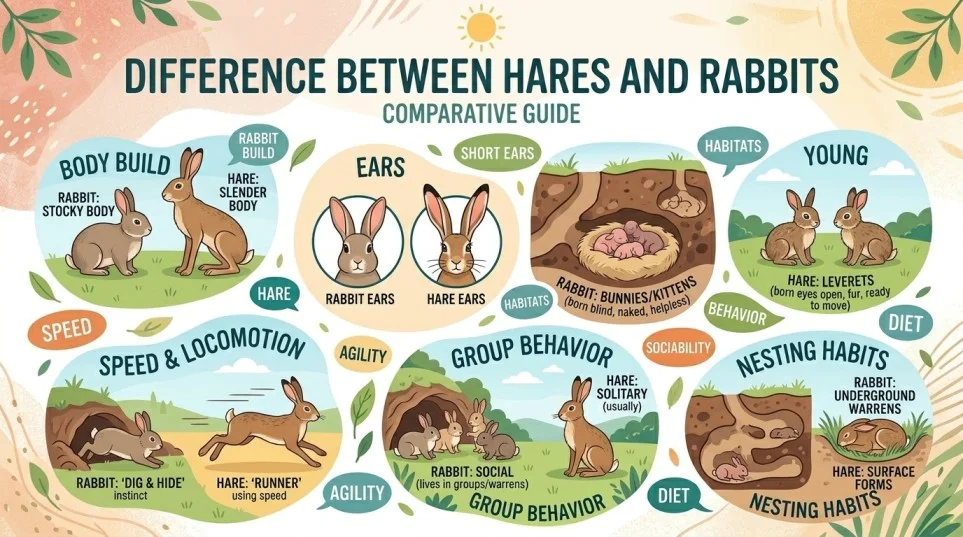
The biggest difference between hares and rabbits is how their young are born and how they survive.
Hare babies, called leverets, are born fully furred with open eyes and can move shortly after birth.
Rabbit babies, called kits, are born blind, hairless, and completely dependent on their mothers.
This difference affects nearly every part of their lifestyle. Hares depend on speed and independence, while rabbits depend on protection through family groups and burrows.
Many beginners overlook this distinction, but it explains most of the behavioral differences between the two animals.
Key Differences Explained
1. Body Size and Appearance
Hares
- Usually larger
- Longer ears
- Longer legs
- Leaner build
Rabbits
- More compact bodies
- Shorter ears
- Shorter limbs
- Rounder appearance
Practical Impact
In real-world observation, hares often appear more athletic, while rabbits look more compact and cuddly.
2. Birth and Development
Hares
- Babies are born fully developed
- Eyes open
- Covered with fur
Rabbits
- Babies are born helpless
- Eyes closed
- No fur initially
Practical Impact
This affects survival strategies from the first day of life.
3. Living Environment
Hares
- Prefer open landscapes
- Stay above ground
Rabbits
- Prefer burrows
- Live underground for protection
Practical Impact
Rabbits can better avoid predators by hiding, while hares depend on speed.
4. Social Behavior
Hares
- Solitary animals
- Usually live alone
Rabbits
- Social creatures
- Often live in groups
Practical Impact
Many people first assume both animals behave similarly, but rabbits are generally far more social.
5. Running Speed
Hares
- Can reach extremely high speeds
- Built for long-distance escape
Rabbits
- Fast but not as fast
- Use quick direction changes
Practical Impact
Hares often outrun predators, while rabbits rely on quick hiding opportunities.
6. Nesting Habits
Hares
- Use simple surface nests
- Minimal shelter construction
Rabbits
- Dig complex warrens
- Create protective tunnel systems
Practical Impact
One small difference most people overlook is how much energy rabbits invest in building homes.
7. Predator Avoidance
Hares
- Escape through speed
- Depend on strong vision
Rabbits
- Escape through concealment
- Depend on burrows
Practical Impact
Different environments require different survival methods.
8. Intelligence and Adaptability
Hares
- Adapted for independent survival
Rabbits
- Adapt well to group living
Practical Impact
Rabbits often adjust better to environments influenced by humans.
9. Domestication
Hares
- Rarely domesticated
Rabbits
- Common household pets
Practical Impact
Most pet rabbits are descendants of European rabbits.
10. Lifespan
Hares
- Often face more environmental risks
Rabbits
- Can live longer in protected settings
Practical Impact
Domestic rabbits frequently outlive wild hares.
11. Relationship With Humans
Hares
- Primarily wildlife animals
Rabbits
- Wildlife and pets
Practical Impact
For everyday use as companion animals, rabbits are the clear choice.
Similarities Between Them
Despite their differences, hares and rabbits share many characteristics.
- Both belong to the Leporidae family
- Both are mammals
- Both are herbivores
- Both have powerful hind legs
- Both possess excellent hearing
- Both reproduce quickly
- Both are important parts of ecosystems
These similarities explain why people often confuse them.
Pros and Cons
Pros of Hares
- Extremely fast runners
- Highly independent
- Well adapted to open habitats
- Strong survival instincts
Cons of Hares
- Difficult to domesticate
- More vulnerable without shelter
- Harder to observe closely
Pros of Rabbits
- Social and adaptable
- Can be domesticated
- Effective underground protection
- Popular companion animals
Cons of Rabbits
- Depend heavily on burrows
- Vulnerable when exposed
- Require care if kept as pets
Which Is Better for Different Situations?
For Wildlife Observation
Hares are often more fascinating because of their speed and unique behaviors.
For Pet Owners
Rabbits are the better choice.
For Families
Rabbits are generally more suitable due to domestication.
For Students Studying Animal Behavior
Comparing both provides valuable insight into evolution and adaptation.
For Nature Enthusiasts
Both offer unique learning opportunities.
For Long-Term Human Interaction
Rabbits are the clear winner.
Common Mistakes People Make
Assuming Every Long-Eared Animal Is a Rabbit
Many people incorrectly identify hares as rabbits.
Thinking Hares Are Just Large Rabbits
They are separate species with distinct behaviors.
Ignoring Habitat Differences
Where the animal lives often provides a major clue.
Confusing Baby Development
This is one of the easiest ways to tell them apart.
Believing Both Make Good Pets
Some users later regret assuming hares can be cared for like domestic rabbits.
Expert Recommendation
Choose Hares If:
- You enjoy wildlife observation
- You study animal adaptation
- You are interested in natural ecosystems
- You want to learn about speed-based survival
Choose Rabbits If:
- You want a pet
- You prefer social animals
- You have a family environment
- You want an animal that adapts well to human care
Avoid Hares If:
- You want a domestic companion
- You expect social interaction
- You lack wildlife experience
Avoid Rabbits If:
- You cannot provide proper care
- You underestimate long-term responsibility
- You expect completely independent behavior
Final Verdict
When comparing hares and rabbits, neither animal is universally better. They simply evolved for different lifestyles.
Hares are built for speed, independence, and survival in open environments. Their long legs, larger bodies, and highly developed young make them impressive wildlife animals.
Rabbits, on the other hand, excel at social living, burrow construction, and adapting to life around humans. This is one reason they became some of the world’s most popular small pets.
For most people, rabbits are the more familiar choice because of their presence in homes, farms, and educational settings. However, hares remain fascinating examples of natural adaptation and resilience.
Understanding these differences helps you appreciate both animals for what they truly are rather than assuming they are simply different versions of the same creature.
FAQ Section
Which is better, a hare or a rabbit?
Neither is universally better. Hares are better adapted for wild survival and speed, while rabbits are better suited for social living and domestication. The better choice depends on your purpose and interest.
Are hares and rabbits the same animal?
No. Hares and rabbits belong to the same family but are different species with unique behaviors, habitats, and reproductive characteristics.
Which is faster, a hare or a rabbit?
A hare is generally faster. Its longer legs and larger body help it run at higher speeds across open terrain.
Which is easier to keep as a pet?
Rabbits are much easier to keep as pets because they have been domesticated for generations and adapt well to human environments.
Why are baby hares different from baby rabbits?
Baby hares are born fully developed with fur and open eyes, while baby rabbits are born helpless and require extensive parental care.
Do hares live in burrows?
No. Most hares live above ground and rest in shallow depressions called forms rather than digging extensive burrow systems.
What do most people prefer?
Most people are more familiar with rabbits because they are common pets and are often seen around farms, homes, and educational settings.
What mistake should beginners avoid?
The biggest mistake is assuming size alone determines whether an animal is a hare or rabbit. Habitat, behavior, and newborn characteristics provide more accurate identification.
Conclusion
Hares and rabbits may look similar at first glance, but they live remarkably different lives. Hares are larger, faster, and more independent, relying on speed to escape danger. Rabbits are smaller, social, and skilled at creating underground homes that provide protection for their families. These differences influence everything from how they raise their young to how they interact with their environment.
Many people confuse the two because they share long ears, powerful hind legs, and membership in the same animal family. However, once you understand their habitats, behavior, and development, the distinctions become much clearer.
Whether you are a student, wildlife enthusiast, pet owner, or simply curious about nature, knowing the difference between hares and rabbits helps you better appreciate these fascinating animals and the unique ways they have adapted to survive.

Hi! I am Arshad Ullah presently working as linguist in Punjab Education Department. I have done MA in English Literature while M.Phil in Applied Linguistics. I have taught creative writing to the post graduation classes for 15 years. Presently I am working as content writer, and offering classes for blog writing. On this site, I research each topic from authoritative sources and edit every comparison for accuracy and clear, simple language.