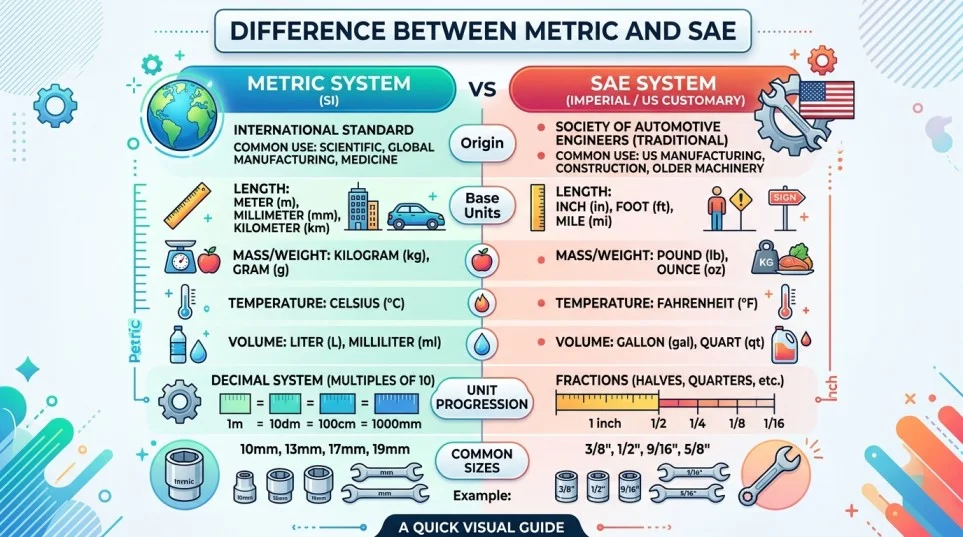
The first time I tried to loosen a bolt on my car, I grabbed a wrench that looked like the perfect fit. It almost worked—but not quite. The wrench slipped, rounded the bolt edges, and turned a simple repair into a frustrating afternoon.
Later, I discovered the problem: I was using a Metric wrench on an SAE fastener.
Many people compare Metric and SAE because both systems are used to measure tools, bolts, nuts, sockets, and mechanical parts. At first glance, they seem very similar. In reality, choosing the wrong system can cause damaged hardware, wasted money, and unnecessary frustration.
The confusion becomes even greater when working on vehicles, machinery, bicycles, home repairs, or industrial equipment. Many beginners assume Metric and SAE are interchangeable, but that is not always true.
This guide explains everything in simple English with practical examples so you can clearly understand the real difference.
What Is Metric?
Metric is a measurement system based on millimeters (mm), centimeters (cm), and meters (m). In the tool world, Metric sizes are measured in millimeters.
The Metric system originated in Europe and is now the standard measurement system in most countries around the world.
For example:
- 8 mm wrench
- 10 mm socket
- 13 mm bolt
- 17 mm spanner
Most modern vehicles, motorcycles, bicycles, and industrial machines use Metric fasteners.
How Metric Works
Each tool size corresponds to a measurement in millimeters.
For example:
- 10 mm = 10 millimeters wide
- 12 mm = 12 millimeters wide
- 14 mm = 14 millimeters wide
The numbering system is simple and consistent, making it easier for beginners to understand.
Who Uses Metric?
Metric is commonly used by:
- Automotive manufacturers
- Engineers
- Mechanics
- Construction industries
- Manufacturing companies
- International businesses
Real-World Example
If you work on a modern Japanese, German, Korean, or many newer American vehicles, you will likely need Metric tools.
What Is SAE?
SAE stands for the Society of Automotive Engineers. In everyday tool usage, SAE refers to measurements based on inches and fractions of inches.
Examples include:
- 1/4 inch
- 3/8 inch
- 1/2 inch
- 9/16 inch
- 3/4 inch
SAE measurements are commonly associated with the traditional U.S. measurement system.
How SAE Works
Instead of millimeters, SAE sizes use fractions.
Examples:
- 1/4″
- 5/16″
- 7/16″
- 1/2″
- 9/16″
Because fractions are involved, many beginners find SAE measurements slightly harder to memorize.
Who Uses SAE?
SAE is often used by:
- Older American vehicles
- Agricultural equipment
- Some industrial machinery
- Certain construction equipment
- Legacy manufacturing systems
Real-World Example
If you are repairing an older American truck or classic vehicle, SAE tools are often necessary.
Quick Comparison Table
| Feature | Metric | SAE |
| Measurement Unit | Millimeters | Inches |
| Numbering Style | Decimal-based | Fraction-based |
| Origin | Europe | United States |
| Common Sizes | 8mm, 10mm, 13mm | 3/8″, 1/2″, 9/16″ |
| Learning Curve | Easier | Slightly harder |
| Global Popularity | Very high | More limited |
| Automotive Usage | Most modern vehicles | Many older American vehicles |
| Manufacturing Use | Worldwide standard | Certain U.S. industries |
| Precision | Very precise | Less granular in common sizes |
| Tool Availability | Extremely common | Common in North America |
| Best For | Modern equipment | Older U.S. equipment |
| Main Advantage | Simplicity and global use | Compatibility with older systems |
| Main Drawback | Not ideal for some legacy equipment | Fraction measurements can be confusing |
Biggest Difference
The biggest difference between Metric and SAE is the unit of measurement.
Metric uses millimeters, while SAE uses inches and fractions of inches.
This may sound like a small distinction, but it affects every wrench, socket, bolt, nut, and fastener you use.
Many beginners first assume a 13 mm socket and a 1/2-inch socket are the same. They are actually slightly different sizes.
In real-world use, even a tiny difference can cause:
- Rounded bolts
- Damaged tools
- Slipping wrenches
- Increased repair costs
Over the long term, using the correct measurement system protects both tools and equipment.
Key Differences Explained
1. Measurement Units
Metric
Metric relies on millimeters.
Examples:
- 8 mm
- 10 mm
- 15 mm
SAE
SAE relies on inches.
Examples:
- 1/4″
- 3/8″
- 5/8″
Example:
- Metric: 10 mm socket
- SAE: 3/8-inch socket
2. Numbering System
Metric
Uses whole numbers and decimals.
SAE
Uses fractions.
Example:
- Metric: 14 mm
- SAE: 9/16″
Many beginners find Metric easier because it avoids fractions.
3. Global Usage
Metric
Used throughout most of the world.
SAE
Primarily used in the United States and older U.S.-based systems.
Real-World Impact:
International manufacturers overwhelmingly favor Metric standards.
4. Automotive Applications
Metric
Found on most modern vehicles.
SAE
Common on older American vehicles.
Example:
- Modern sedan = mostly Metric
- Classic muscle car = often SAE
5. Ease of Learning
Metric
Simple progression.
SAE
Requires understanding fractions.
Example:
Going from 10 mm to 11 mm is straightforward.
Comparing 7/16″ to 1/2″ often takes more thought.
6. Precision and Sizing
Metric
Offers highly consistent increments.
SAE
Uses fraction increments.
Practical Effect:
Engineers often prefer Metric because measurements can be communicated more precisely.
7. Tool Organization
Metric
Typically easier to sort and identify.
SAE
Can require memorizing fractional sizes.
Common Frustration:
Many people spend extra time searching for the correct SAE size among similar-looking fractions.
8. Availability of Parts
Metric
Common worldwide.
SAE
More common in older U.S. equipment.
Example:
Replacement Metric hardware is often easier to source globally.
9. Manufacturing Standards
Metric
Used by most global manufacturers.
SAE
Often found in legacy U.S. manufacturing environments.
10. Conversion Challenges
Metric
Requires conversion to inches when working with SAE equipment.
SAE
Requires conversion to millimeters when working with Metric equipment.
Example:
A mechanic may need both systems when servicing mixed-origin vehicles.
11. Cost of Tool Ownership
Metric
Usually included in most modern tool kits.
SAE
Often requires a separate set.
Real-World Observation:
Many DIY users eventually purchase both systems because modern workshops frequently encounter both types of fasteners.
Similarities Between Them
Despite their differences, Metric and SAE share many similarities.
- Both measure fasteners and tools.
- Both are used in mechanical work.
- Both help ensure proper fitment.
- Both are available in wrench and socket sets.
- Both are trusted by professionals.
- Both can perform the same job when used correctly.
This overlap is why people often confuse them.
Pros and Cons
Pros of Metric
- Easy numbering system
- Global standard
- Common on modern vehicles
- Easier for beginners
- Highly precise
Cons of Metric
- Not compatible with all older equipment
- May require conversion when using SAE hardware
Pros of SAE
- Ideal for older American equipment
- Widely available in North America
- Useful for classic vehicle restoration
- Long-established standard
Cons of SAE
- Fraction measurements can be confusing
- Less common internationally
- Harder for some beginners to learn
Which Is Better for Different Situations?
For Beginners
Metric is usually easier to learn.
For Professional Mechanics
Owning both systems is often essential.
For Modern Vehicles
Metric is usually the better choice.
For Classic American Cars
SAE is often required.
For Budget Users
Metric sets often provide the greatest day-to-day usefulness.
For Long-Term Workshop Use
Having both Metric and SAE tools prevents compatibility issues.
For Home Repairs
Metric generally covers more modern products and equipment.
Common Mistakes People Make
Assuming They Are Interchangeable
A close fit is not always the correct fit.
Buying Only One Tool Set
Many users later regret purchasing only Metric or only SAE.
Ignoring Vehicle Specifications
Manufacturers specify the correct fastener system for a reason.
Using Near-Match Sizes
This often damages bolts and nuts.
Following Guesswork
Choosing tools by appearance instead of measurement creates expensive mistakes.
Overlooking Mixed Systems
Some equipment contains both Metric and SAE fasteners.
Expert Recommendation
Choose Metric If:
- You work on modern vehicles
- You want easier measurements
- You need globally accepted standards
- You are a beginner
Choose SAE If:
- You repair older American vehicles
- You restore classic cars
- You work with legacy machinery
- Your equipment specifically uses SAE hardware
Avoid Metric If:
- Your equipment exclusively uses SAE fasteners
- You frequently work on older U.S. machinery
Avoid SAE If:
- Most of your work involves modern imported equipment
- You want a simpler measurement system
FAQ
Which is better, Metric or SAE?
Neither system is universally better. Metric is preferred for most modern equipment and international manufacturing, while SAE remains important for older American vehicles and machinery.
Is it worth owning both Metric and SAE tools?
Yes. Many mechanics and DIY users eventually need both. Having complete tool sets prevents damage caused by using incorrect sizes.
Which lasts longer, Metric or SAE tools?
Tool durability depends more on quality and materials than the measurement system itself. A high-quality Metric wrench and a high-quality SAE wrench can last equally long.
Which is easier for beginners?
Metric is generally easier because it uses simple millimeter measurements rather than fractions.
What do most people prefer today?
Most modern industries, manufacturers, and mechanics prefer Metric because it has become the global standard.
Are Metric and SAE interchangeable?
Not completely. Some sizes appear close, but even slight differences can damage fasteners or reduce tool effectiveness.
Why do mechanics own both systems?
Many vehicles and machines contain different measurement standards. Owning both sets ensures proper fit and professional results.
What mistake should beginners avoid?
The biggest mistake is forcing a nearly fitting tool onto a fastener. Always use the exact Metric or SAE size recommended.
Conclusion
Understanding the difference between Metric and SAE is more important than many people realize. While both systems serve the same basic purpose—measuring and fitting tools, bolts, and fasteners—they use completely different measurement standards. Metric relies on millimeters and has become the dominant global system, while SAE uses inches and remains common in older American vehicles and equipment.
For most people today, Metric will be encountered more often, especially when working with modern cars, bicycles, appliances, and machinery. However, SAE still plays an important role in classic vehicle restoration, agriculture, and legacy equipment maintenance.
In real-world use, the smartest approach is often not choosing one over the other but understanding both. After using both systems for some time, most professionals realize that having the correct tool matters far more than personal preference. Knowing when to use Metric and when to use SAE will save time, prevent damage, and make every repair job easier.

Hi! I am Arshad Ullah presently working as linguist in Punjab Education Department. I have done MA in English Literature while M.Phil in Applied Linguistics. I have taught creative writing to the post graduation classes for 15 years. Presently I am working as content writer, and offering classes for blog writing. On this site, I research each topic from authoritative sources and edit every comparison for accuracy and clear, simple language.