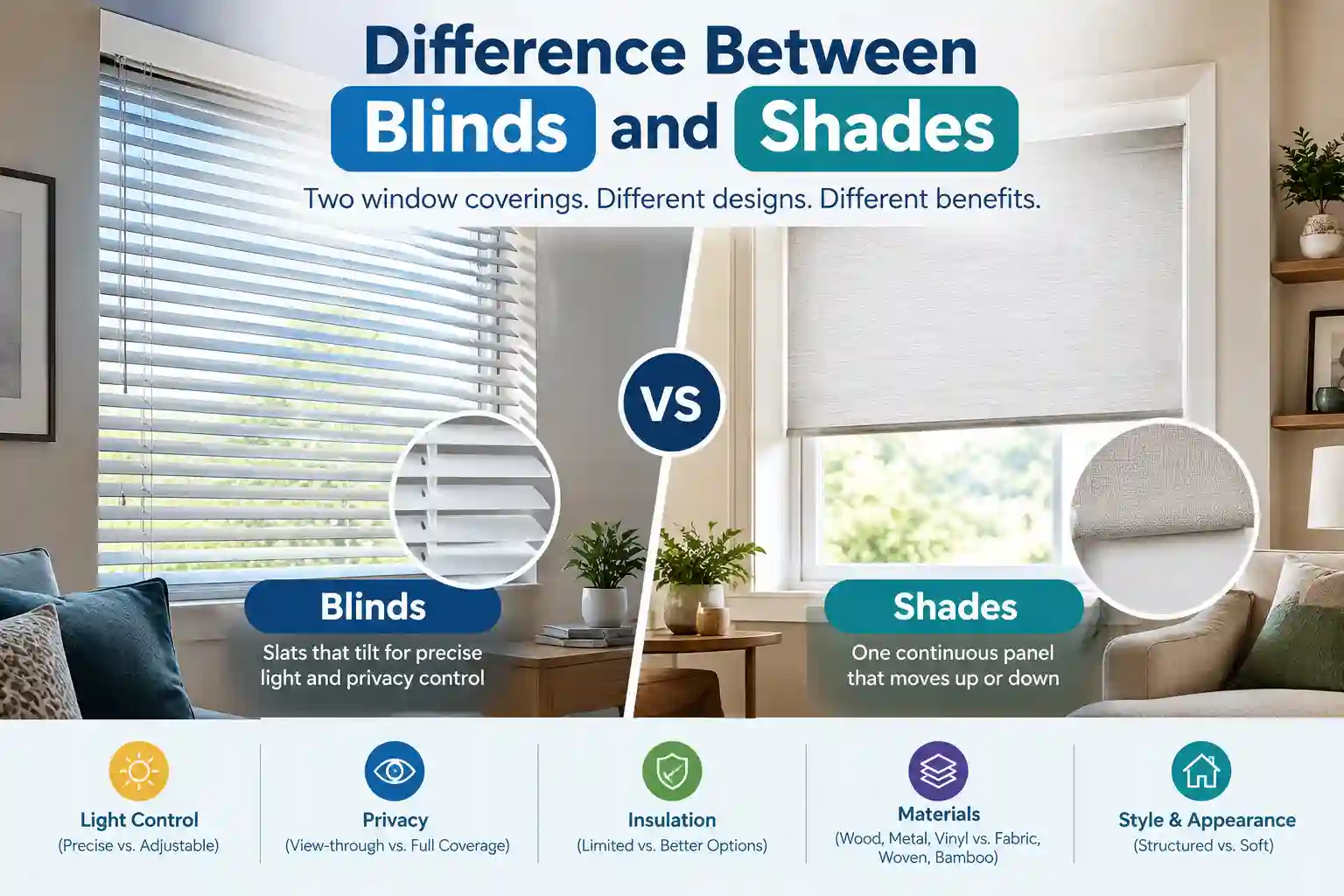
Blinds and shades are both window coverings, but they work in different ways. Blinds use individual slats or louvers that can be tilted to control light and privacy. Shades usually use one piece of fabric or woven material that moves up or down. Blinds offer more precise light control, while shades often provide a softer look and can offer better insulation, depending on the type.
| Feature | Blinds | Shades |
| Basic design | Slats or louvers | One continuous panel or folded material |
| Light control | Tilt slats for precise control | Raise, lower, or adjust depending on style |
| Common materials | Wood, metal, vinyl, some fabric | Fabric, woven wood, bamboo, other materials |
| View when partly closed | Often possible through tilted slats | Usually limited unless the style is designed for it |
| Appearance | Structured and clean | Soft and decorative |
| Insulation | Usually limited | Some types, especially cellular shades, provide strong insulation |
| Common types | Venetian, wood, faux wood, vertical | Roller, Roman, cellular, woven wood |
| Best known for | Adjustable light and privacy | Style, coverage, and specialized light control |
Introduction
The words blinds and shades are often used as if they mean the same thing. Both cover windows and help control light and privacy.
However, they are not exactly the same.
The main difference is their construction. Blinds are made with slats that can usually tilt. Shades are generally made from a continuous piece of material that moves up or down.
This difference affects how they control light, how they look, and how well certain styles insulate a room.
What Are Blinds?
Blinds are window coverings made from separate slats or louvers. The slats can be horizontal or vertical.
Many blinds allow you to:
- Raise or lower the covering.
- Tilt the slats.
- Let in some light.
- Block more light.
- Adjust the outside view.
This makes blinds useful when you want fine control over light and privacy.
Common Types of Blinds
Common blind styles include:
- Wood blinds
- Faux-wood blinds
- Metal blinds
- Venetian blinds
- Vertical blinds
Blinds can be made from materials such as wood, metal, and other rigid materials.
What Are Shades?
Shades are window coverings that usually use a single panel of fabric or woven material. Instead of tilting separate slats, you normally raise or lower the shade.
There are many shade designs. Examples include:
- Roller shades
- Roman shades
- Cellular shades
- Woven wood shades
- Solar shades
- Sheer shades
Because shades come in many materials and designs, they can provide different levels of light filtering, privacy, and insulation.
Core Difference Between Blinds and Shades
1. Construction
The clearest difference is the way they are built.
Blinds have separate slats. The slats can rotate to change the amount of light entering the room.
Shades usually have a continuous material. The material moves up or down to cover or uncover the window.
2. Light Control
Blinds are especially useful when you want precise control over incoming light.
You can tilt the slats partly open, fully open, or closed. This can let you adjust both light and your view through the window.
Shades normally work by raising or lowering the covering. However, some modern shades have special designs that allow more flexible light control.
3. Privacy and Outside View
Blinds can provide a useful balance between privacy and visibility.
For example, you can tilt the slats so that sunlight enters while the slats limit the view into the room.
Traditional shades usually provide less view-through when they are lowered. However, specialized sheer and solar shades can allow some natural light and outside visibility.
4. Insulation
Not all blinds and shades have the same insulation performance.
Basic blinds can reduce some sunlight, but they generally provide limited insulation. The U.S. Department of Energy notes that cellular shades can provide greater energy-saving potential because their honeycomb structure traps air.
Cellular shades are therefore a notable choice when insulation is important.
5. Appearance
Blinds often have a more structured appearance because of their individual slats.
Shades can create a softer appearance because many styles use fabric or woven materials.
For example:
- Wood blinds can give a room a traditional look.
- Roller shades can create a simple, clean appearance.
- Roman shades can add folds and texture.
- Woven shades can add a natural look.
The best style depends on the room and the desired appearance.
6. Cleaning and Maintenance
Blinds usually have individual slats that can be dusted or wiped.
Shades need care based on their material. Fabric shades may require more careful cleaning than wood or metal blinds.
The cleaning method therefore depends more on the material and design than simply on whether a product is a blind or shade.
Blinds vs. Shades: Practical Examples
Imagine a bedroom with strong morning sunlight.
Blinds allow you to tilt the slats to control how much sunlight enters while still allowing some view through the window.
Now imagine a room where insulation is a major concern. A cellular shade may be a better choice because its honeycomb structure creates air pockets that add insulation at the window.
For a living room, a homeowner may choose a Roman shade or woven shade because of its decorative appearance.
When to Use Blinds
Blinds may be a good choice when you want:
- Precise control over light.
- Adjustable outside views.
- Adjustable privacy.
- A structured window treatment.
- Wood, metal, or similar materials.
- Slats that can be tilted.
Blinds are especially useful when controlling the direction and amount of light matters.
When to Use Shades
Shades may be a good choice when you want:
- A softer appearance.
- Fabric or woven materials.
- Simple up-and-down operation.
- Different decorative styles.
- Light-filtering options.
- Better insulation from specialized designs such as cellular shades.
The right shade depends on the room and the specific type of shade.
Common Misconceptions
Are Blinds and Shades the Same Thing?
No. They are both window coverings, but their construction is different.
Blinds generally use separate slats or louvers. Shades generally use a continuous panel or another unified covering.
Are All Shades Made of Fabric?
No. Many shades use fabric, but shades can also be made from woven natural materials such as bamboo, reeds, grasses, and wood.
Are Blinds Always Better for Light Control?
Not necessarily. Blinds are known for precise control through their adjustable slats, but some modern shades also offer advanced light-control options.
For example, certain sheer shades combine fabric vanes with sheer material and allow the vanes to be adjusted.
Do Shades Always Provide Better Insulation?
No. Insulation depends on the type.
Cellular shades are designed with honeycomb-shaped cells that trap air and can improve insulation. A basic shade may not provide the same benefit.
FAQs
What is the main difference between blinds and shades?
The main difference is their construction. Blinds use separate slats or louvers that can usually tilt. Shades generally use a continuous piece of fabric or woven material that moves up or down. This makes blinds especially useful for adjustable light and view control, while shades offer many styles and material choices.
Are blinds or shades better for privacy?
Both can provide privacy. Blinds offer the advantage of adjustable slats, so you can control light and visibility at the same time. Shades can provide strong privacy when fully lowered, but the level of privacy depends on the material and style.
Which is better for insulation: blinds or shades?
Certain shades can provide better insulation than basic blinds. Cellular shades are a strong example because their honeycomb structure traps air near the window. The U.S. Department of Energy identifies cellular shades as an energy-efficient window-covering option.
Can blinds block all light?
Blinds can greatly reduce incoming light when their slats are closed. However, small gaps and spaces around the window treatment can still allow some light to enter. The amount depends on the blind design and installation.
Are shades only used for decoration?
No. Shades can control light and privacy as well as provide decorative value. Some types also offer specialized benefits. For example, cellular shades can improve insulation, while solar shades can help reduce UV exposure while maintaining some outside visibility.
Can a window have both blinds and shades?
Some window treatments combine features associated with both categories. Sheer shades, for example, can use adjustable fabric vanes that work in a way similar to blind slats.
Conclusion
The difference between blinds and shades mainly comes down to design and operation. Blinds use separate slats or louvers that can tilt, giving you detailed control over light, privacy, and outside views. Shades usually use one continuous panel or woven material that moves up or down.
Choose blinds when adjustable slats and precise light control are important. Choose shades when you prefer a softer look, more material choices, or specialized features such as the insulation offered by cellular shades. Neither is always better. The best choice depends on the window, room, light, privacy needs, and style you want.

Hi! I am Arshad Ullah presently working as linguist in Punjab Education Department. I have done MA in English Literature while M.Phil in Applied Linguistics. I have taught creative writing to the post graduation classes for 15 years. Presently I am working as content writer, and offering classes for blog writing. On this site, I research each topic from authoritative sources and edit every comparison for accuracy and clear, simple language.