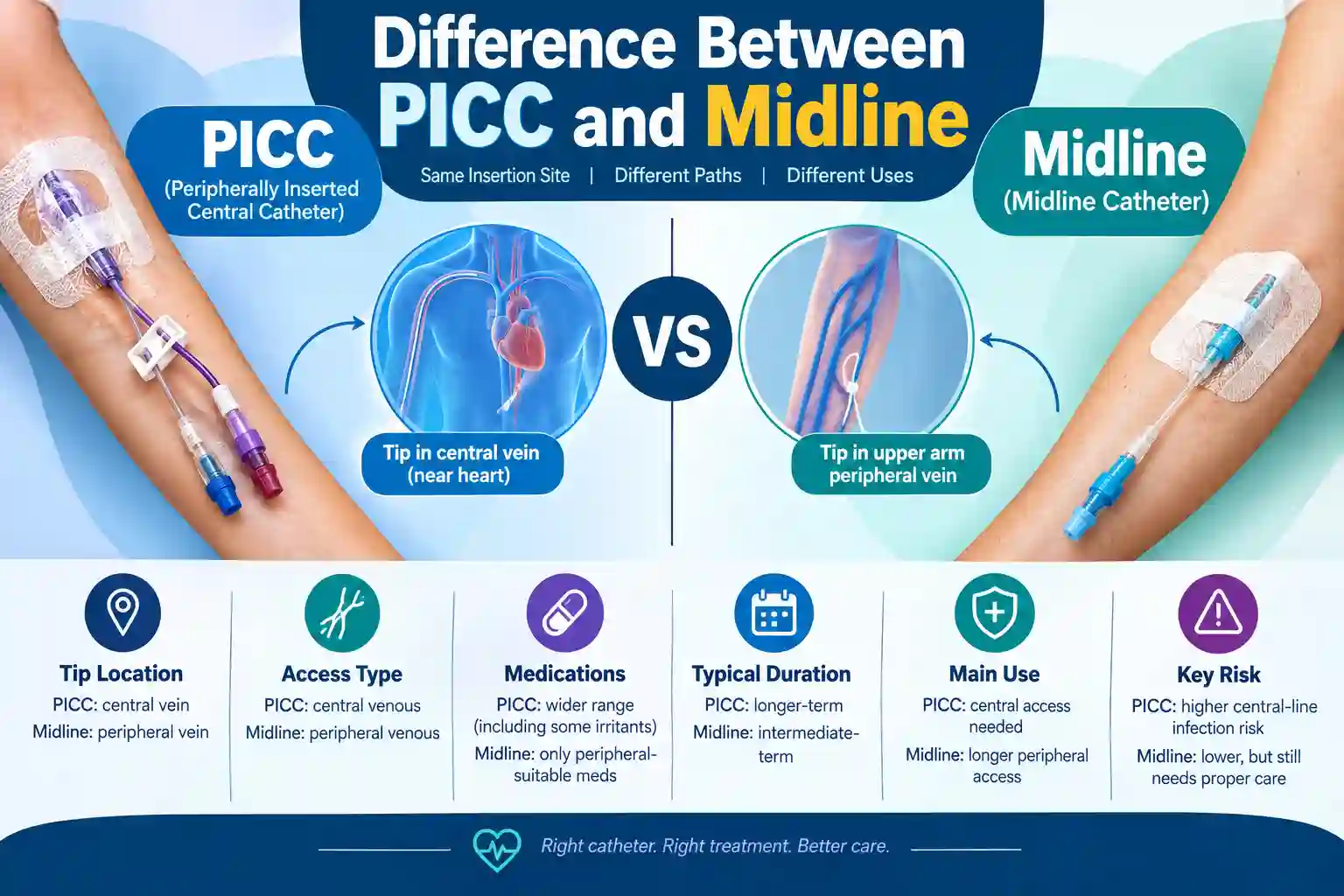
A PICC and a midline are both IV catheters placed through a vein in the arm. The main difference is where the catheter tip ends. A PICC travels into a large central vein near the heart, while a midline stays in the peripheral veins of the upper arm. This difference affects which medicines can be given, how long the line may be used, and the risks involved.
| Feature | PICC | Midline |
| Full name | Peripherally inserted central catheter | Midline catheter |
| Entry site | Arm vein | Arm vein |
| Catheter tip | Central vein, usually near the superior vena cava | Does not enter the central veins |
| Type | Central venous access | Peripheral venous access |
| Typical use | Longer-term IV treatment | Intermediate-term peripheral IV treatment |
| Suitable medicines | Can handle some medicines that need central access | Only medicines suitable for peripheral veins |
| Duration | Often used for longer treatment | Often used for shorter treatment |
| Placement | Usually requires careful tip-position assessment | Usually does not require central-tip placement |
| Main advantage | Provides central venous access without chest/neck insertion | Provides longer peripheral access without entering a central vein |
Introduction
Both PICC and midline catheters can reduce the need for repeated needle sticks. They are often considered when a patient needs IV treatment for more than a few days. The CDC recommends considering a midline or PICC instead of a short peripheral IV when IV therapy is expected to exceed six days.
The important point is that a PICC is a central line, but a midline is not normally a central line. The location of the catheter tip is what makes the major difference.
What Is a PICC?
PICC stands for peripherally inserted central catheter.
It is inserted through a vein in the arm. The catheter is then advanced toward the body’s larger central veins. According to the CDC, PICCs may be inserted through the basilic, cephalic, or brachial veins and enter the superior vena cava.
Main Characteristics of a PICC
- It enters through an arm vein.
- The catheter travels into a central vein.
- It provides central venous access.
- It can be used when treatment needs longer-term IV access.
- Some medicines that are not suitable for peripheral veins may require central access.
- The catheter tip needs to be correctly positioned.
Because the tip is in a major central vein, PICC placement and maintenance require careful infection-control practices. WHO recommends sterile technique for PICC insertion.
What Is a Midline?
A midline catheter is a longer peripheral IV catheter.
It is inserted into a vein in the upper arm, such as the basilic or cephalic vein. Unlike a PICC, it does not advance into the central veins.
Main Characteristics of a Midline
- It is inserted through an arm vein.
- Its tip remains outside the central veins.
- It is considered peripheral venous access.
- It can be useful for longer peripheral IV treatment.
- The medication must be appropriate for administration through a peripheral vein.
- It can reduce the need for repeated short IV placements.
Core Difference Between PICC and Midline
1. Catheter Tip Location
This is the most important difference.
A PICC travels from an arm vein into a central vein. A midline remains in the peripheral venous system.
Think of it this way:
PICC:
Arm vein → central vein
Midline:
Arm vein → upper-arm peripheral vein
This difference determines what the catheter can safely be used for.
2. Central vs Peripheral Access
A PICC is classified as a central venous catheter because its tip is positioned in a central vein.
A midline is a peripheral catheter. It is not intended to terminate in a major central vessel near the heart.
3. Type of Medication
This difference is very important.
A PICC can provide central access for therapies that require a large central vein. A midline should generally be used only for medications and fluids that are appropriate for peripheral administration.
Some drugs can irritate or damage peripheral veins. The choice of catheter therefore depends partly on the medication’s properties.
WHO notes that more vein-damaging or irritating therapies may favor a PICC because it allows more central drug delivery.
Important: The decision should be made by the treating medical team. A midline should not be assumed to be suitable simply because a PICC is not available.
4. Expected Treatment Duration
Both devices can be used when IV treatment is expected to last longer than a few days.
There is no single duration that applies to every patient. The choice depends on the treatment, medication, patient condition, and local clinical practice.
WHO guidance notes that midlines are often used for periods under about 14 days, while PICCs can remain in place much longer when appropriate.
5. Infection Considerations
Both devices can develop complications, including infection.
A PICC is a central venous catheter, so a bloodstream infection involving the catheter can have serious consequences. A midline does not normally terminate in a central vein and is therefore managed differently from a central line.
This does not mean that a midline is risk-free. Both require proper insertion, dressing care, monitoring, and removal when no longer needed.
6. Treatment Choice
The choice is not simply:
PICC = better
Midline = worse
That is incorrect.
The correct catheter depends on what the patient needs.
A midline may be a good choice when the patient needs peripheral-compatible IV treatment for an intermediate period. A PICC may be more suitable when central venous access or a longer treatment period is needed.
PICC vs Midline: Simple Example
Imagine a patient needs IV antibiotics for several days.
If the antibiotic is suitable for peripheral administration, a midline may be considered.
If the medication requires central administration or treatment is expected to continue for a much longer period, a PICC may be more appropriate.
The exact decision depends on the medication and the patient’s clinical situation.
Similarities Between PICC and Midline
Although they are different, PICCs and midlines have several things in common.
- Both can be inserted through veins in the arm.
- Both can reduce repeated needle sticks.
- Both can provide IV access for more than a few days.
- Both require proper catheter care.
- Both can develop complications such as infection, blockage, or thrombosis.
- Both should be selected according to the patient’s treatment needs.
The CDC recommends selecting the catheter based on the intended purpose, expected duration, and possible complications.
When Is a PICC Usually Considered?
A PICC may be considered when:
- Central venous access is needed.
- Treatment is expected to continue for a longer period.
- The medication is not suitable for peripheral administration.
- The patient needs a reliable longer-term IV route.
- The treatment requires characteristics of central venous access.
The exact choice should be made by a qualified healthcare professional.
When Is a Midline Usually Considered?
A midline may be considered when:
- IV treatment is expected to last longer than a few days.
- The prescribed medication is suitable for peripheral administration.
- Central venous access is not required.
- A longer peripheral IV route is useful.
Current guidance commonly places midlines in the short-to-intermediate treatment range, although the appropriate duration varies with the patient and treatment.
Common Misconceptions
Is a Midline the Same as a PICC?
No. They are both inserted through arm veins, but their catheter tips have different destinations.
A PICC enters the central venous system. A midline remains outside the central veins.
Is a Midline a Central Line?
Normally, no. A midline is intended to be a peripheral catheter. However, CDC notes that the actual catheter-tip location and intended use can matter when determining whether a device meets the definition of a central line.
Can Any IV Medicine Be Given Through a Midline?
No. A midline is not automatically suitable for every IV medication. Drugs that are too irritating or otherwise unsuitable for peripheral administration may require central access.
Is a PICC Always Better Than a Midline?
No. The two devices serve different purposes. Using a PICC when central access is not needed may expose the patient to unnecessary central-line risks. Conversely, using a midline when central access is required may be inappropriate.
Which Is Better: PICC or Midline?
Neither is universally better.
The better choice depends on:
- The medication being given.
- How long treatment is expected to last.
- Whether central venous access is required.
- The patient’s veins and medical condition.
- The risks associated with each device.
- Local clinical expertise and available resources.
For example, CDC materials have described midlines as preferred over PICCs for some shorter courses of peripheral-compatible therapy, while PICCs may be preferred when longer central access is needed.
FAQs
What is the main difference between a PICC and a midline?
The main difference is the catheter-tip location. A PICC travels into a central vein, while a midline remains in the peripheral venous system. Because of this difference, PICCs can provide central venous access, while midlines are used for therapies that are appropriate for peripheral administration.
Is a PICC more serious than a midline?
A PICC provides central venous access, so it carries central-line considerations that a midline generally does not. This does not mean that every PICC is unsafe or every midline is safer in every situation. The appropriate device depends on the treatment and the patient’s needs.
How long can a midline stay in?
There is no single maximum duration that applies to every patient and device. Current guidance often describes midlines as useful for short-to-intermediate periods, with some guidance suggesting use for less than about 14 days in many situations. Clinical condition, catheter function, and treatment type also matter.
Can a PICC be used for antibiotics?
Yes. PICCs are commonly used when IV antibiotic treatment requires longer-term access or central venous administration. The specific antibiotic and treatment plan determine whether a PICC is appropriate.
Can a midline be used for antibiotics?
Sometimes. A midline can be used for antibiotics that are compatible with peripheral administration. Not every antibiotic is appropriate for a midline, so the specific drug must be checked by the medical team.
Is a midline safer than a PICC?
Not in every situation. A midline avoids central venous catheter placement, but it has its own possible complications. A PICC may be the safer and more effective choice when central access is medically required.
Conclusion
The key difference between a PICC and a midline is where the catheter ends. A PICC starts in an arm vein but travels into a central vein, giving central venous access. A midline also starts in an arm vein but remains outside the central veins, making it a peripheral catheter. This difference affects which medicines can be given and how the device is selected. Neither catheter is always better. The right choice depends on the medication, expected treatment length, patient needs, and clinical judgment.

Hi! I am Arshad Ullah presently working as linguist in Punjab Education Department. I have done MA in English Literature while M.Phil in Applied Linguistics. I have taught creative writing to the post graduation classes for 15 years. Presently I am working as content writer, and offering classes for blog writing. On this site, I research each topic from authoritative sources and edit every comparison for accuracy and clear, simple language.