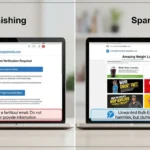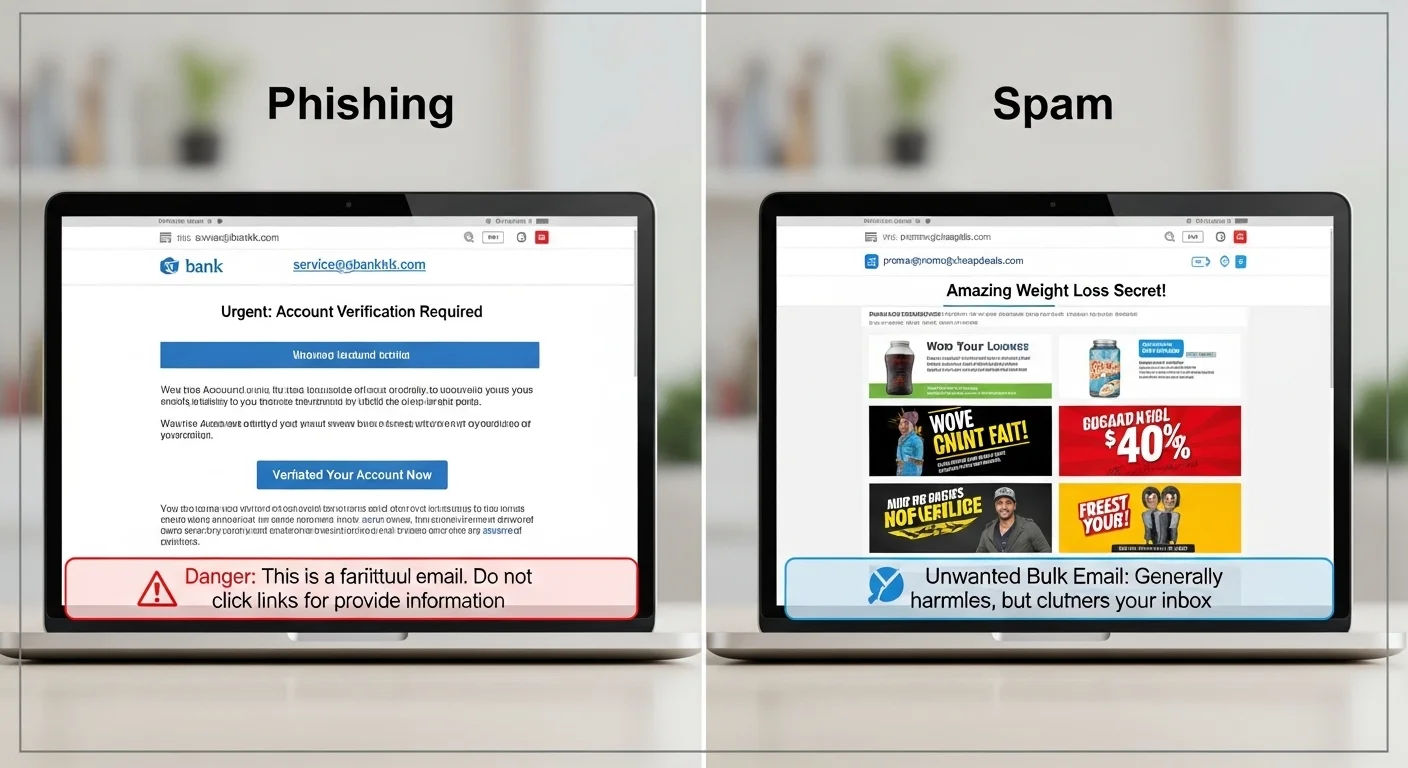
One morning, Ali checked his email. He saw two new messages. One said he won a prize and asked for his bank details. Another was just an ad for shoes. Both felt annoying. But one was dangerous. This is where the difference between phishing and spam matters.
The difference between phishing and spam is about intent and risk. Phishing tries to steal your private data. Spam just sends unwanted messages. Many people mix them up. So, knowing the difference between phishing and spam helps you stay safe online.
In daily life, we see emails, texts, and ads all the time. Some are safe, some are not. Learning the difference between phishing and spam helps you act smart. It protects your data, money, and time.
Phishing vs Spam
Phishing is a scam. It tricks you to share personal data.
Spam is unwanted content. It may not always be harmful.
Why Is Their Difference Necessary to Know for Learners and Experts in Society
Knowing this difference keeps people safe. Students, workers, and families all use the internet daily. If they know what phishing is, they avoid scams. If they know spam, they can filter it. Experts use this knowledge to build better security systems. In society, this reduces fraud and builds trust online.
Pronunciation
- Phishing
- US: /ˈfɪʃɪŋ/
- UK: /ˈfɪʃɪŋ/
- Spam
- US: /spæm/
- UK: /spæm/
Let’s explore the difference between phishing and spam in detail with clear points and examples.
A List of 10 Differences Between Phishing and Spam
1. Purpose
- Phishing:
- 🔴 Example: Email asking for bank login.
- 🔴 Example: Fake website link to steal data.
- Sentence: The phishing email asked for my password.
- Spam:
- 🟣 Example: Ads for cheap products.
- 🟣 Example: Repeated sales emails.
- Sentence: I got spam about new shoes.
2. Intent
- Phishing:
- 🔴 Trick to steal identity.
- 🔴 Fake offers to gain trust.
- Sentence: Phishing aims to cheat users.
- Spam:
- 🟣 Promote products.
- 🟣 Send bulk messages.
- Sentence: Spam fills inboxes with ads.
3. Risk Level
- Phishing:
- 🔴 High risk of loss.
- 🔴 Can harm finances.
- Sentence: Phishing can cause serious damage.
- Spam:
- 🟣 Low risk mostly.
- 🟣 Annoying but not harmful.
- Sentence: Spam wastes time but is less risky.
4. Message Style
- Phishing:
- 🔴 Looks urgent.
- 🔴 Pretends to be real.
- Sentence: The phishing message looked official.
- Spam:
- 🟣 Casual ads.
- 🟣 No urgency.
- Sentence: Spam messages are easy to spot.
5. Targeting
- Phishing:
- 🔴 Targets specific users.
- 🔴 Uses personal info.
- Sentence: Phishing emails often use your name.
- Spam:
- 🟣 Sent to many people.
- 🟣 No personal touch.
- Sentence: Spam goes to large groups.
6. Legitimacy
- Phishing:
- 🔴 Fake identity.
- 🔴 Pretends to be trusted.
- Sentence: Phishing hides behind fake brands.
- Spam:
- 🟣 Often real companies.
- 🟣 Just unwanted.
- Sentence: Spam may come from real sellers.
7. Action Required
- Phishing:
- 🔴 Urges quick action.
- 🔴 Requests sensitive data.
- Sentence: Phishing asks for fast replies.
- Spam:
- 🟣 Optional reading.
- 🟣 No need to respond.
- Sentence: I ignored the spam email.
8. Detection
- Phishing:
- 🔴 Hard to detect.
- 🔴 Looks real.
- Sentence: Phishing can fool many users.
- Spam:
- 🟣 Easy to filter.
- 🟣 Goes to spam folder.
- Sentence: Spam is often auto-blocked.
9. Legal Impact
- Phishing:
- 🔴 Illegal activity.
- 🔴 Criminal offense.
- Sentence: Phishing is a cybercrime.
- Spam:
- 🟣 Sometimes legal.
- 🟣 Depends on rules.
- Sentence: Some spam follows laws.
10. User Reaction
- Phishing:
- 🔴 Causes fear.
- 🔴 Needs caution.
- Sentence: I felt worried after a phishing attempt.
- Spam:
- 🟣 Causes irritation.
- 🟣 Easy to ignore.
- Sentence: Spam just annoys me.
Nature and Behaviour
Phishing:
It is deceptive and harmful. It acts like a trap. It uses trust to steal data.
Spam:
It is repetitive and annoying. It spreads widely. It focuses on promotion.
Why People Confuse Phishing and Spam
Both come as messages. Both appear in inboxes. Both can look unwanted. So, people think they are the same. But phishing is dangerous, while spam is mostly harmless.
Table: Difference and Similarity
| Feature | Phishing | Spam | Similarity |
| Purpose | Steal data | Promote content | Both send messages |
| Risk | High | Low | Both unwanted |
| Target | Specific | Mass | Use digital channels |
| Nature | Fraud | Marketing | Can be annoying |
Which Is Better in What Situation?
Phishing is never good. It is harmful in all cases. You should always avoid it and report it. It has no safe use.
Spam can be useful sometimes. Some spam emails share deals or updates. If trusted, they can help users find offers. Still, most people prefer to block spam for a clean inbox.
H3: How Are the Keywords Used in Metaphors and Similes?
🟣 Phishing is like a hidden hook in water.
🟣 Spam is like noise in a busy market.
🟣 Phishing feels like a trap.
🟣 Spam feels like clutter.
Connotative Meaning
- Phishing: Negative
- Example: Phishing brings fear and loss.
- Spam: Neutral to Negative
- Example: Spam can be annoying but not always harmful.
Idioms or Proverbs Related
🟣 “Too good to be true” (Phishing)
Example: That offer was too good to be true, so it was phishing.
🟣 “Junk mail” (Spam)
Example: My inbox is full of junk mail today.
Works in Literature
🟣 Spam Nation – Non-fiction, Brian Krebs, 2014
🟣 The Art of Deception – Non-fiction, Kevin Mitnick, 2002
Movies Related
🟣 The Net – 1995, USA
🟣 Blackhat – 2015, USA
FAQs
1. Is phishing a type of spam?
Yes, phishing can come as spam, but not all spam is phishing.
2. Which is more dangerous?
Phishing is more dangerous.
3. Can spam turn into phishing?
Sometimes, yes, if it tries to steal data.
4. How can I stay safe?
Do not click unknown links. Check sender details.
5. Should I delete spam emails?
Yes, or mark them as spam.
How Are Both Useful for Surroundings?
Spam helps businesses share offers. It spreads information quickly. Phishing has no real benefit. But awareness of phishing helps improve online safety. Together, they teach people to be careful and smart online.
Final Words for Both
Phishing is a serious threat. Spam is a common annoyance. Knowing both helps you act wisely.
Conclusion
The difference between phishing and spam is simple but very important. Phishing is harmful and aims to steal personal data. Spam is unwanted but usually safe. Both appear in digital communication, but their impact is different. By learning this difference, people can protect themselves from scams and manage their inbox better. In today’s digital world, this knowledge is not optional. It is necessary for safe and smart online living.

Hi! I am Arshad Ullah presently working as linguist in Punjab Education Department. I have done MA in English Literature while M.Phil in Applied Linguistics. I have taught creative writing to the post graduation classes for 15 years. Presently I am working as content writer, and offering classes for blog writing.