Imagine someone hurts you badly. Maybe they lied to you, cheated you, insulted your family, or caused real emotional pain. In moments like this, many people think about two things: justice and revenge.
At first, both can look similar. Both happen after someone does something wrong. Both may involve punishment. That is why many people confuse them.
But in real life, the difference between justice and revenge is much deeper than most beginners realize.
One leads toward fairness, healing, and social order. The other often grows from anger, pain, and personal emotions.
This difference matters in daily life, relationships, religion, law, workplaces, schools, and even online arguments. Some people later regret acting out of revenge because it creates more damage over time.
Understanding the difference between justice and revenge can help people make smarter emotional and moral decisions.
This guide explains everything in simple English with practical examples so you can clearly understand the real difference.
What Is Justice?
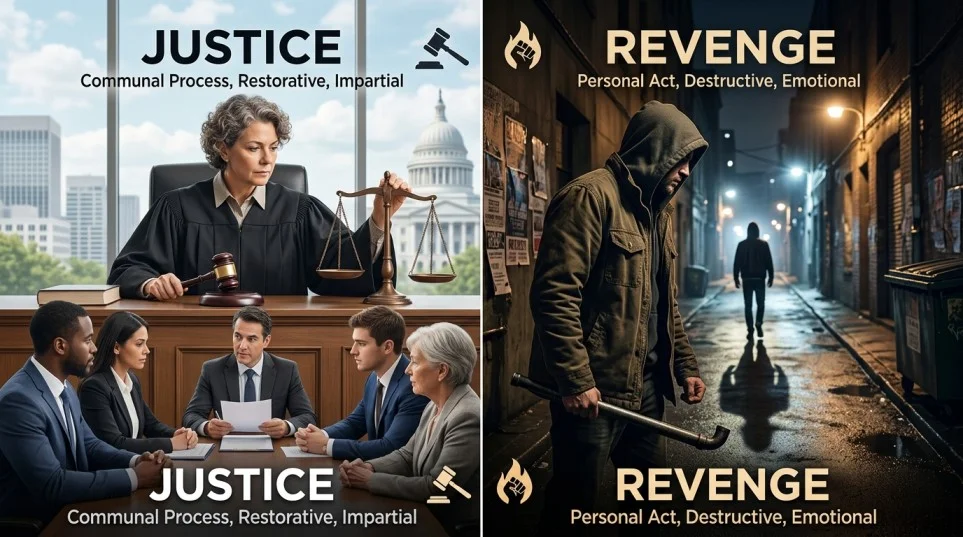
Justice means fairness. It is the process of correcting wrong actions in a balanced and lawful way.
The main goal of justice is not personal satisfaction. Its purpose is to protect rights, maintain order, and create fairness for everyone.
Justice is usually connected with:
- laws
- courts
- judges
- ethical systems
- community rules
- moral responsibility
For example:
- A thief goes to court and receives legal punishment.
- A company that harms workers pays compensation.
- A school punishes bullying fairly after hearing both sides.
In real-world use, justice tries to stay neutral. It looks at facts, evidence, and fairness instead of emotions alone.
Many people first assume justice means “getting even.” But true justice focuses more on balance than personal revenge.
Justice has existed for thousands of years in human societies. Ancient civilizations created legal systems because endless revenge cycles often destroyed families and communities.
One small difference most people overlook is that justice usually protects everyone, including innocent people. Revenge often does not.
Practical Meaning of Justice
Justice helps society function peacefully.
Without justice:
- people stop trusting systems
- crime increases
- conflicts grow worse
- fear spreads in communities
For everyday life, justice creates stability and accountability.
What Is Revenge?
Revenge is a personal response to hurt, anger, betrayal, or humiliation.
The main goal of revenge is emotional satisfaction. A person wants the other side to suffer because they suffered.
Unlike justice, revenge is deeply emotional.
For example:
- Someone spreads rumors after being insulted.
- An employee secretly damages a coworker’s reputation after workplace conflict.
- A person hurts an ex-partner emotionally after a breakup.
Revenge usually comes from feelings such as:
- anger
- hatred
- humiliation
- betrayal
- jealousy
- resentment
After using revenge for some time, many people realize it rarely brings lasting peace. Instead, it often creates more conflict.
This matters more than many beginners realize because revenge can quickly escalate. One action leads to another, and the cycle continues.
Practical Meaning of Revenge
Revenge focuses on personal emotions rather than fairness.
Sometimes revenge may feel satisfying for a short time. But over the long term, it can damage:
- relationships
- mental peace
- reputation
- trust
- family connections
- workplaces
Many religious and ethical teachings warn against revenge because it can become destructive very quickly.
Quick Comparison Table
| Feature | Justice | Revenge |
| Main Meaning | Fair correction of wrongdoing | Personal retaliation |
| Purpose | Fairness and order | Emotional satisfaction |
| Driven By | Law, ethics, fairness | Anger and emotion |
| Decision Process | Careful and balanced | Often impulsive |
| Focus | Society and fairness | Personal feelings |
| Emotional Control | Usually controlled | Often emotional |
| Long-Term Impact | Stability and trust | More conflict |
| Fairness | Important | Not always important |
| Legal Support | Usually legal | Sometimes illegal |
| Best Use Case | Solving disputes fairly | Emotional reaction |
| Pros | Protects rights and order | Temporary emotional release |
| Cons | Can feel slow | Can become destructive |
Biggest Difference Between Justice and Revenge
The biggest difference between justice and revenge is motivation.
Justice seeks fairness.
Revenge seeks personal satisfaction.
This may sound simple, but it changes everything.
Justice asks:
“What is fair for everyone involved?”
Revenge asks:
“How can I make them suffer too?”
In real-world situations, justice tries to stop future harm while revenge often creates more harm.
For example, if someone steals money:
- Justice may involve legal punishment and repayment.
- Revenge may involve personally attacking or humiliating the person.
One approach builds order. The other can create endless conflict.
Over the long term, societies built on justice are usually more stable than societies driven by revenge.
Key Differences Explained
- Purpose and Intention
- Justice aims to restore balance.
- Revenge aims to satisfy emotions.
- This difference affects how decisions are made. Justice considers fairness. Revenge mainly focuses on pain and retaliation.
- Emotional Control
- Justice usually involves calm thinking.
- Revenge often happens during anger.
- Some users later regret revenge because emotional decisions can create bigger problems later.
- Fairness
- Justice tries to remain proportional.
- If someone commits a small mistake, the punishment should match the action.
- Revenge does not always follow balance. People sometimes overreact emotionally.
- Legal vs Personal Action
- Justice often works through legal or organized systems.
- Revenge is usually personal.
- For example:
- Courts deliver justice.
- Individuals carry out revenge.
- Long-Term Results
- Justice helps rebuild trust.
- Revenge often damages relationships permanently.
- In families and workplaces, revenge can continue for years and create toxic environments.
- Impact on Society
- Justice supports social stability.
- Revenge can increase violence and fear.
- History shows that revenge cycles between groups or families can continue for generations.
- Focus on Evidence
- Justice relies on facts and proof.
- Revenge may rely on assumptions or emotions.
- This is dangerous because people sometimes punish innocent individuals when acting emotionally.
- Healing vs Escalation
- Justice can help victims heal emotionally.
- Revenge often keeps anger alive.
- Many people expect revenge to bring peace, but emotional pain sometimes becomes stronger afterward.
- Public vs Private Goals
- Justice usually serves society.
- Revenge serves the individual.
- That is why governments and legal systems discourage personal revenge.
- Moral Perspective
- Most ethical systems support justice more than revenge.
- Many religions teach forgiveness, fairness, and controlled responses rather than emotional retaliation.
- Speed of Action
Justice can feel slow.
Revenge is often immediate.
Some people choose revenge because they become frustrated with slow systems. However, fast emotional reactions can create long-term regret.
Similarities Between Justice and Revenge
Justice and revenge are related because both happen after wrongdoing.
That is why people confuse them so often.
Both involve:
- responding to harm
- punishment
- emotional reactions
- conflict situations
- moral questions
In some situations, the line between them becomes blurry.
For example, a person may believe they are seeking justice when they are actually acting from anger.
Both can also involve consequences for bad behavior.
However, the deeper motivation usually reveals whether something is justice or revenge.
Pros and Cons
Pros of Justice
- Creates fairness
- Protects society
- Reduces chaos
- Encourages accountability
- Builds long-term trust
- Prevents emotional overreaction
Cons of Justice
- Legal systems can feel slow
- Outcomes may not satisfy emotions
- Justice is not always perfect
- Some systems can be unfair or biased
Pros of Revenge
- May provide temporary emotional relief
- Can make people feel emotionally powerful for a short time
- Sometimes discourages repeated mistreatment in personal situations
Cons of Revenge
- Often escalates conflict
- Damages relationships
- Can become illegal or harmful
- Rarely brings lasting peace
- May create guilt later
- Can hurt innocent people
Which Is Better for Different Situations?
For Beginners Learning Ethics or Morality
Justice is usually the better path because it teaches fairness and emotional control.
For Families
Justice helps preserve long-term relationships better than revenge.
Revenge inside families often creates emotional wounds that last for years.
For Workplaces
Professional environments function better with fair procedures instead of personal retaliation.
For Emotional Situations
Many people feel tempted by revenge during betrayal or humiliation. But emotional reactions often create unintended consequences.
For Long-Term Peace
Justice is usually healthier because it focuses on resolution instead of emotional destruction.
For Society
Communities become safer when justice systems work properly.
Without justice, revenge cycles can increase violence and instability.
Common Mistakes People Make
Confusing Anger With Justice
Many people think emotional punishment automatically equals justice.
But anger alone does not create fairness.
Believing Revenge Will Bring Happiness
Movies often make revenge look satisfying.
In real life, many people still feel empty afterward.
Ignoring Long-Term Consequences
Some users later regret revenge because it damages careers, relationships, or reputations.
Acting Too Quickly
Emotional decisions made during anger are often poor decisions.
Assuming Justice Means Weakness
Some people think avoiding revenge means weakness.
In reality, emotional control often requires more strength.
Trusting Emotion Over Facts
Revenge sometimes targets the wrong person because emotions cloud judgment.
Expert Recommendation
Choose Justice If:
- you want fairness
- you value long-term peace
- you want stable relationships
- you prefer ethical solutions
- you care about social order
- you want problems solved responsibly
Choose Revenge If:
Revenge is generally not recommended as a long-term solution. However, people emotionally drawn toward revenge often seek control or emotional release after serious hurt.
Avoid Justice If:
- the system is dangerously corrupt
- immediate safety is impossible
- legal protection does not exist
Even then, careful solutions are usually better than emotional retaliation.
Avoid Revenge If:
- emotions are extremely high
- relationships matter long term
- legal consequences are possible
- innocent people may get hurt
- you want emotional peace later
Final Verdict
The difference between justice and revenge is not just about punishment. It is about purpose, emotional control, and long-term impact.
Justice focuses on fairness, balance, and protecting society. Revenge focuses on personal emotions and retaliation.
At first, revenge can feel powerful. Many people naturally want emotional payback after being hurt. But over time, revenge often creates more pain instead of real peace.
Justice may feel slower and less emotionally satisfying in the moment, but it usually creates healthier outcomes for individuals, families, workplaces, and communities.
In real-world life, emotional reactions rarely solve problems permanently. Fairness, accountability, and controlled decision-making usually lead to better long-term results.
Understanding this difference helps people respond more wisely during conflict, anger, and difficult situations.
FAQ Section
Which is better: justice or revenge?
Justice is generally better because it focuses on fairness and long-term stability. Revenge may feel emotionally satisfying for a short time, but it often creates more conflict and regret later.
Are justice and revenge the same thing?
No. Justice seeks fairness and accountability, while revenge seeks personal emotional satisfaction. They may look similar on the surface, but their goals are very different.
Why do people confuse justice with revenge?
People confuse them because both involve responding to wrongdoing. However, justice focuses on balance and fairness, while revenge is usually driven by anger or emotional pain.
Does revenge ever bring peace?
Sometimes revenge provides temporary emotional relief, but many people later realize it does not remove deeper pain or anger. In some cases, it even increases emotional stress.
Which is better for society?
Justice is better for society because it supports law, trust, and social stability. Revenge can create ongoing cycles of conflict and violence.
Is revenge always wrong?
Different cultures and beliefs view revenge differently. However, uncontrolled revenge often causes harm, emotional escalation, and damaged relationships.
What mistakes should beginners avoid?
Beginners should avoid acting emotionally, confusing anger with fairness, and assuming revenge will solve emotional pain permanently.
Can justice and forgiveness exist together?
Yes. A person can support justice while still choosing forgiveness emotionally. Fair consequences and emotional healing can happen at the same time.
Conclusion
Justice and revenge may appear similar at first, but their deeper purpose makes them completely different. Justice is built around fairness, accountability, and protecting people from further harm. Revenge is usually driven by emotional pain, anger, or the desire to make someone suffer in return.
In daily life, this difference matters more than many people realize. Decisions made during anger often create long-term problems that affect relationships, careers, families, and emotional well-being. Justice, even when imperfect or slow, usually leads to healthier and more stable outcomes over time.
Many people naturally feel the urge for revenge after betrayal or hurt. That reaction is human. But lasting peace rarely comes from emotional retaliation. Understanding the difference between justice and revenge helps people make wiser, calmer, and more responsible choices during difficult situations.

Hi! I am Arshad Ullah presently working as linguist in Punjab Education Department. I have done MA in English Literature while M.Phil in Applied Linguistics. I have taught creative writing to the post graduation classes for 15 years. Presently I am working as content writer, and offering classes for blog writing. On this site, I research each topic from authoritative sources and edit every comparison for accuracy and clear, simple language.