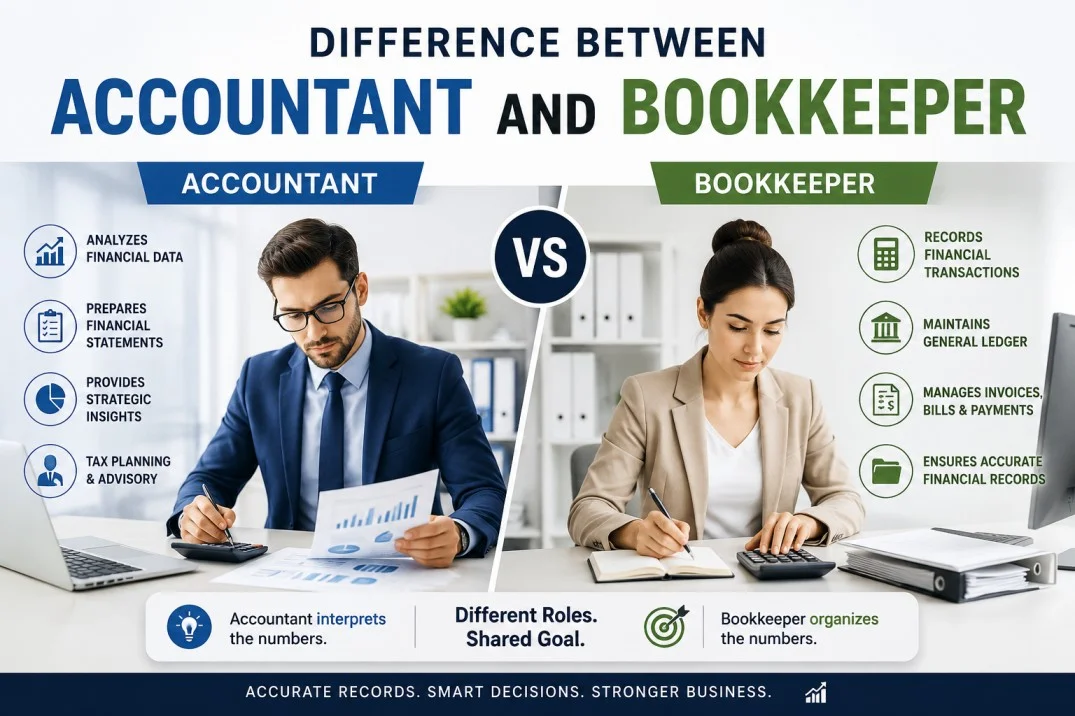
Accountant and Bookkeeper
Ali opened a small shop in his town. At first, he wrote all sales in a notebook. Later, his business grew. Then he heard two words again and again: accountant and bookkeeper. He became confused. What was the difference between accountant and bookkeeper? Were they the same? Did he need both?
Many people ask about the difference between accountant and bookkeeper because both work with money and records. Still, their jobs are not exactly the same. Understanding the difference between accountant and bookkeeper can help students, business owners, and beginners choose the right service or career path.
In this guide, you will learn their meanings, roles, examples, and key differences in very simple words.
What is “Accountant”?
An accountant is a person who studies, checks, and explains financial records. They help businesses understand profits, taxes, and financial health. An accountant also gives advice for better money decisions.
History of Accountant
The work of accountants started thousands of years ago. Ancient people in Egypt and Mesopotamia kept records of trade and taxes. Later, in the 1400s, an Italian writer named Luca Pacioli introduced modern accounting methods. Because of this, many people call him the “Father of Accounting.” Over time, accounting became a professional field. Today, accountants work in companies, schools, banks, and governments around the world.
What is “Bookkeeper”?
A bookkeeper is a person who records daily money activities. They write down sales, payments, bills, and expenses. Their work keeps financial records organized and updated.
History of Bookkeeper
Bookkeeping also began in ancient times when traders recorded business transactions by hand. In early markets, merchants needed a simple way to track goods and money. Later, bookkeeping became more organized with the double-entry system. Before computers, bookkeepers used large paper books called ledgers. Today, most bookkeeping is done with accounting software, but the main job remains the same: recording financial information clearly and correctly.
Accountant vs Bookkeeper
An accountant analyzes and explains financial data, while a bookkeeper records daily financial transactions.
Both jobs are important for businesses. However, they focus on different parts of money management. Let’s understand each one more deeply.
How “Accountant” Works
An accountant studies financial reports and helps businesses make smart decisions.
Key Features
- Prepares tax reports
- Analyzes financial records
- Gives financial advice
- Creates budgets
- Helps with business planning
- Checks legal financial rules
Example Sentences
🔵 The accountant prepared the company’s yearly tax report.
🔵 Sara asked the accountant for advice about saving business costs.
Uses
- Business finance
- Tax preparation
- Company planning
- Government reporting
- School and banking work
How “Bookkeeper” Works
A bookkeeper records daily money activities and keeps records organized.
Key Features
- Records sales and expenses
- Updates financial data
- Manages invoices
- Tracks payments
- Organizes receipts
- Uses accounting software
Example Sentences
🟢 The bookkeeper entered all shop sales into the computer.
🟢 Ahmed hired a bookkeeper to manage monthly bills.
Uses
- Small businesses
- Shops and stores
- Offices
- Freelance work
- Daily expense tracking
Which One Should You Use?
Use a bookkeeper if you need help recording daily transactions and keeping financial records organized. Use an accountant if you need tax help, financial advice, or business planning. Many businesses use both because their work supports each other.
10 Differences Between Accountant and Bookkeeper
1. Main Role
Accountant: An accountant analyzes and explains financial information.
🔴 The accountant checked yearly profits.
🔴 She prepared the company tax report.
Bookkeeper: A bookkeeper records daily financial activities.
🔴 The bookkeeper entered shop expenses.
🔴 He updated payment records every day.
2. Level of Work
Accountant: Works on higher financial analysis and planning.
🔴 The accountant created a financial strategy.
🔴 She advised the company on investments.
Bookkeeper: Focuses on basic record keeping.
🔴 The bookkeeper saved all receipts.
🔴 He recorded cash payments.
3. Education
Accountant: Usually needs a degree or certification.
🔴 She studied accounting at university.
🔴 The accountant passed a finance exam.
Bookkeeper: May need short training or experience.
🔴 He learned bookkeeping online.
🔴 The bookkeeper completed a simple course.
4. Daily Tasks
Accountant: Reviews reports and gives advice.
🔴 The accountant checked tax documents.
🔴 She reviewed yearly budgets.
Bookkeeper: Updates daily transactions.
🔴 The bookkeeper recorded sales.
🔴 He tracked supplier payments.
5. Decision Making
Accountant: Helps businesses make financial decisions.
🔴 The accountant suggested cost cuts.
🔴 She planned future budgets.
Bookkeeper: Usually does not make financial decisions.
🔴 The bookkeeper organized invoices.
🔴 He updated expense lists.
6. Tax Work
Accountant: Prepares and files taxes.
🔴 The accountant completed tax forms.
🔴 She explained tax rules to the client.
Bookkeeper: Collects records for taxes.
🔴 The bookkeeper saved tax receipts.
🔴 He organized payment documents.
7. Salary
Accountant: Usually earns more because of advanced work.
🔴 The accountant received a high yearly salary.
🔴 She worked for a large company.
Bookkeeper: Usually earns less than accountants.
🔴 The bookkeeper worked part-time.
🔴 He managed records for a small shop.
8. Software Use
Accountant: Uses software for reports and analysis.
🔴 The accountant created charts in software.
🔴 She analyzed yearly expenses online.
Bookkeeper: Uses software to enter transactions.
🔴 The bookkeeper updated records in QuickBooks.
🔴 He entered customer payments daily.
9. Financial Reports
Accountant: Creates and explains financial reports.
🔴 The accountant prepared balance sheets.
🔴 She explained company profits clearly.
Bookkeeper: Provides records for reports.
🔴 The bookkeeper organized sales data.
🔴 He managed transaction files.
10. Work Focus
Accountant: Focuses on the future financial growth of a business.
🔴 The accountant planned next year’s budget.
🔴 She advised on business expansion.
Bookkeeper: Focuses on current daily records.
🔴 The bookkeeper updated today’s sales.
🔴 He checked daily cash entries.
Why People Get Confused About Their Use
People get confused because accountants and bookkeepers both work with money and financial records. They often use similar software and work together in the same business. Still, their responsibilities are different. A bookkeeper records information, while an accountant studies and explains it.
Table: Difference and Similarity
| Feature | Accountant | Bookkeeper | Similarity |
| Main Work | Financial analysis | Recording transactions | Both manage financial data |
| Education | Degree or certification | Basic training | Both need accuracy |
| Tax Work | Prepares taxes | Organizes records | Both help with taxes |
| Reports | Creates reports | Provides data | Both use reports |
| Daily Tasks | Planning and advice | Data entry | Both work with money |
| Salary | Higher | Lower | Both are paid finance jobs |
| Software | Analysis tools | Entry tools | Both use accounting software |
Which is Better in What Situation?
An accountant is better when a business needs tax help, financial planning, or advice for growth. Large companies often need accountants to study profits and create strategies.
A bookkeeper is better for daily financial records and small business management. Small shops and freelancers often use bookkeepers to organize sales, bills, and expenses.
How Are “Accountant” and “Bookkeeper” Used in Metaphors and Similes?
🟣 “The accountant was like a financial doctor for the company.”
🟣 “The bookkeeper kept records as neatly as a librarian organizes books.”
🟣 “An accountant can be the compass of a business.”
🟣 “A bookkeeper works like the memory of a company.”
Connotative Meaning
Accountant
- Usually positive and professional
- Often linked with expertise and trust
🟣 “People trust accountants with important financial decisions.”
Bookkeeper
- Neutral and practical
- Linked with organization and accuracy
🟣 “A careful bookkeeper keeps every record safe.”
Idioms or Proverbs
🟣 “Balance the books” — to make financial records correct
Example: “The accountant stayed late to balance the books.”
🟣 “Count every penny” — to spend money carefully
Example: “The bookkeeper counted every penny in the report.”
Works in Literature
🟣 The Accountant’s Story — by Roberto Escobar, 1988
🟣 Bartleby, the Scrivener — by Herman Melville, 1853
🟣 Bleak House — by Charles Dickens, 1853
Movies Related to the Keywords
🟣 The Accountant — 2016, USA
🟣 Middle Men — 2009, USA
🟣 Office Space — 1999, USA
Frequently Asked Questions
Is an accountant higher than a bookkeeper?
Yes. An accountant usually has more education and handles advanced financial work.
Can a bookkeeper become an accountant?
Yes. Many bookkeepers study further and become accountants.
Do small businesses need both?
Sometimes yes. Small businesses may use a bookkeeper daily and an accountant for taxes.
Who prepares taxes?
Usually an accountant prepares taxes.
Which job is easier?
Bookkeeping is often simpler because it focuses on recording information.
Final Words
Learning financial words can help you in business, study, and daily life. Accountant and bookkeeper may sound similar, but their jobs are different and equally important. When you understand these terms, you can make smarter career and business decisions.
Conclusion
The difference between accountant and bookkeeper is mainly about the type of work they do. A bookkeeper records daily financial activities, while an accountant studies and explains financial information. Both roles help businesses stay organized and successful. Understanding the difference between accountant and bookkeeper can help students, workers, and business owners choose the right support for their needs. With simple knowledge, these financial terms become easy to understand and use.

Hi! I am Arshad Ullah presently working as linguist in Punjab Education Department. I have done MA in English Literature while M.Phil in Applied Linguistics. I have taught creative writing to the post graduation classes for 15 years. Presently I am working as content writer, and offering classes for blog writing. On this site, I research each topic from authoritative sources and edit every comparison for accuracy and clear, simple language.