Imagine you are cleaning a swimming pool. One person says, “Use chlorine.” Another says, “Try bromine.” Now you feel confused. What is the real difference between bromine and chlorine? Both are chemicals. Both kill germs. Yet they work in different ways.
The difference between bromine and chlorine is important in pools, water cleaning, science labs, and daily life. Many students also mix them up because they belong to the same chemical family.
Learning the difference between bromine and chlorine helps you choose the right chemical for the right job. It also makes science easier to understand. In this guide, you will learn simple meanings, examples, uses, and key differences in very easy English.
What is “Bromine”?
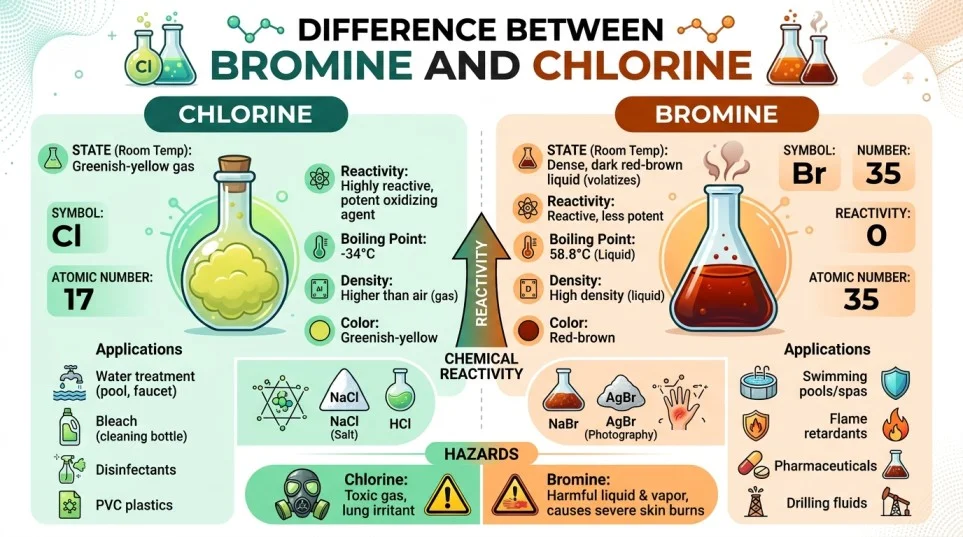
Bromine is a chemical element. It is a reddish-brown liquid with a strong smell. Its symbol is Br. Bromine belongs to the halogen family in chemistry. People use it in hot tubs, medicines, flame retardants, and water cleaning.
Bromine works well in warm water. That is why many people use it in spas and hot tubs instead of chlorine.
Bromine was discovered in 1826 by a French scientist named Antoine Balard. He found it while studying saltwater from marshes. The name “bromine” comes from a Greek word meaning “bad smell.” In the 1800s, scientists used bromine in photography and medicine. Later, industries started using it in fire safety products and water treatment systems. Today, bromine is important in chemistry, electronics, and pool care around the world.
What is “Chlorine”?
Chlorine is a chemical element with the symbol Cl. It is a greenish-yellow gas with a strong smell. Chlorine is also part of the halogen family. People mainly use it to clean water and kill bacteria.
Chlorine is common in swimming pools, drinking water systems, cleaning products, and factories.
Chlorine was discovered in 1774 by Swedish scientist Carl Wilhelm Scheele. At first, people thought it was a type of oxygen. Later, scientist Humphry Davy proved it was a new element and named it chlorine. The name came from a Greek word meaning “greenish-yellow.” During the 1900s, chlorine became very important for clean drinking water. It helped stop many dangerous diseases. Today, chlorine is still widely used in homes, industries, and public water systems.
Bromine vs Chlorine
Bromine is a reddish liquid mainly used in hot water systems. Chlorine is a greenish gas mainly used for water cleaning and pools.
Both chemicals fight germs, but they react differently in heat, sunlight, and water. Let us explore them in detail.
How “Bromine” Works
Bromine kills bacteria and other harmful germs in water. It reacts with microorganisms and stops them from growing.
Key Features
- Works well in warm water
- Has a softer smell than chlorine
- Stays active longer in hot tubs
- Costs more than chlorine
- Less irritating for some people
🔵 Bromine keeps hot tub water clean and safe.
🔵 Many spa owners prefer bromine because it smells milder.
Uses
- Hot tubs
- Spas
- Water treatment
- Flame retardants
- Medicines
- Photography chemicals
How “Chlorine” Works
Chlorine kills germs by breaking down harmful bacteria and viruses in water. It works quickly and keeps water safe.
Key Features
- Strong germ killer
- Common in swimming pools
- Lower cost than bromine
- Strong smell
- Works fast in cool water
🟢 Chlorine is often used in public swimming pools.
🟢 Cities use chlorine to clean drinking water.
Uses
- Swimming pools
- Drinking water systems
- Cleaning products
- Factories
- Paper production
- Disinfectants
Which One Should You Use?
Use bromine for hot tubs and warm water because it stays stable in heat. Use chlorine for large pools and public water systems because it is cheaper and works fast.
10 Differences Between Bromine and Chlorine
1. Physical Form
Bromine:
Bromine is a reddish-brown liquid at room temperature.
🔴 Bromine looks dark red in bottles.
🔴 Scientists store bromine carefully because it evaporates easily.
Chlorine:
Chlorine is a greenish-yellow gas at room temperature.
🔴 Chlorine gas has a sharp smell.
🔴 Chlorine spreads quickly in the air.
2. Smell
Bromine:
Bromine has a milder smell.
🔴 Bromine in spas feels less harsh.
🔴 Some people prefer bromine because of its softer odor.
Chlorine:
Chlorine has a stronger smell.
🔴 Chlorine pools often smell powerful.
🔴 Strong chlorine can irritate the nose.
3. Best Water Temperature
Bromine:
Bromine works best in warm water.
🔴 Bromine is popular in hot tubs.
🔴 Warm spas use bromine often.
Chlorine:
Chlorine works better in cooler water.
🔴 Chlorine is common in outdoor pools.
🔴 Large pools usually use chlorine.
4. Cost
Bromine:
Bromine is more expensive.
🔴 Bromine tablets cost more.
🔴 Spa care with bromine may need a bigger budget.
Chlorine:
Chlorine is cheaper.
🔴 Chlorine is affordable for public pools.
🔴 Many homes use chlorine because it costs less.
5. Reaction to Sunlight
Bromine:
Bromine loses power faster in sunlight.
🔴 Outdoor sunlight weakens bromine quickly.
🔴 Bromine is better indoors.
Chlorine:
Chlorine can be protected with stabilizers.
🔴 Pool owners add stabilizers to chlorine.
🔴 Chlorine lasts longer outdoors with protection.
6. Skin Effect
Bromine:
Bromine may feel gentler on skin.
🔴 Some swimmers feel less itching with bromine.
🔴 Bromine may reduce eye irritation.
Chlorine:
Chlorine can irritate skin.
🔴 Chlorine may dry the skin.
🔴 Eyes may turn red after swimming.
7. Speed
Bromine:
Bromine works more slowly.
🔴 Bromine takes longer to kill germs.
🔴 Bromine gives long-lasting cleaning.
Chlorine:
Chlorine works very fast.
🔴 Chlorine kills bacteria quickly.
🔴 Public pools need chlorine for fast cleaning.
8. Main Use
Bromine:
Bromine is mostly used in spas.
🔴 Many luxury spas use bromine.
🔴 Hot tubs often depend on bromine systems.
Chlorine:
Chlorine is mostly used in pools and drinking water.
🔴 Cities clean water with chlorine.
🔴 Schools use chlorine in pools.
9. Availability
Bromine:
Bromine is less common.
🔴 Some stores do not sell bromine.
🔴 Bromine products are limited in some areas.
Chlorine:
Chlorine is widely available.
🔴 Chlorine tablets are easy to find.
🔴 Most pool shops sell chlorine.
10. Chemical Strength
Bromine:
Bromine stays stable in heat.
🔴 Bromine keeps working in warm spas.
🔴 Heat affects bromine less.
Chlorine:
Chlorine becomes weaker in hot water.
🔴 Hot temperatures reduce chlorine strength.
🔴 Chlorine needs more checking in heated pools.
Why People Get Confused About Their Use
People get confused because bromine and chlorine belong to the same chemical family called halogens. Both clean water and kill germs. They also have strong smells and similar uses in pools and spas. Because of this, many beginners think they are the same chemical. However, their behavior in water and heat is different.
Table: Difference and Similarity
| Feature | Bromine | Chlorine | Similarity |
| Color | Reddish-brown | Greenish-yellow | Both are halogens |
| Form | Liquid | Gas | Both are chemicals |
| Main Use | Hot tubs | Pools | Both clean water |
| Smell | Milder | Stronger | Both have odors |
| Cost | Higher | Lower | Both sold commercially |
| Heat Performance | Better in heat | Better in cool water | Both kill germs |
| Speed | Slower | Faster | Both disinfect |
| Skin Effect | Gentler | More irritating | Both affect skin |
| Sunlight Reaction | Weakens faster | More stable with stabilizers | Both react to sunlight |
| Availability | Less common | More common | Both used worldwide |
Which is Better in What Situation?
Bromine is better for hot tubs and spas. It works well in warm water and has a softer smell. Many people also like it because it may feel gentler on skin and eyes.
Chlorine is better for large pools and public water systems. It is cheaper and kills germs quickly. That is why cities and schools often choose chlorine for daily cleaning.
How Are “Bromine” and “Chlorine” Used in Metaphors and Similes?
🟣 “The room spread gossip like chlorine in a pool.”
🟣 “His anger was as sharp as chlorine gas.”
🟣 “The calm spa felt smooth like bromine-treated water.”
🟣 “Her ideas spread slowly like bromine in warm water.”
Connotative Meaning
Bromine
- Neutral to positive meaning
- Often linked with calm spas and softer cleaning
🟣 “The spa used bromine for a relaxing feeling.”
Chlorine
- Neutral to negative meaning
- Often linked with strong smells and chemicals
🟣 “The strong chlorine smell filled the pool area.”
Idioms or Proverbs
There are no famous English idioms directly based on bromine or chlorine. However, people sometimes use related phrases.
🟣 “Throw someone in the deep end” — meaning to place someone in a difficult situation.
Example: “My new job threw me in the deep end.”
🟣 “Clear as water” — meaning very easy to understand.
Example: “The teacher’s science lesson was clear as water.”
Works in Literature
🟣 The Periodic Table — by Primo Levi (1975)
🟣 Uncle Tungsten — by Oliver Sacks (2001)
🟣 Napoleon’s Buttons — by Penny Le Couteur and Jay Burreson (2003)
Movies Related to the Keywords
🟣 Dark Waters (2019, USA) — about chemical pollution and public safety
🟣 Erin Brockovich (2000, USA) — about water contamination issues
🟣 Radioactive (2019, UK) — about science and chemical discoveries
Frequently Asked Questions
1. Is bromine safer than chlorine?
Bromine may feel gentler on skin, but both chemicals must be used carefully.
2. Why does chlorine smell stronger?
Chlorine releases stronger chemical odors in water and air.
3. Can bromine replace chlorine?
Yes, many hot tubs use bromine instead of chlorine.
4. Which is cheaper, bromine or chlorine?
Chlorine is usually cheaper.
5. Are bromine and chlorine both halogens?
Yes, both belong to the halogen family in chemistry.
Final Words
Bromine and chlorine may look similar, but they work in different ways. When you understand their uses, choosing the right one becomes easy. Small science lessons like this can make daily life and learning more interesting.
Conclusion
The difference between bromine and chlorine is simple when explained clearly. Bromine works better in hot water and has a softer smell. Chlorine works faster and costs less, which makes it common in pools and drinking water systems. Both chemicals are useful and important in modern life. By learning the difference between bromine and chlorine, students and beginners can better understand chemistry, water cleaning, and daily safety. Choose bromine for warm spas and chlorine for large pools or public water systems.

Hi! I am Arshad Ullah presently working as linguist in Punjab Education Department. I have done MA in English Literature while M.Phil in Applied Linguistics. I have taught creative writing to the post graduation classes for 15 years. Presently I am working as content writer, and offering classes for blog writing. On this site, I research each topic from authoritative sources and edit every comparison for accuracy and clear, simple language.