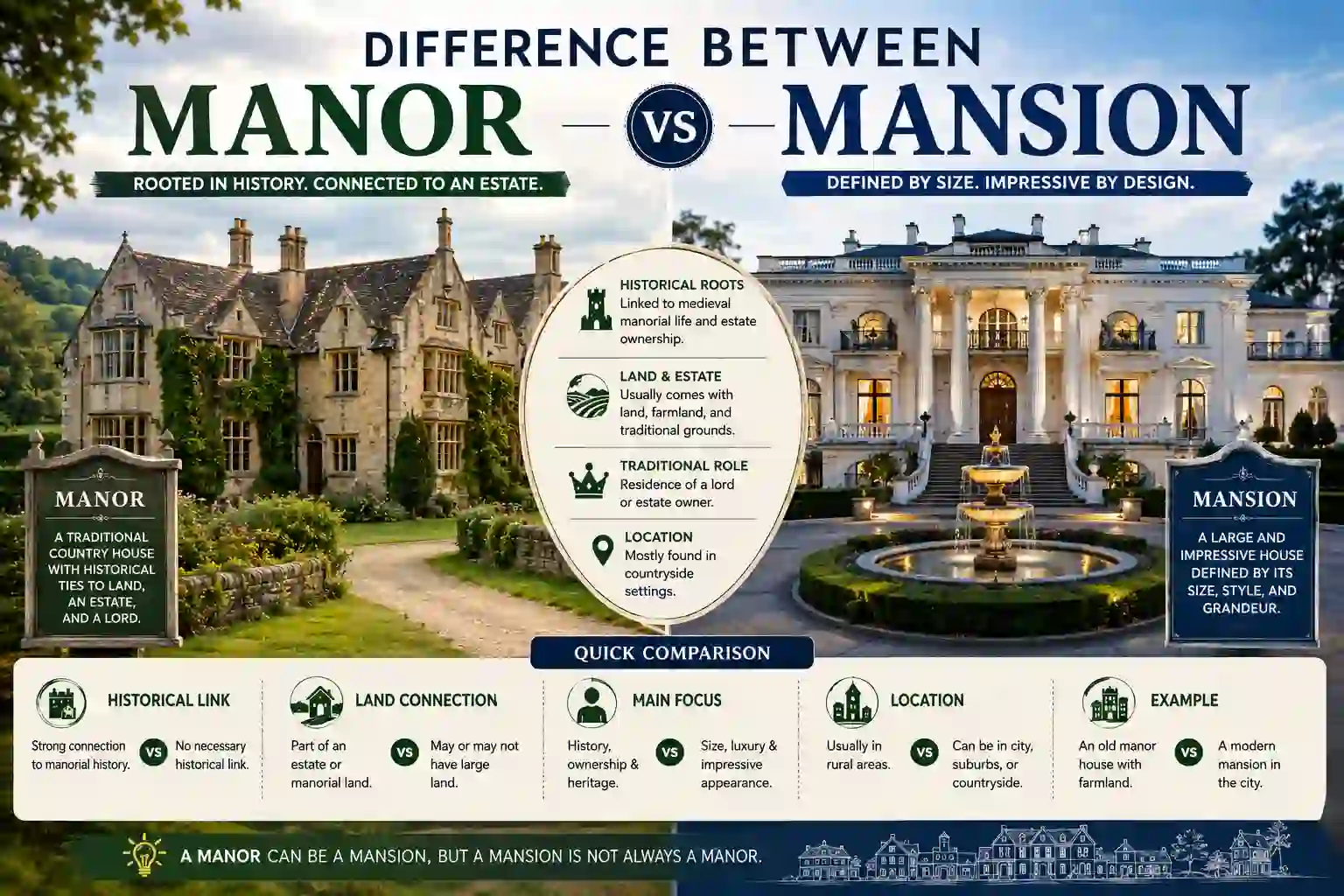
A manor is traditionally a large country house connected to an estate or, historically, to the land and authority of a lord. A mansion is simply a large and impressive residence. The key difference is historical function and land connection: a manor has a specific estate or manorial history, while a mansion is mainly defined by its size and grandeur.
| Feature | Manor | Mansion |
| Basic meaning | Large house linked to a manor or estate | Large, impressive house |
| Main idea | History, estate, and ownership | Size, appearance, and grandeur |
| Historical link | Strong link to medieval manorial life | Not necessarily medieval |
| Land | Usually associated with surrounding land | May or may not have large grounds |
| Location | Often a country setting | Country or city |
| Typical use | Residence of a lord or estate owner | Private luxury residence |
| Can be historic? | Often | Yes, but not required |
| Can they overlap? | A manor can be a mansion | A mansion can be a manor house |
Manor and mansion both describe large homes, so they are easy to confuse. In some contexts, the words can even overlap.
But they are not exact synonyms.
The word manor has a stronger connection to land, an estate, and historical social organization. A mansion focuses more on the large and impressive nature of the house itself.
What Is a Manor?
A manor can refer to a large country house and the land connected to it. Historically, a manor was also a landed unit under a lord in medieval Europe.
Main Characteristics of a Manor
- It is often associated with a country estate.
- It has a strong historical connection to land ownership.
- A manor house was traditionally the residence of the lord of the manor.
- The property could include land and smaller buildings.
- Many traditional manors have medieval or later historic roots.
For example:
The lord lived in the manor and managed the surrounding estate.
The important point is that manor is not only about the size of the house. Its historical connection to an estate matters.
What Is a Mansion?
A mansion is a large, impressive house. The word does not require the property to have a medieval history or to have once belonged to a lord.
Main Characteristics of a Mansion
- It is usually large.
- It is often impressive or luxurious.
- It can be in the city or countryside.
- It can be old or modern.
- It does not need to be connected to a manor or feudal estate.
For example:
The businessman built a huge mansion overlooking the city.
Here, mansion tells us about the size and grandeur of the home. It does not tell us that the house has a manorial history.
Core Difference Between Manor and Mansion
1. Historical Meaning
The biggest difference is historical.
A manor has a specific historical connection to a manorial estate and its lord. In medieval Europe, the manor was more than simply a house. It was a land-based social and economic unit.
A mansion, by contrast, is mainly a term for a large and impressive residence.
2. House vs. Estate
A useful way to remember the difference is:
- Manor → house + estate/history
- Mansion → large and impressive house
The word manor can refer to the house itself or, depending on context, the wider estate and land connected with it.
Mansion normally focuses on the building.
3. Size Is Not the Main Test for a Manor
A manor can be large and grand, but size alone does not make a house a manor.
A large modern house may be a mansion without being a manor.
Likewise, a historic manor house does not have to be the biggest house in the area.
4. Location
Traditional manors are strongly associated with rural or country estates.
Mansions can be found in many settings:
- Cities
- Suburbs
- Countryside
- Coastal areas
A mansion can therefore exist in a location where the word manor would not make historical sense.
Manor vs. Mansion: An Important Overlap
The distinction is not always absolute.
A manor house can also be a mansion if it is large and impressive. In fact, dictionaries sometimes list mansion as a synonym for manor house.
This means the words can describe the same building from different angles.
For example:
The old manor is a magnificent mansion.
Here, manor highlights the property’s historical or estate connection, while mansion highlights its size and grandeur.
Simple Examples
Example 1: Manor
The historic manor stood at the center of a large country estate.
Manor is appropriate because the house is connected to an estate.
Example 2: Mansion
They bought a modern mansion with ten bedrooms.
Mansion is appropriate because the focus is on the large, impressive home.
Example 3: Both
The ancient manor is now a beautiful mansion open to visitors.
Both words can work because they describe different aspects of the same property.
Common Misconceptions
Is Every Manor a Mansion?
No. A manor may be a large or impressive house, but the defining idea is its historical connection to a manor or estate. Mansion mainly describes a large, impressive residence.
Is Every Mansion a Manor?
No. A modern luxury home can be a mansion without having any connection to a historical manor or estate.
Are Manor and Mansion Synonyms?
Sometimes, but not perfectly. In modern English, they can overlap. However, manor carries more historical and estate-related meaning, while mansion emphasizes size and impressiveness.
Can a Manor Be in a City?
The traditional meaning points to a country estate. However, modern usage can be broader, and the word may appear as part of a property’s name. The historical meaning should not be confused with modern naming practices.
FAQs
What is the main difference between a manor and a mansion?
A manor is connected to a historical manor or estate, while a mansion is simply a large and impressive residence. A manor may also be a mansion, but a mansion does not have to be a manor.
Is a manor bigger than a mansion?
Not necessarily. There is no fixed size rule that makes a manor bigger than a mansion. Mansion describes a large, impressive home, while manor is more about historical and estate connections.
Can a manor house be called a mansion?
Yes. A large manor house can also be called a mansion. The two words can describe the same building, but they emphasize different features. Manor points to its historical or estate role; mansion points to its size and grandeur.
Is a modern house a manor or a mansion?
If it is simply a large and impressive modern home, mansion is usually the better word. Calling it a manor suggests a historical, estate, or traditional country-house connection.
What is a manor house?
A manor house is traditionally the main residence of the lord of a manor. It was associated with the wider manorial estate.
Are manor and mansion interchangeable?
They can be interchangeable in some contexts, especially when referring to a large historic house. However, they are not exact equivalents. Manor carries additional historical and land-related meaning.
Conclusion
The simplest way to remember the difference between manor and mansion is this: a manor is defined mainly by its historical connection to an estate, while a mansion is defined mainly by being large and impressive. A manor house can certainly be a mansion, but a modern mansion does not automatically qualify as a manor. When talking about a historic country estate, manor is often the more precise word. When you simply want to describe a very large and impressive home, mansion is usually the better choice.

Hi! I am Arshad Ullah presently working as linguist in Punjab Education Department. I have done MA in English Literature while M.Phil in Applied Linguistics. I have taught creative writing to the post graduation classes for 15 years. Presently I am working as content writer, and offering classes for blog writing. On this site, I research each topic from authoritative sources and edit every comparison for accuracy and clear, simple language.