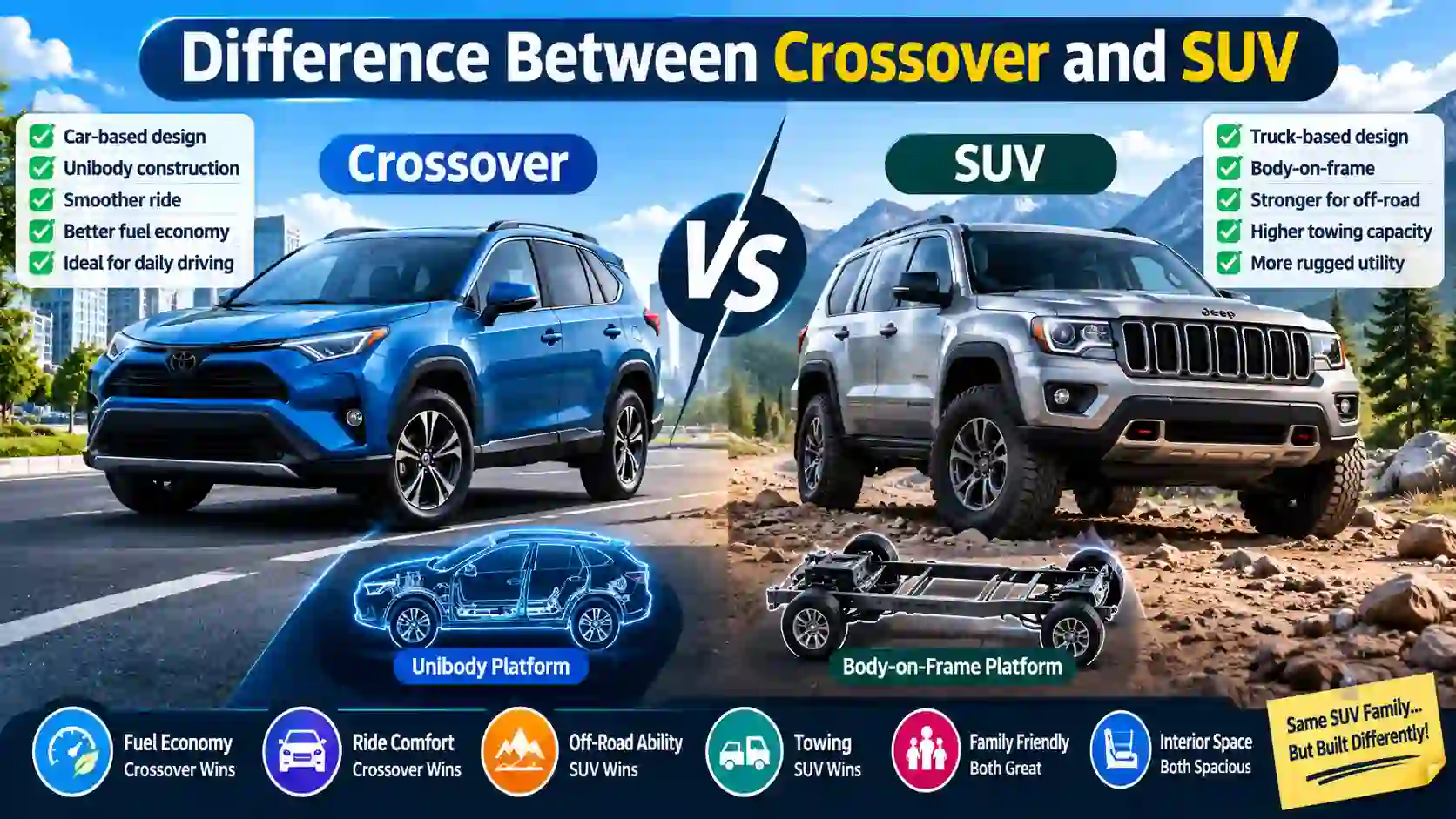
A crossover is a type of SUV, but the terms are not always used in the same way. The main technical difference is construction. A crossover normally uses a car-based unibody platform, while a traditional SUV often uses a truck-based body-on-frame design. Crossovers usually focus on comfort, fuel economy, and everyday driving. Traditional SUVs are generally better suited to heavy towing and serious off-road use. The difference between crossover and SUV is described through a table:
| Feature | Crossover | Traditional SUV |
| Basic design | Car-based | Truck-based |
| Construction | Usually unibody | Usually body-on-frame |
| Driving feel | More like a car | More like a truck |
| Ride comfort | Usually smoother | Usually firmer |
| Fuel economy | Usually better | Usually lower |
| Off-road ability | Light to moderate | Usually stronger |
| Towing | Usually lower | Usually higher |
| Best for | Daily driving and families | Towing and rugged use |
Introduction
The words crossover and SUV are often used as if they mean the same thing. This is understandable because modern crossovers look like SUVs and are often sold in the same market category.
The important difference is the vehicle’s underlying structure. A crossover normally uses a unibody design, while a traditional SUV uses a separate frame.
What Is a Crossover?
A crossover is a vehicle that combines some SUV features with the structure and driving behavior of a passenger car.
Most crossovers use a unibody construction. In this design, the body and main structural frame are integrated into one unit.
Main Characteristics of a Crossover
- Car-based platform
- Usually unibody construction
- Higher seating position than a sedan
- Good passenger and cargo space
- Usually comfortable on paved roads
- Often available with front-wheel drive or all-wheel drive
- Generally lighter and more fuel-efficient than comparable traditional SUVs
Examples include vehicles such as the Honda CR-V and Toyota RAV4.
What Is an SUV?
SUV stands for Sport Utility Vehicle. The term is now used very broadly.
A traditional SUV is usually built on a body-on-frame platform. The vehicle body sits on a separate frame, similar to the construction used for many pickup trucks.
However, there is an important point: not every vehicle marketed as an SUV is a traditional body-on-frame SUV. Many modern SUVs are actually crossovers.
Main Characteristics of a Traditional SUV
- Often truck-based
- Usually body-on-frame
- Strong towing ability
- Better suited to demanding off-road driving
- Often heavier than a crossover
- Can use four-wheel-drive systems designed for difficult terrain
- Usually feels more truck-like on the road
Core Difference Between Crossover and SUV
1. Construction
This is the biggest technical difference.
A crossover usually has a unibody structure. The body and structural frame work as one piece.
A traditional SUV usually has a body-on-frame structure. The body is mounted on a separate frame.
This construction difference affects weight, handling, towing, and off-road performance.
2. On-Road Driving
Crossovers are generally designed with everyday road use in mind.
Their car-based structure can provide:
- Smoother handling
- Easier maneuvering
- A more car-like driving feel
- Good highway comfort
Traditional body-on-frame SUVs tend to have a more truck-like character.
3. Off-Road Ability
Traditional SUVs generally have an advantage when the road becomes difficult.
Their truck-based construction and available four-wheel-drive hardware can make them better suited to demanding off-road conditions. Some systems can also provide low-range gearing for slow travel over difficult terrain.
Crossovers can still handle dirt roads, snow, gravel, and some light trails, especially when equipped with all-wheel drive. But most are not designed for the same level of off-road work as rugged body-on-frame SUVs.
4. Towing
Traditional SUVs usually have an advantage for heavy towing.
Their truck-based design can support higher towing demands. Crossovers can tow trailers too, but their typical focus is family transportation and everyday driving rather than heavy-duty towing.
5. Fuel Economy
Crossovers are generally lighter and more car-like. This often helps them achieve better fuel economy than larger, heavier body-on-frame SUVs.
This is one reason crossovers have become so popular with everyday drivers.
6. Comfort and Interior Space
Crossovers often provide a good balance of passenger space, cargo room, and road comfort.
Their car-based design can also make them easier to drive and park in normal city conditions.
Traditional SUVs can offer large cabins and strong utility, especially in larger sizes, but their truck-based design can make them heavier and less car-like.
Similarities Between Crossovers and SUVs
Crossovers and traditional SUVs share many features:
- Both usually have a tall driving position.
- Both can have five or more seats.
- Both can provide large cargo areas.
- Both can offer all-wheel drive or four-wheel drive, depending on the model.
- Both can be useful for families.
- Both are often designed with more ground clearance than ordinary sedans.
This overlap is why the two terms are often used interchangeably.
A Simple Example
Think of the two vehicles this way:
Crossover:
A car that has been made taller, larger, and more SUV-like.
Traditional SUV:
A truck-based vehicle designed to provide SUV space and utility.
This is a simple rule, not a perfect description of every vehicle.
A Common Misconception
“Every SUV is a traditional body-on-frame vehicle.”
False.
Many vehicles called SUVs today are actually crossovers. The modern SUV market contains many unibody vehicles.
So it is more accurate to say:
A crossover is generally a type of SUV, while a traditional SUV is usually truck-based.
Which Is Better?
Neither is automatically better.
Choose a crossover if you mainly want:
- Comfortable daily driving
- Good fuel economy
- Easy city driving
- Car-like handling
- Family and cargo space
Choose a traditional SUV if you need:
- Serious off-road capability
- Heavy towing
- A more rugged vehicle
- Truck-based construction
The right choice depends on how you plan to use the vehicle.
FAQs
Is a crossover an SUV?
Yes. In modern automotive use, a crossover is generally considered a type of SUV. The key distinction is that a crossover normally uses a car-based unibody platform, while a traditional SUV often uses a truck-based body-on-frame platform.
Are all SUVs body-on-frame?
No. Many modern SUVs use unibody construction and are therefore commonly described as crossovers. The word SUV has become a broad market term that includes both crossovers and traditional body-on-frame vehicles.
Which is better for off-road driving, a crossover or SUV?
A traditional body-on-frame SUV is usually better for serious off-road driving. Crossovers can handle light trails and rough roads, but rugged SUVs are generally designed for more demanding terrain.
Which gets better fuel economy?
Crossovers generally have an advantage because they are usually lighter and use car-based platforms. However, actual fuel economy depends on the vehicle, engine, drivetrain, size, and driving conditions.
Which is better for towing?
A traditional body-on-frame SUV is generally the better choice for heavy towing. Crossovers can tow, but they are usually designed more for everyday transportation than heavy-duty work.
Do crossovers have four-wheel drive?
Some do. Many crossovers offer all-wheel drive, while certain traditional SUVs offer four-wheel-drive systems designed for demanding off-road use. The exact system depends on the vehicle.
Conclusion
The main difference between crossover and SUV is the way they are built. A crossover usually uses a car-based unibody structure and focuses on comfort, efficiency, and everyday road driving. A traditional SUV usually uses a separate body-on-frame structure and is better suited to heavy towing and serious off-road work.
But remember that SUV is now a broad term. Many modern SUVs are actually crossovers. So the best way to tell them apart is not simply by their appearance. Look at the vehicle’s platform and construction. For daily family driving, a crossover is often the practical choice. For demanding off-road work or heavy towing, a traditional SUV may be the better fit.

Hi! I am Arshad Ullah presently working as linguist in Punjab Education Department. I have done MA in English Literature while M.Phil in Applied Linguistics. I have taught creative writing to the post graduation classes for 15 years. Presently I am working as content writer, and offering classes for blog writing. On this site, I research each topic from authoritative sources and edit every comparison for accuracy and clear, simple language.











2 thoughts on “Difference Between Crossover and SUV: A Better Understanding”