I remember sitting in my college English class, staring at my professor’s feedback on an essay. “You’ve confused principle and principal again,” she had written in red ink. I felt embarrassed—this was the third time that semester. And honestly? I wasn’t alone. Many of my classmates struggled with the same confusion.
The thing is, these two words sound exactly alike when you say them out loud. But they mean completely different things. Mixing them up can make you look careless in professional emails, academic papers, or even job applications. And if you’re a student, it can cost you valuable marks on assignments.
What makes it trickier is that both words have multiple meanings, and they overlap in some surprising ways. One is about rules and beliefs. The other is about people and money. Yet somehow, they keep tripping people up.
This guide explains everything in simple English with practical examples so you can clearly understand the real difference. By the end, you’ll never confuse them again—and you’ll even have a simple trick to remember which is which.
What Is Principle?
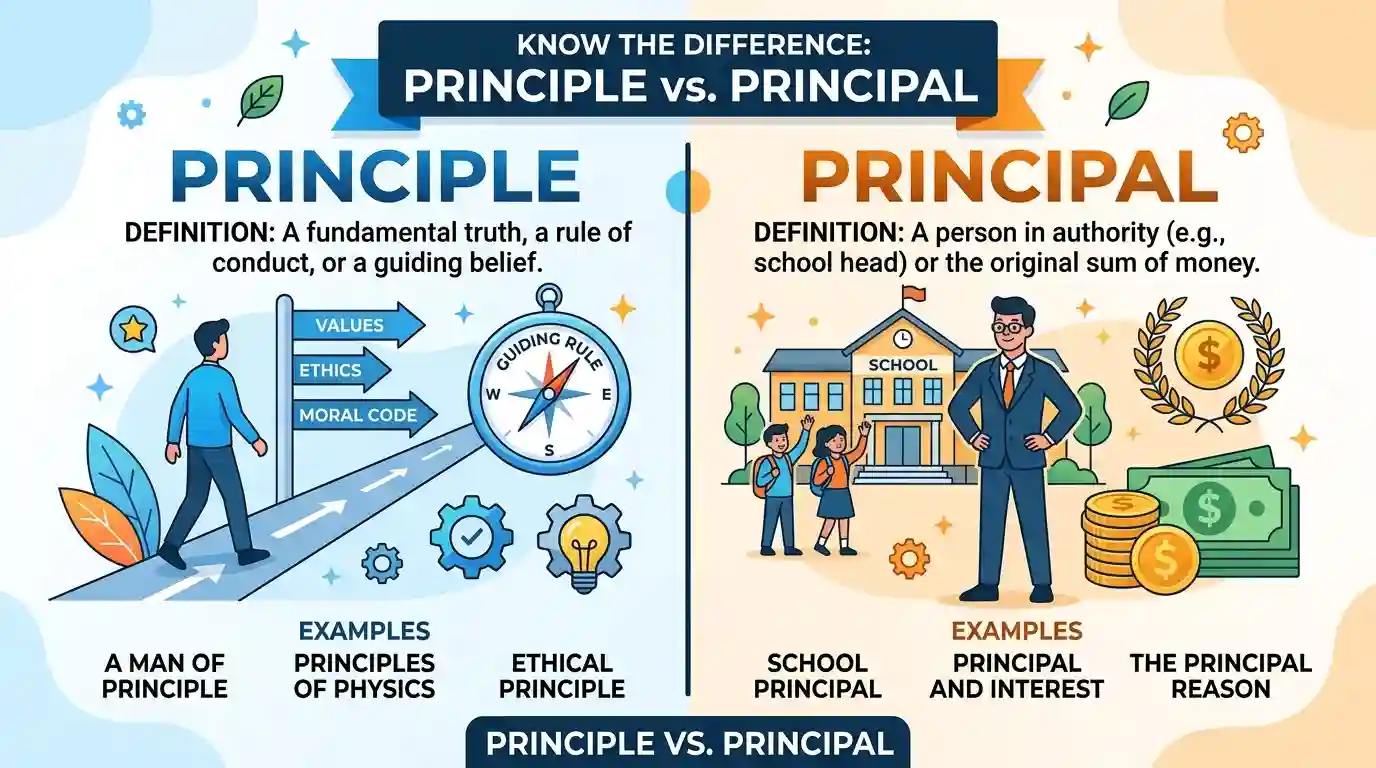
A principle is a fundamental truth, rule, or belief that guides behavior or thinking. Think of it as the foundation upon which something is built. It’s about what should happen or what is considered correct.
How Principles Work in Real Life
When you have principles, you have personal standards. For example, honesty is a principle many people live by. If you believe stealing is wrong no matter what, that’s a moral principle. If a company claims to care about environmental sustainability and actually follows through, they’re acting on their principles.
Who Uses Principles?
Everyone uses principles in daily life, even if they don’t think about it. Parents teach principles of kindness to their children. Scientists rely on principles of physics to conduct experiments. Teachers use educational principles to help students learn better.
Practical Examples
- A business might have a principle of treating every customer with respect, regardless of how much they spend.
- The principle of supply and demand explains why prices go up when something is scarce.
- A vegan follows the principle of not consuming animal products.
- The US Constitution is built on democratic principles like freedom and equality.
Where Does the Word Come From?
The word principle comes from the Latin word “principium,” which means beginning or foundation. That makes sense because principles are the starting points—the foundations—upon which other ideas are built.
What Is Principal?
Principal is a multi-purpose word with three main meanings. It can be a noun referring to a person in a leadership position, an adjective describing something as primary or most important, or a noun referring to a sum of money.
The Person Meaning
In education, the principal is the head of a school. This is probably the most common usage people remember. The principal runs the school, makes important decisions, and oversees teachers and students.
The Adjective Meaning
When used as an adjective, principal means main or most important. The principal reason for doing something is the main reason. The principal ingredient in a recipe is the main ingredient. This usage emphasizes primary importance.
The Financial Meaning
In finance, principal refers to the original amount of money borrowed or invested. When you take out a loan, the principal is the amount you borrowed before interest is added. When you invest, the principal is the money you initially put in.
How Principals Function in Different Settings
School principals handle discipline, hire teachers, and ensure students get a good education. In a business, a principal might be someone who owns a company or has significant authority. In finance, the principal amount determines how much interest you’ll pay or earn.
Practical Examples
- The school principal announced new safety measures at the assembly.
- The principal reason for moving to a new city was the job opportunity.
- When you pay off your mortgage, you’re reducing the principal amount.
- The principal dancer in a ballet company gets the lead roles.
- In a law firm, a principal is a senior partner with decision-making power.
Where Does the Word Come From?
Principal comes from the Latin word “principalis,” which means first or chief. That’s why it refers to people in charge or things that are most important.
Quick Comparison Table
| Feature | Principle | Principal |
| Basic Meaning | Rule, belief, or truth | Leader, main thing, or money amount |
| Part of Speech | Always a noun | Noun or adjective |
| Common Usage | Morals, rules, scientific laws | School head, main reason, finance |
| Pronunciation | PRIN-suh-pul | PRIN-suh-pul |
| Memory Trick | Rule has an “L” like “principle” | “Pal” means person (principal) |
| Cost/Value | Free, it’s an idea | Can involve money |
| Usability | Used in ethics, science, law | Used in education, business, finance |
| Best Use Case | Explaining why | Identifying who or what is most important |
| Popularity | Common in philosophical contexts | Common in everyday conversation |
| Pro | Helps make good decisions | Identifies authority figures |
| Con | Can be abstract and confusing | Multiple meanings cause mix-ups |
Biggest Difference
The core practical difference between principle and principal comes down to what each word refers to. A principle is an idea—something you believe in or follow. It’s intangible and can’t be touched. You can’t hold a principle in your hand.
A principal, on the other hand, is almost always something or someone concrete. It’s a person in charge, the main thing in a group, or an actual amount of money. You can point to a principal. You can calculate a principal amount. You can walk into a school and meet the principal.
Why does this matter? Because confusing them changes the entire meaning of what you’re saying. If you write “the principle of the school,” you’re suggesting the school is guided by a rule. But if you mean the person in charge, you need “principal.” One sentence could mean something completely different from what you intended.
The biggest mistake beginners make is trying to treat these words as interchangeable. They’re not. One is about beliefs and rules; the other is about people, priority, and money. Once you understand that fundamental difference, you’ll choose correctly almost every time.
Key Differences Explained
1. Part of Speech
Principle is always a noun. You can’t make it into an adjective or verb. It stays in its noun form no matter what.
Principal can be both a noun and an adjective. When it describes something, it’s an adjective. When it refers to a person or money, it’s a noun.
Why It Matters: This difference determines how you use each word in a sentence. You can say “principal reason” but you can’t say “principle reason.” That would be grammatically incorrect.
2. Core Meaning
Principle deals with rules, truths, and beliefs. It’s about what should be done or what is fundamentally correct.
Principal deals with leadership, importance, or money. It’s about who’s in charge, what matters most, or how much you owe.
Why It Matters: When you want to talk about ethics or basic truths, you need principle. When you want to talk about the main thing or the person in charge, you need principal. Mixing them up confuses your message.
3. Application in Different Contexts
Principle appears frequently in ethics, law, science, and philosophy. Principles guide behavior and explain how things work.
Principal appears in education, business, finance, and law. Principals are people who hold authority or things that are primary.
Why It Matters: The context tells you which word to use. If you’re discussing morality or scientific laws, it’s principle. If you’re discussing school, money, or main reasons, it’s principal.
4. The Money Connection
Principle has nothing to do with money. It’s purely about ideas and beliefs.
Principal directly relates to money in financial contexts. The principal is the amount you owe or invest.
Why It Matters: This is where many people make expensive mistakes. If you sign a loan document and it says “principle amount,” that’s actually incorrect. The proper term is “principal amount.” Getting this wrong could confuse lenders or indicate you don’t understand financial documents.
5. The Leadership Connection
Principle doesn’t refer to people in charge. It refers to ideas that guide people.
Principal refers to leaders in various settings. School principals, law firm principals, and company principals all hold authority positions.
Why It Matters: When you’re talking about authority figures, you always use principal. Imagine applying for a job and writing “I worked closely with the principle of the school.” That mistake could cost you the opportunity.
6. Specificity vs. Abstraction
Principle is often abstract. It requires interpretation and sometimes debate. What exactly is the principle of fairness? People might define it differently.
Principal is usually concrete and specific. The school principal is a real person. The principal amount is a specific number. The principal reason is a clear choice.
Why It Matters: If you’re being vague or discussing philosophical concepts, principle is the better choice. If you’re being specific and practical, principal is usually correct.
7. Common Phrases
Principle appears in phrases like “in principle,” “on principle,” “principle of operation,” and “moral principles.”
Principal appears in phrases like “principal dancer,” “principal amount,” “school principal,” and “principal objective.”
Why It Matters: Knowing common phrases helps you choose correctly by ear. If you’ve heard a phrase before, you’ll recognize which word fits.
Similarities Between Them
Despite their differences, principle and principal share some interesting similarities. Understanding these similarities helps explain why people confuse them so often.
Pronunciation
The most obvious similarity is how they sound. Both are pronounced “PRIN-suh-pul.” This identical pronunciation means you can’t tell which word someone is using just by hearing it. You have to understand context.
Both Can Be Nouns
Both words function as nouns. You can have “a principle” and “a principal.” This shared grammatical role makes them feel more interchangeable than they really are.
Both Begin With “Princip”
Both words share the same root. “Princip” comes from Latin and relates to beginnings or first things. This shared origin means both words relate to foundational concepts.
Overlapping Usage in Some Contexts
In rare cases, these words can appear in similar contexts. For example, you might discuss the principles of a school and also the principal of that school. They exist in the same environment but refer to completely different things.
Both Relate to Foundations
A principle is a foundation for behavior or belief. A principal is foundational in terms of leadership or importance. Both involve the concept of something being at the base or most fundamental level.
They’re Often Studied Together
Because they’re commonly confused, these words often appear together in grammar guides and vocabulary lessons. Students encounter them as a pair, which reinforces their connection in people’s minds.
Pros and Cons
Pros of Principle
- Guides Ethical Behavior: Having clear principles helps you make better decisions when faced with difficult choices.
- Builds Trust: People respect those who stick to their principles, especially in challenging situations.
- Provides Consistency: Principles create a reliable framework for thinking and acting.
- No Cost: Principles are free to adopt. They don’t require money to implement.
- Universal Application: Principles apply across cultures, situations, and time periods.
Cons of Principle
- Can Be Abstract: Some principles are hard to explain or apply in real situations.
- May Conflict With Practicality: Following principles sometimes means making choices that aren’t convenient or profitable.
- Interpretation Varies: Different people interpret the same principle differently.
- Can Seem Rigid: Uncompromising adherence to principles can make someone seem inflexible.
- Hard to Teach: Principles often require experience to truly understand.
Pros of Principal
- Clear Authority: The principal in any setting provides leadership and makes decisions.
- Financial Clarity: Understanding principal amounts helps you manage loans and investments better.
- Priority Setting: Knowing the principal reason for something helps you focus on what matters.
- Easy to Identify: In most cases, the principal is clearly identifiable—you know who the principal is.
- Widely Recognized: Most people understand what a principal is, especially in educational contexts.
Cons of Principal
- Confusing Multiple Meanings: Having different meanings makes it hard to know which is meant.
- Cost Involved: Financial principals mean you owe money or have invested funds at risk.
- Responsibility Burden: Being a principal leader means taking on significant responsibility.
- Mispronunciation Issues: Some people incorrectly pronounce it with a “ple” ending instead of “pal.”
- Limited Use: Some contexts don’t have a principal at all.
Which Is Better for Different Situations?
For Beginners Learning the Difference
If you’re just starting to learn English or struggling with this distinction, focus on the memory trick. Remember that your principal is your “pal” (a person). This simple association helps more than memorizing complex definitions.
For Students
Students need to know both words well. Teachers and school principals are the authority figures in your educational environment. Meanwhile, you’ll study scientific principles, mathematical principles, and principles of good writing. Both words matter.
For Professionals
Professionals must use these words correctly in emails, reports, and presentations. Using “principle” when you mean “principal” can damage credibility. If you work in finance, knowing the difference is absolutely essential—mistakes with financial language can be costly.
For Families
Parents often teach principles to their children while also dealing with school principals. Both words appear regularly in family life. Understanding the difference helps parents communicate clearly with teachers and children.
For Budget-Conscious People
If you’re borrowing money, always pay attention to the principal amount. This is what you’ll actually need to repay. Understanding principal vs. interest helps you make smarter financial decisions and avoid paying too much in interest.
For Long-Term Users
Over time, understanding principles becomes more important than understanding the word itself. Living by solid principles—honesty, hard work, kindness—creates a better life. Meanwhile, knowing who the principal is in various settings helps you navigate authority structures.
Common Mistakes People Make
Choosing the Wrong Word in Professional Emails
Many professionals have sent emails where they meant to refer to the school principal but wrote “principle.” These mistakes make you look careless and unprofessional. One executive I know received a reply correcting her word usage, which wasted time and felt embarrassing.
Financial Confusion
Some people sign loan documents without understanding that the principal is what they actually owe. They focus on monthly payments instead. Later, they realize they’ve paid more in interest because they didn’t understand how the principal amount works.
Confusing Marketing With Reality
When companies claim to follow certain principles, they don’t always actually do so. Beginners often assume stated principles reflect actual behavior. In reality, many organizations claim ethical principles but fail to follow them.
Overcomplicating the Difference
Some people try to memorize dozens of rules for choosing between principle and principal. The real solution is simpler: remember that principal has a “pal” (person) meaning, and everything else is principle.
Assuming They’re Interchangeable
Probably the biggest mistake is thinking these words can be swapped when you’re unsure. They can’t. One word means something completely different from the other. Guessing wrong will create confusion.
Forgetting the Adjective Form
People often forget that principal can be an adjective. They know it as a noun and don’t realize it can also describe something. This leads to errors like “the principle concern” instead of “the principal concern.”
Expert Recommendation
After years of working with writers, students, and professionals, I’ve developed clear recommendations for when to use each word.
Choose PRINCIPLE if:
- You’re discussing ethical or moral rules
- You’re explaining how something works or should work
- You’re referring to laws of science or nature
- You’re talking about personal or organizational values
- The word is followed by “of” (principle of operation)
- You’re using phrases like “in principle” or “on principle”
Choose PRINCIPAL if:
- You’re referring to the head of a school or organization
- You’re describing the most important reason or factor
- You’re talking about money you borrowed or invested
- You’re using it as an adjective before a noun
- You’re referring to a leading performer or participant
- You’re thinking about authority figures
Avoid PRINCIPLE if:
- You’re referring to a person in charge
- You’re talking about money amounts
- You’re describing the most important thing in a group
- You’re using it as an adjective
Avoid PRINCIPAL if:
- You’re discussing moral beliefs or rules
- You’re explaining scientific or natural laws
- You’re talking about guiding philosophies
- You’re referring to foundations of behavior
Final Verdict
Here’s the truth about principle vs. principal. Most people spend way too much time overthinking this distinction. The solution is surprisingly simple. Think about what you’re actually trying to say.
If you’re talking about a rule, belief, or truth, use principle. That’s it. Principles are about what should happen or what is correct. They guide how people think and act. They’re abstract, but they matter enormously to ethics, science, and law.
If you’re talking about a person, priority, or money, use principal. The school principal is the person in charge. The principal reason is the main reason. The principal amount is what you owe or invest. These are concrete things you can identify.
Remember that your principal at school is your “pal.” That’s the easy memory trick that works every time. Teachers use it with students because it actually helps. Once you know that principal can mean “pal,” the other meaning—main or primary—makes sense too.
The bottom line is this: if you can remember that one word is about ideas and the other is about people, money, and importance, you’ll choose correctly. Don’t overcomplicate it. Don’t guess. Think about what you mean, and the right word will follow.
Frequently Asked Questions
Which is better, principle or principal?
Neither is better. They serve different purposes. You need both words for different situations. The question of “better” only matters when you’re choosing between them in a specific sentence. In that case, the right choice depends entirely on what you’re trying to say.
Is it worth learning the difference?
Absolutely. Using these words incorrectly makes you look less competent. In professional writing, these mistakes stand out. In academic work, they cost marks. In financial documents, they can cause real confusion. Learning the difference is worth the small effort.
Which lasts longer, principles or principals?
Principles last much longer. A school principal leaves the job after a few years. Financial principals are paid off eventually. But principles—values like honesty and fairness—can last forever. They’re passed down through generations and outlast any individual leader.
Which is easier to understand?
For most people, principal is easier because it’s concrete. A school principal is a real person you can meet. The principal amount is a specific number. Principles are more abstract, which makes them harder for beginners to grasp.
Which is best for beginners?
Beginners should focus on principal first. It’s more concrete and appears more frequently in daily conversation. Once you understand principal, learning principle becomes easier because you’ll know the difference.
What do most people prefer?
Most people don’t prefer one over the other. They just need to use both correctly. In surveys of common writing mistakes, confusing principle and principal consistently ranks among the most frequent errors. People often wish they were simpler to distinguish.
Are they interchangeable?
Absolutely not. You can’t replace one with the other. They have completely different meanings. Thinking they’re interchangeable is the root of the problem for most people who struggle with them.
What mistakes should beginners avoid?
Beginners should avoid treating these words as synonyms. They should also avoid guessing when unsure. Instead, use the memory tricks: principal has a “pal” meaning a person, or principal is the most important thing. Everything else is principle.
Conclusion
The difference between principle and principal ultimately comes down to what you’re talking about. Principles are abstract ideas—rules, beliefs, and truths that guide behavior. Principal is concrete—it’s a person in charge, the most important thing, or a sum of money.
When you first learn about this distinction, it seems complicated. Both words sound identical. Both have multiple meanings. Both relate to foundational concepts. But once you use the “pal” trick to remember principal, everything becomes clearer.
The consequences of getting it wrong vary. In casual conversation, you can probably get away with the mistake. But in professional writing, it damages your credibility. In financial documents, it could lead to costly misunderstandings. Taking the time to learn this difference is an investment in your communication skills.
Here’s my final advice: whenever you’re uncertain, ask yourself what you’re actually referring to. Is it an idea or a person? A rule or a reason? An amount of money or a moral standard? Once you answer that, the right word becomes obvious. And if you still feel unsure, take a moment to look it up. A quick check can save you from an embarrassing error.

Hi! I am Arshad Ullah presently working as linguist in Punjab Education Department. I have done MA in English Literature while M.Phil in Applied Linguistics. I have taught creative writing to the post graduation classes for 15 years. Presently I am working as content writer, and offering classes for blog writing. On this site, I research each topic from authoritative sources and edit every comparison for accuracy and clear, simple language.