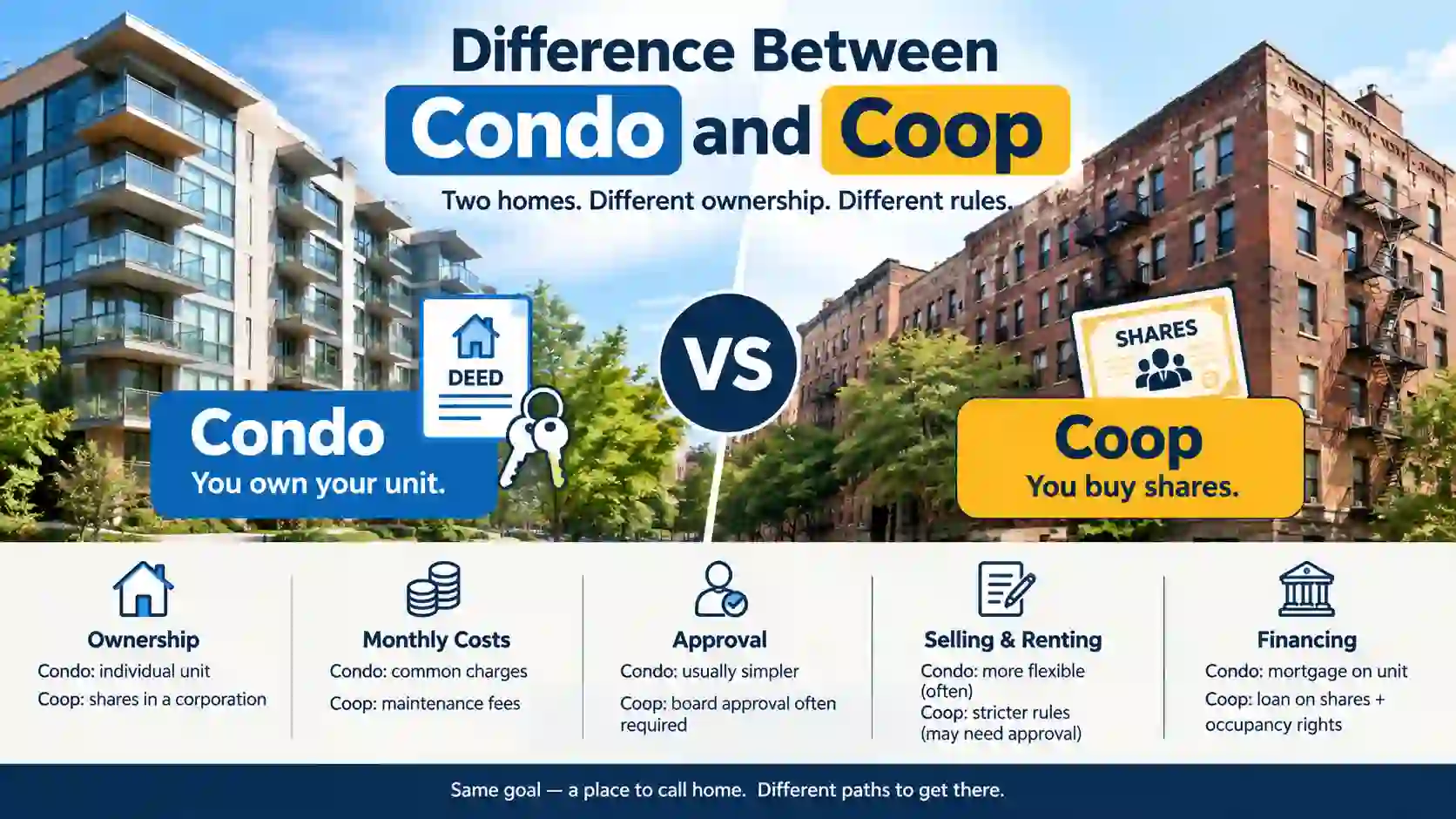
A condo (condominium) is a type of home that you own individually, along with a shared interest in common areas. A coop (cooperative) is a home where you buy shares in a corporation that owns the building, giving you the right to live in a specific unit. The main difference between a condo and a coop is what you own legally and how you manage your home.
Quick Comparison Table
| Feature | Condo | Coop |
| What you own | Your individual unit | Shares in a corporation |
| Right to live there | Comes with unit ownership | Comes with shares and a proprietary lease or occupancy agreement |
| Building ownership | Owners share common areas | The corporation owns the building |
| Approval to buy | Usually fewer restrictions | Board approval is often required |
| Monthly costs | Common charges or HOA fees | Maintenance fees |
| Selling your home | Often more flexible | May require board approval |
| Renting it out | Depends on building rules | Often has stricter rules |
| Financing | Mortgage on the unit | Loan secured by cooperative shares and occupancy rights |
Rules vary by location and building. The term “coop” is especially common in the United States.
Introduction
When you look for an apartment, you may find two options: a condo and a coop. Both can give you a place to live, but the legal setup is different.
This difference matters when you buy, sell, borrow money, or rent out your home. It can also affect your monthly payments and the rules you must follow.
What Is a Condo?
A condo is a home that you own as a separate unit in a larger building or community. You usually own the inside of your unit and share ownership or rights in common areas, based on local law and the building’s legal documents.
For example, you may own Apartment 204 in a building with 50 apartments. You can use your apartment as your home, subject to the community’s rules.
Main Characteristics of a Condo
- Individual ownership: You hold legal title to your unit.
- Shared areas: You may share hallways, lifts, gardens, parking areas, or a swimming pool.
- Monthly fees: You pay charges for shared services and upkeep.
- Resale: You can usually sell your unit, subject to applicable laws and community rules.
- Building rules: You must follow rules about noise, pets, renovations, and other matters.
Fannie Mae explains that condo ownership differs from cooperative ownership in the way the unit and common areas are legally held.
What Is a Coop?
A coop, short for cooperative, is a building owned by a corporation or another legal entity. Instead of buying your apartment directly, you buy shares in that organization.
Those shares give you the right to live in a particular apartment under a proprietary lease or similar occupancy agreement. The corporation owns the building, while its shareholders have rights linked to their shares.
Main Characteristics of a Coop
- Share ownership: You own shares in the corporation, not direct title to your apartment.
- Right to live there: Your shares are linked to the right to occupy a specific unit.
- Board approval: The cooperative may require approval before a new buyer can join.
- Monthly maintenance: Payments may cover building expenses, taxes, insurance, upkeep, and a share of building debt.
- Resale and rental rules: The cooperative’s governing documents may place limits on selling or renting your unit.
The exact rules depend on the cooperative’s documents and the laws where the property is located.
Core Differences Between Condo and Coop
1. Ownership
This is the main difference between a condo and a coop.
With a condo:
- You own your individual unit.
- Your ownership is usually recorded in a deed.
- You share responsibility for common areas through the applicable association or ownership structure.
With a coop:
- You own shares in the corporation that owns the building.
- Your shares are linked to your right to occupy a specific apartment.
- Your rights depend on the share documents and occupancy agreement.
2. Buying a Home
The buying process can differ.
Buying a condo
- You typically sign a purchase contract for the unit.
- You arrange financing if needed.
- You review the association’s rules, finances, fees, and records.
Buying a coop
- You buy shares and the associated right to occupy the unit.
- You may need to submit financial records and an application to the board.
- You must check the corporation’s financial position and rules.
Board approval is common in coops, but the exact process varies. Fannie Mae’s cooperative housing guidance explains how share ownership and occupancy rights are documented.
3. Monthly Fees and Other Costs
Both types of homes can have monthly costs, but what those costs cover may differ.
| Cost | Condo | Coop |
| Monthly payment | Common charges or association fees | Cooperative maintenance charges |
| Building upkeep | Usually funded through association charges | Usually funded through cooperative maintenance |
| Property taxes | Often billed to the unit owner | Often paid by the corporation and reflected in maintenance, depending on the structure |
| Building loan | Usually separate from your unit mortgage | Your maintenance may include a share of the building’s mortgage costs |
| Special assessments | Possible | Possible |
Important: Do not compare only the monthly fee. Check what is included, whether the building has debt, and whether major repairs may lead to extra charges.
4. Selling Your Home
Condo owners generally sell their individually owned units. Coop owners transfer their shares and the related occupancy rights.
A condo sale may be more straightforward, but it can still involve building documents, buyer checks, and legal requirements. A coop sale may involve an application and board approval, depending on the governing documents.
Before buying either type, ask how long a typical sale process takes and what restrictions apply.
5. Renting Out Your Home
Rules for renting can vary widely.
- Condo: The association may limit rentals, require registration, or restrict short-term stays.
- Coop: The board or governing documents may require permission, limit subletting, or impose occupancy conditions.
Never assume that owning a condo means you can rent it freely, or that every coop prohibits rentals. Check the actual documents before you buy.
Similarities Between Condo and Coop
Although the ownership structure differs, condos and coops have several things in common.
- Both can provide a permanent home in a shared building.
- Both may require monthly payments for building services and upkeep.
- Both may have rules about pets, noise, renovations, and visitors.
- Both may require extra payments for major repairs.
- Both can involve financing, legal documents, and checks of the building’s finances.
Practical Examples
Imagine two apartments in the same city, each with two bedrooms.
Example 1: Condo
Sarah buys an apartment and receives legal title to that unit. She pays her mortgage, her building fees, and any other costs she owes as the owner.
Example 2: Coop
Ahmed buys shares in a company that owns an apartment building. His shares and occupancy agreement give him the right to live in one apartment. He pays monthly maintenance to the cooperative.
Both people have a home, but they hold different legal interests.
When to Choose a Condo or Coop
The right choice depends on your needs, finances, and the rules of the building.
Consider a Condo When:
- You want direct ownership of your individual unit.
- You want more flexibility when selling or renting, subject to local rules.
- You prefer to review your own unit’s ownership and costs separately.
- You want a property that may be easier to finance or sell in your local market.
Consider a Coop When:
- You are comfortable owning shares rather than direct title to the apartment.
- You accept the cooperative’s approval process and community rules.
- The monthly charges and building finances fit your budget.
- You understand the limits on resale, subletting, and occupancy.
Before making a decision, review the legal documents, monthly fees, building debt, repair plans, and financing options for the specific property.
Common Misconceptions
1. Is a Coop the Same as Renting?
No. A coop shareholder owns shares in the corporation and has a right to occupy a unit under an agreement. A renter usually pays rent under a rental agreement and does not own shares in the building’s cooperative corporation.
2. Is a Condo Always More Expensive?
No. Prices depend on the location, size, condition, building facilities, and local housing market. A condo may have high association fees, while a coop may have high maintenance charges or a share of building debt. Compare the full cost of each property.
3. Can You Get a Mortgage for a Coop?
Yes. In the United States, eligible buyers can often obtain a special loan secured by their cooperative shares and occupancy rights. This differs from a typical mortgage secured by direct ownership of a condo unit. Loan availability depends on the lender, buyer, and cooperative. Fannie Mae’s co-op loan guidance explains the relevant requirements.
4. Can You Inherit a Condo or Coop?
Both may be passed on through an estate, subject to applicable law and the relevant ownership documents. With a condo, the property interest is transferred. With a coop, the shares and associated occupancy rights are handled under the cooperative’s rules and applicable law. Legal advice may be needed for a particular case.
5. Are Condos and Coops Found Everywhere?
Both exist in various housing markets, but their popularity differs by location. Cooperative apartments are especially well known in New York City. The legal terms and ownership structures may differ in other countries, so always check local law.
FAQs
What is the biggest difference between a condo and a coop?
The biggest difference is what you own. A condo owner holds legal title to an individual unit. A coop owner holds shares in a corporation that owns the building, along with a right to occupy a specific apartment. This affects the purchase process, financing, resale, and the rules that apply to the home.
Is a condo the same as an apartment?
Not exactly. An apartment describes a type of home, while a condo describes an ownership structure. An apartment may be rented from a landlord or owned as a condominium unit. A coop apartment is occupied through shares and associated rights in a cooperative corporation.
Why do coops require board approval?
Many coops use board approval to review potential buyers before they become shareholders. The application process may include financial documents and other information. The board’s authority and the limits on its decisions depend on the cooperative’s governing documents and local law.
Do condo owners pay monthly maintenance fees?
Usually, condo owners pay common charges or association fees for shared services and building upkeep. The amount depends on the property and the services provided. Owners may also pay property taxes, insurance, mortgage costs, and special assessments for major repairs.
Can you sell a coop apartment?
Yes. A coop shareholder can generally sell or transfer their shares and associated occupancy rights, subject to the cooperative’s documents and applicable law. A buyer may need board approval. The process and any restrictions should be checked before entering into a purchase agreement.
Which has more freedom: a condo or a coop?
The answer depends on the specific building. Condo owners often have more flexibility in selling or renting their units, but association rules still apply. Coop owners may face additional board approval and subletting rules. Compare the actual documents instead of relying only on the property type.
Conclusion
The main difference between a condo and a coop is the form of ownership. A condo gives you legal ownership of an individual unit, while a coop gives you shares in a corporation that owns the building and the right to live in a particular apartment.
Both can offer a home in a shared building, but their fees, financing, resale rules, and rental restrictions can differ. Before buying, review the building’s finances, legal documents, and monthly costs. These details will help you understand your responsibilities and the rights that come with the property.

Hi! I am Arshad Ullah presently working as linguist in Punjab Education Department. I have done MA in English Literature while M.Phil in Applied Linguistics. I have taught creative writing to the post graduation classes for 15 years. Presently I am working as content writer, and offering classes for blog writing. On this site, I research each topic from authoritative sources and edit every comparison for accuracy and clear, simple language.











1 thought on “Difference Between Condo and Coop: A Complete Guide”