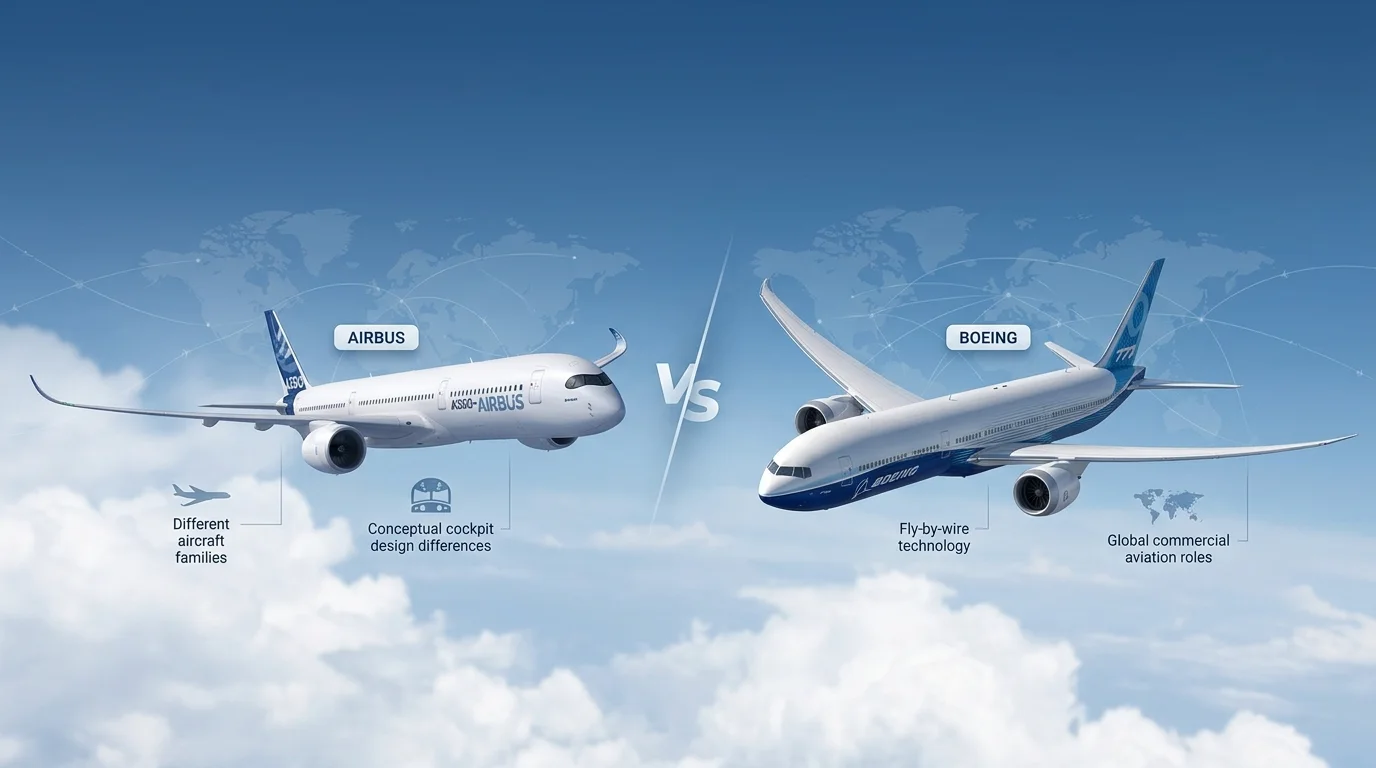
The main difference between Airbus and Boeing is that they are two different aircraft manufacturers with different design histories and product families. Airbus is a European aerospace company, while Boeing is a U.S. aerospace company. Their modern passenger jets serve many of the same routes, but they differ in aircraft models, cockpit design, flight-control systems, and design approaches.
Quick Comparison Table
| Attribute | Airbus | Boeing |
| Company origin | European cooperation | United States |
| Early commercial focus | A300 and later A320 families | 707, 737 and later families |
| Common single-aisle family | A220 / A320 | 737 |
| Common wide-body aircraft | A330 / A350 | 787 / 777 |
| Cockpit control | Sidestick on major modern Airbus jets | Control column/yoke on major Boeing families |
| Flight-control approach | Extensive digital fly-by-wire | Modern Boeing jets also use fly-by-wire, with design differences between families |
| Famous large aircraft | A380 | 747 |
| Main market | Commercial, defence, space and helicopters | Commercial, defence, space and other aerospace products |
Introduction
When people ask about the difference between Airbus and Boeing, they are usually comparing the two biggest names in commercial passenger aircraft.
But Airbus and Boeing are not aircraft models. They are aerospace companies.
They design and build many types of aircraft. Some are small single-aisle jets for shorter routes. Others are large wide-body aircraft for long international flights.
This means an Airbus aircraft is not automatically the same as another Airbus aircraft. The same is true for Boeing.
For example:
- Airbus A320 and Boeing 737 are competing single-aisle families.
- Airbus A350 and Boeing 787 are competing long-range wide-body aircraft.
- Airbus A330 and Boeing 777 can also serve overlapping markets.
So, the best comparison depends on the specific aircraft model.
What Is Airbus?
Airbus is a European aerospace company that makes commercial aircraft, helicopters, defence systems and space products.
Airbus grew from cooperation among European aerospace companies. The first Airbus aircraft, the A300B1, made its first flight on 28 October 1972. The A300 helped establish Airbus as a major commercial aircraft manufacturer.
Main Airbus Passenger Families
Today, Airbus commercial passenger aircraft include:
- A220 — smaller single-aisle aircraft
- A320 Family — single-aisle aircraft such as the A319, A320 and A321
- A330 — wide-body aircraft
- A350 — modern long-range wide-body aircraft
The A380 is no longer produced, but many A380 aircraft remain in airline service. Airbus describes it as the world’s largest passenger aircraft.
Airbus Design Approach
One important Airbus idea is cockpit commonality.
Many Airbus aircraft use similar cockpit layouts and flight-control concepts. This can make it easier for pilots and airlines to move between related Airbus aircraft types after the required training.
What Is Boeing?
Boeing is a U.S. aerospace company with a long history in aircraft manufacturing.
William Boeing formed Pacific Aero Products in 1916. The company was renamed Boeing Airplane Company in 1917. Its early work included military aircraft before Boeing became a major commercial aircraft manufacturer.
Boeing later played an important role in the development of commercial jet travel. Its 707 helped usher in the commercial Jet Age, while the 737 became one of the world’s most widely used passenger aircraft families.
Main Boeing Passenger Families
Boeing’s commercial aircraft range includes:
- 737 MAX — single-aisle aircraft
- 787 Dreamliner — long-range wide-body aircraft
- 777 — large wide-body aircraft
- 777X — new-generation large wide-body aircraft
Boeing also continues to support older aircraft such as the 747 and 737 Next Generation in airline fleets, even though these are no longer available as new commercial production models.
Core Difference Between Airbus and Boeing
1. Company History and Origin
The first major difference is where the two companies came from.
Airbus
Airbus grew from European cooperation involving France, Germany, the United Kingdom and Spain. Its commercial aircraft story began with the A300 program.
Boeing
Boeing began in the United States in the early 20th century. Its early aircraft included military and training aircraft before the company became a major commercial jet manufacturer.
So, in simple terms:
- Airbus: European aerospace cooperation
- Boeing: American aerospace company
2. Aircraft Naming Systems
Airbus and Boeing use different aircraft names.
Airbus
Airbus aircraft normally use an A-number system:
- A220
- A320
- A330
- A350
- A380
Boeing
Boeing commercial aircraft commonly use a 7-series naming system:
- 707
- 717
- 727
- 737
- 747
- 757
- 767
- 777
- 787
The numbers alone do not tell you everything about an aircraft’s size or purpose.
For example, the Airbus A320 and Boeing 737 are both popular single-aisle aircraft families, while the Airbus A350 and Boeing 787 are designed for long-range wide-body operations.
3. Airbus A320 vs Boeing 737
This is one of the most useful comparisons for beginners.
Both aircraft families are single-aisle jets. They are widely used for short- and medium-haul routes.
Airbus A320 Family
The A320 family includes:
- A319
- A320
- A321
- A321XLR
The A321XLR extends the family into longer-range operations. Airbus says the family covers the single-aisle market from roughly 120 to 244 seats, depending on the model and configuration.
Boeing 737 Family
The current 737 MAX family includes:
- 737-7
- 737-8
- 737-9
- 737-10
Boeing lists two-class seating ranges from about 135 to 210 seats across these models, with maximum seating varying by aircraft.
The Simple Difference
Think of them as competing aircraft families.
An airline may compare an A320-family aircraft with a similar 737-family aircraft when deciding which aircraft fits its routes, fleet and business needs.
4. Cockpit Controls
One of the easiest differences to notice is the pilot’s main control.
Airbus
Modern Airbus passenger aircraft use sidestick controllers rather than a traditional central control column.
The A320 introduced digital fly-by-wire flight controls in commercial passenger aviation and used a sidestick as part of the system.
Boeing
Many Boeing passenger aircraft use a control column/yoke in the cockpit.
However, it is important not to treat all Boeing aircraft as having identical systems. Boeing has also used advanced fly-by-wire technology in newer aircraft.
Important Point
The difference is not simply “Airbus has computers and Boeing does not.”
Modern aircraft from both companies use advanced computers and electronic flight-control systems. The important differences are in how those systems are designed and how the pilot interacts with them.
5. Fly-by-Wire Technology
Fly-by-wire means that pilot control inputs are processed electronically rather than being sent only through traditional mechanical cables and linkages.
Airbus introduced digital fly-by-wire on the A320 in 1988. Airbus says the technology is now used across its modern passenger aircraft families.
But Boeing also uses fly-by-wire on several modern aircraft.
For example:
- Boeing 777 uses fly-by-wire.
- Boeing 787 uses advanced electronic flight-control systems.
- Older Boeing aircraft use different control technologies.
Therefore, it is incorrect to say:
“Airbus uses fly-by-wire, but Boeing does not.”
The real difference is how each aircraft family implements its flight-control system.
6. Aircraft Size and Mission
Airbus and Boeing both build aircraft for different missions.
Airbus Examples
- A220: smaller single-aisle routes
- A320: short- and medium-haul routes
- A321XLR: longer-range single-aisle routes
- A330: wide-body operations
- A350: long-range wide-body operations
- A380: very large passenger aircraft
Boeing Examples
- 737 MAX: single-aisle routes
- 787: medium- and long-haul routes
- 777: large long-range aircraft
- 777X: next-generation large wide-body aircraft
Boeing describes the 787 as an aircraft designed to help airlines open new nonstop routes, while its 777 family serves large-capacity, long-range markets.
7. Materials and Aircraft Design
Modern aircraft from both companies use advanced materials.
The Boeing 787 Dreamliner, for example, uses a structure made of about 50% composites by weight. Boeing says this helps reduce weight and supports efficiency and long-range operation.
Airbus also uses advanced materials in newer aircraft.
The Airbus A350 is a modern long-range aircraft designed with extensive use of advanced materials and composites. Airbus describes it as a clean-sheet wide-body design.
So, there is no simple rule that says one company uses modern materials while the other does not.
Both manufacturers use:
- Aluminium alloys
- Titanium
- Carbon-fiber composites
- Advanced engines
- Digital flight systems
- Modern aerodynamic designs
The exact material mix depends on the aircraft model.
8. Passenger Experience
Passengers may notice differences between individual aircraft, but the manufacturer alone does not determine the whole experience.
The airline chooses:
- Seat pitch
- Seat width
- Cabin layout
- Lighting
- Entertainment systems
- Food service
- Cabin configuration
For example, an Airbus A320 operated by one airline can feel very different from an A320 operated by another airline.
The same applies to Boeing aircraft.
Airbus highlights features such as larger overhead bins, lighting and cabin design in its newer aircraft, while Boeing highlights features such as larger windows and cabin comfort on the 787.
Therefore, airline configuration matters as much as the aircraft manufacturer for many passenger-experience questions.
Airbus and Boeing Similarities
Although Airbus and Boeing compete with each other, they have many things in common.
What They Have in Common
- Both build commercial passenger aircraft.
- Both build single-aisle and wide-body aircraft.
- Both serve airlines around the world.
- Both use advanced digital systems.
- Both use modern materials and aerodynamic designs.
- Both produce aircraft for short-, medium- and long-range markets.
- Both have major defence and aerospace businesses beyond passenger aircraft.
Airbus operates across commercial aircraft, helicopters, defence and space, while Boeing’s businesses also extend beyond commercial passenger aircraft.
Airbus vs Boeing: Common Aircraft Comparisons
The companies are often compared through aircraft families rather than as complete companies.
| Airbus | Boeing | General Market |
| A220 | 737 family | Smaller single-aisle market |
| A320 Family | 737 MAX | Single-aisle market |
| A330 | 787 / 777 | Wide-body market |
| A350 | 787 / 777 | Long-range wide-body market |
| A380 | 747 | Very large passenger aircraft |
These are not exact one-to-one matches. Aircraft have different sizes, ranges, engines, configurations and operating roles.
Common Misconceptions
Misconception 1: Airbus and Boeing are aircraft models
They are not.
Airbus and Boeing are aerospace manufacturers.
An Airbus A320 is an aircraft. A Boeing 737 is an aircraft. Airbus and Boeing are the companies that design and produce aircraft families.
Misconception 2: All Airbus aircraft are the same
They are not.
An A220, A320, A350 and A380 have very different sizes, designs and missions.
Even within one family, different versions can have different seating, range and performance.
Misconception 3: Boeing aircraft do not use fly-by-wire
This is incorrect.
Modern Boeing aircraft such as the 777 and 787 use advanced electronic flight-control systems. Airbus also uses fly-by-wire extensively across its modern passenger aircraft.
Misconception 4: An Airbus flight is always safer than a Boeing flight, or vice versa
Aircraft safety cannot be judged simply by the manufacturer name.
Safety depends on many factors, including:
- Aircraft design
- Certification
- Maintenance
- Airline procedures
- Pilot training
- Manufacturing quality
- Regulatory oversight
- Operational conditions
Aircraft are certified and regulated through aviation authorities and must meet applicable airworthiness requirements.
Misconception 5: Passengers can always tell Airbus and Boeing apart
Sometimes they can, but not always.
Some aircraft have recognizable cockpit windows, nose shapes, wing designs or cabin features. But many aircraft look similar from inside the passenger cabin.
The easiest way to know is often to check the aircraft type shown on the airline’s booking or flight information.
FAQs
Is Airbus better than Boeing?
There is no single answer because Airbus and Boeing make many different aircraft for different markets. An A320 and a 737, for example, compete in a similar market, while an A350 and a 737 serve very different roles. The aircraft model, airline configuration, route and operating needs all matter.
What is the main difference between Airbus and Boeing?
The main difference is that Airbus and Boeing are different aircraft manufacturers with different histories and design approaches. Airbus developed from European cooperation, while Boeing grew from an American aerospace company. Their aircraft also differ in cockpit controls, model families and technical design choices.
Which is bigger, Airbus or Boeing?
The answer depends on what is being measured, such as revenue, employees, commercial aircraft deliveries, total aerospace business or order backlog. These figures also change from year to year. It is better to compare a specific measure and a specific year rather than use one general statement.
Is an Airbus A320 the same as a Boeing 737?
No. They are different aircraft families made by different companies, but they compete in similar single-aisle markets. Both are commonly used for short- and medium-haul passenger routes. Their dimensions, systems, cockpit design and operating characteristics are different.
Do Airbus pilots use a joystick?
Modern Airbus passenger aircraft use sidestick controllers. The sidestick is different from a traditional central control column. It sends pilot commands to the aircraft’s flight-control system. Airbus introduced this type of digital flight-control arrangement with the A320.
Do Boeing planes use fly-by-wire?
Some do. Modern Boeing aircraft such as the 777 and 787 use fly-by-wire technology. However, Boeing has produced many aircraft families over several decades, so flight-control systems are not identical across every Boeing model.
Which aircraft is larger, Airbus A350 or Boeing 787?
Both families contain different models, so the answer depends on the exact aircraft. For example, the 787 family includes the 787-8, 787-9 and 787-10, while the A350 family includes the A350-900 and A350-1000. Their seating, dimensions and range vary by version.
Conclusion
The difference between Airbus and Boeing is mainly a difference between two major aerospace manufacturers, not simply two types of airplanes. Airbus grew from European cooperation and is known for aircraft such as the A320, A330 and A350. Boeing is an American aerospace company known for aircraft such as the 737, 787 and 777. Both companies build advanced aircraft for similar global markets. The clearest comparison comes from looking at specific aircraft models, because size, range, cockpit systems and passenger features can vary greatly within each manufacturer’s product line.

Hi! I am Arshad Ullah presently working as linguist in Punjab Education Department. I have done MA in English Literature while M.Phil in Applied Linguistics. I have taught creative writing to the post graduation classes for 15 years. Presently I am working as content writer, and offering classes for blog writing. On this site, I research each topic from authoritative sources and edit every comparison for accuracy and clear, simple language.