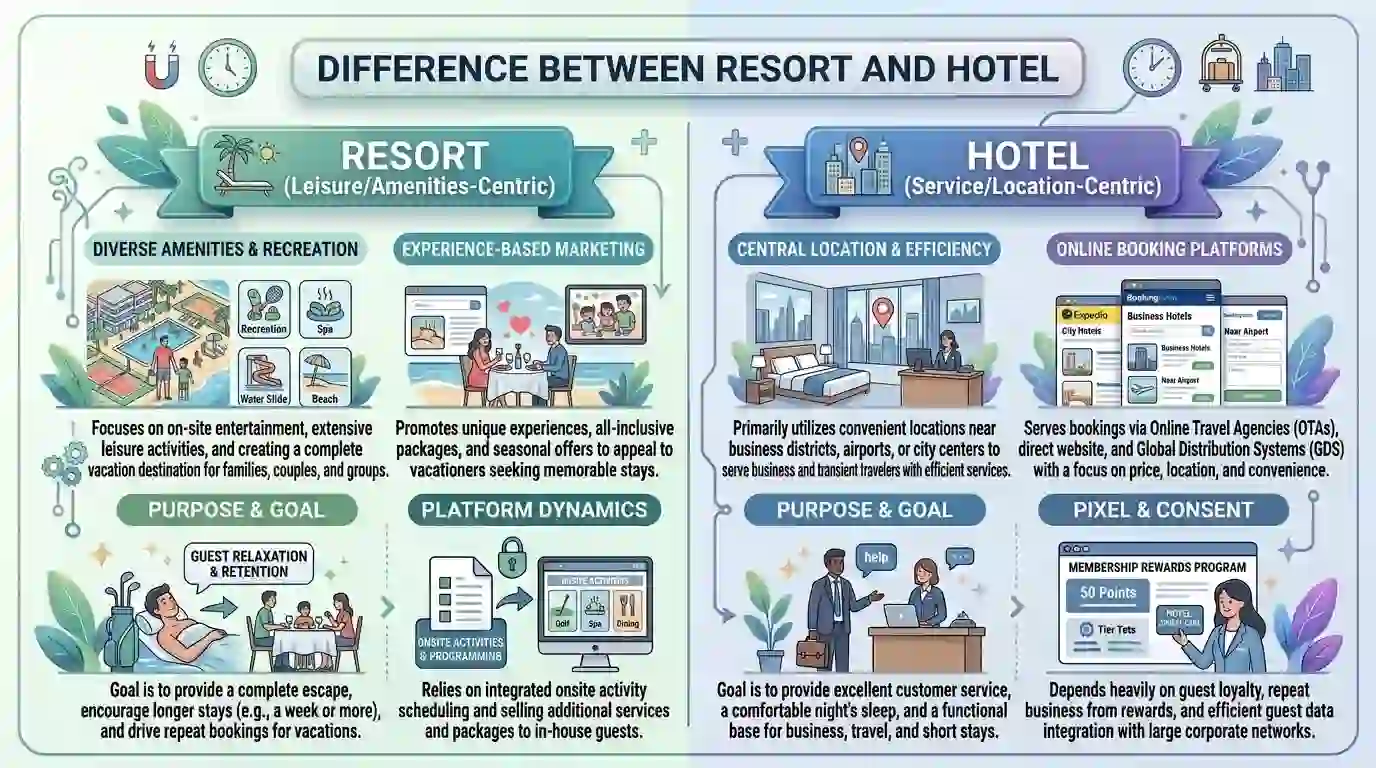
A few years ago, I helped a friend plan a family vacation. While searching online, we kept seeing two types of accommodations: hotels and resorts. At first, they seemed like the same thing. After all, both offer rooms, food, and a place to stay.
But after comparing options, we realized there were major differences. Choosing the wrong one could mean spending more money than necessary or missing out on the experience you really want.
Many people first assume that a resort is simply a bigger hotel. Others think every luxury hotel is a resort. In reality, the two serve different purposes and are designed for different types of travelers.
Understanding the difference between resort and hotel can help you save money, enjoy your trip more, and choose accommodation that matches your expectations.
This guide explains everything in simple English with practical examples so you can clearly understand the real difference.
What Is a Hotel?
A hotel is a business that provides temporary accommodation for travelers.
Its main purpose is to give guests a comfortable place to sleep, relax, and access basic services during their stay.
Hotels are commonly located in:
- Cities
- Business districts
- Airports
- Tourist areas
- Highway routes
Key Features of a Hotel
- Private guest rooms
- Reception desk
- Housekeeping services
- Wi-Fi access
- Restaurants or room service
- Meeting rooms in some properties
Who Uses Hotels?
Hotels are popular among:
- Business travelers
- Solo travelers
- Couples
- Tourists exploring cities
- People attending events or conferences
Real-World Example
Imagine you are visiting a city for three days to attend meetings or explore local attractions. You need a clean room, a comfortable bed, internet access, and a convenient location.
A hotel is usually the ideal choice.
What Is a Resort?
A resort is a vacation-focused property that offers accommodation along with recreational activities, entertainment, and leisure facilities in one location.
Unlike hotels, resorts are designed to be destinations themselves.
Guests often spend most of their time inside the resort rather than leaving daily to explore.
Key Features of a Resort
- Accommodation
- Multiple restaurants
- Swimming pools
- Spa facilities
- Sports activities
- Entertainment programs
- Private beaches or scenic locations
- Family-friendly attractions
Who Uses Resorts?
Resorts are commonly chosen by:
- Families
- Couples on vacation
- Honeymooners
- Luxury travelers
- Groups seeking relaxation
Real-World Example
If you want a beach vacation where everything is available in one place—food, pools, activities, and entertainment—a resort is often the better option.
Quick Comparison Table
| Feature | Hotel | Resort |
| Meaning | Accommodation for travelers | Vacation destination with activities |
| Main Purpose | Lodging and convenience | Recreation and relaxation |
| Location | Cities, airports, tourist centers | Beaches, mountains, islands, scenic areas |
| Activities | Limited | Extensive |
| Dining Options | Usually one or two | Multiple restaurants |
| Entertainment | Basic | Comprehensive |
| Cost | Usually lower | Usually higher |
| Stay Duration | Short-term | Longer vacations |
| Family Friendliness | Moderate | High |
| Facilities | Essential services | Luxury amenities |
| Best For | Business trips and city visits | Holidays and leisure travel |
| Pros | Affordable and convenient | Complete vacation experience |
| Cons | Limited recreation | Higher expenses |
Biggest Difference Between Resort and Hotel
The biggest difference is simple:
A hotel is mainly a place to stay, while a resort is a place to stay and spend your vacation.
This matters more than many beginners realize.
Hotels focus on accommodation and convenience. Resorts focus on creating an entire travel experience.
In real-world use, hotel guests often leave the property to explore nearby attractions. Resort guests often remain on-site because everything they need is already available.
Over the long term, this difference affects cost, convenience, and overall travel satisfaction.
Key Differences Explained
1. Purpose
Hotel
Hotels focus primarily on providing accommodation.
Resort
Resorts focus on delivering a complete vacation experience.
Example
A business traveler may need a hotel. A honeymoon couple may prefer a resort.
2. Location
Hotel
Hotels are often located in busy urban areas.
Resort
Resorts are commonly built in scenic destinations.
Example
- Downtown city center = Hotel
- Beachfront property = Resort
3. Activities and Recreation
Hotel
Activities are usually limited.
Resort
Resorts offer many leisure options.
Examples
- Water sports
- Golf
- Yoga classes
- Kids clubs
- Live entertainment
4. Dining Options
Hotel
Most hotels have one restaurant or cafe.
Resort
Resorts usually offer several dining venues.
Example
Guests may choose from seafood restaurants, buffets, grills, and specialty dining experiences.
5. Length of Stay
Hotel
Ideal for short visits.
Resort
Designed for extended vacations.
Real-World Impact
Many resort guests stay for several days or even weeks.
6. Cost
Hotel
Generally more budget-friendly.
Resort
Often costs more because activities and amenities are included.
Example
A traveler staying one night may save money with a hotel.
7. Family Experience
Hotel
Families may need to find entertainment outside the property.
Resort
Family activities are often available on-site.
Examples
- Water parks
- Kids clubs
- Family events
8. Luxury and Amenities
Hotel
Amenities vary depending on category.
Resort
Luxury experiences are usually a major focus.
Examples
- Spa treatments
- Private beaches
- Golf courses
- Wellness centers
9. Guest Experience
Hotel
Focused on convenience.
Resort
Focused on enjoyment and relaxation.
Real-World Observation
After using both for some time, travelers often describe resorts as experiences rather than accommodations.
10. Business Travel Suitability
Hotel
Excellent for work trips.
Resort
Usually less practical for business travelers.
Example
A hotel near a conference center is often more useful than a remote resort.
11. All-Inclusive Services
Hotel
Guests typically pay separately for services.
Resort
Many resorts offer all-inclusive packages.
Example
Meals, drinks, entertainment, and activities may be included in one price.
Similarities Between Them
Although they are different, hotels and resorts share several characteristics.
Both Offer Accommodation
Guests stay overnight in private rooms or suites.
Both Provide Hospitality Services
Housekeeping, reception, and customer support are common.
Both Serve Travelers
Whether for work or leisure, both cater to people away from home.
Both Can Be Luxury Properties
Some luxury hotels rival high-end resorts in quality and comfort.
These similarities are why many travelers confuse the two.
Pros and Cons
Pros of Hotel
- Usually more affordable
- Convenient city locations
- Ideal for business trips
- Easier for short stays
- More transportation options nearby
Cons of Hotel
- Fewer recreational facilities
- Limited entertainment
- Less immersive vacation experience
Pros of Resort
- All-in-one vacation destination
- Extensive amenities
- Family-friendly environment
- Relaxing atmosphere
- Numerous activities available
Cons of Resort
- Higher cost
- Less flexibility to explore outside
- Can feel crowded during peak seasons
- Extra fees may apply for premium activities
Which Is Better for Different Situations?
For Business Travelers
A hotel is usually the better choice.
For Families
A resort often provides better value because of on-site entertainment.
For Couples
Resorts are excellent for romantic getaways.
For Budget Travelers
Hotels are generally more affordable.
For Convenience Seekers
Resorts reduce planning because everything is available in one location.
For Short Trips
Hotels are usually the smarter option.
For Long Vacations
Resorts often provide a richer experience.
Common Mistakes People Make
Assuming Every Luxury Hotel Is a Resort
Luxury and resort are not the same thing.
Paying for Amenities They Never Use
Some users later regret booking expensive resorts without using most facilities.
Choosing Based on Marketing Photos
Photos may highlight pools and beaches but ignore practical details.
Ignoring Trip Purpose
A work trip and a vacation require different accommodation choices.
Focusing Only on Price
The cheapest option is not always the best value.
Expert Recommendation
Choose Hotel If:
- You are traveling for work
- You need a convenient location
- You have a limited budget
- Your stay is short
- You plan to explore outside frequently
Choose Resort If:
- You want a relaxing vacation
- You prefer activities in one place
- You are traveling with family
- You enjoy luxury amenities
- You want an all-inclusive experience
Avoid Hotel If:
- You expect extensive entertainment
- You want a destination-style vacation
- You need family activities on-site
Avoid Resort If:
- You only need one or two nights
- You are trying to minimize costs
- You prefer exploring local attractions independently
FAQ
Is a resort better than a hotel?
Not necessarily. Resorts are better for vacations and leisure activities, while hotels are often better for business trips, city visits, and short stays.
What is the main difference between a resort and a hotel?
A hotel focuses on accommodation, while a resort provides accommodation plus recreation, entertainment, and leisure facilities.
Are resorts more expensive than hotels?
In most cases, yes. Resorts typically charge more because they offer additional amenities, activities, and services.
Which is better for families?
Resorts are often better for families because they provide activities, pools, kids clubs, and entertainment in one location.
Can a hotel become a resort?
Yes. If a hotel expands its facilities to include recreational amenities and destination-style experiences, it may qualify as a resort.
Which is best for beginners?
For first-time travelers, the best option depends on the trip purpose. Hotels suit short visits, while resorts suit vacations.
Are hotel and resort interchangeable terms?
No. Although both provide accommodation, their purpose, facilities, and guest experiences are different.
What mistake should beginners avoid?
The biggest mistake is choosing based only on price or photos without considering the actual purpose of the trip.
Final Verdict
When comparing the difference between resort and hotel, the choice comes down to how you plan to spend your time.
If you simply need a comfortable place to sleep while exploring a city, attending meetings, or staying for a short trip, a hotel is often the smarter and more cost-effective choice. It offers convenience, accessibility, and essential services without unnecessary extras.
A resort, on the other hand, is designed to be part of the vacation itself. It combines accommodation, dining, entertainment, and recreation into one destination. For families, couples, and travelers seeking relaxation, a resort can provide a more enjoyable and memorable experience.
Many people focus only on room rates, but the real decision should be based on your travel goals. Understanding your needs before booking helps you avoid disappointment, save money, and enjoy a trip that matches your expectations.

Hi! I am Arshad Ullah presently working as linguist in Punjab Education Department. I have done MA in English Literature while M.Phil in Applied Linguistics. I have taught creative writing to the post graduation classes for 15 years. Presently I am working as content writer, and offering classes for blog writing. On this site, I research each topic from authoritative sources and edit every comparison for accuracy and clear, simple language.









1 thought on “Difference Between Resort and Hotel: A Guide”